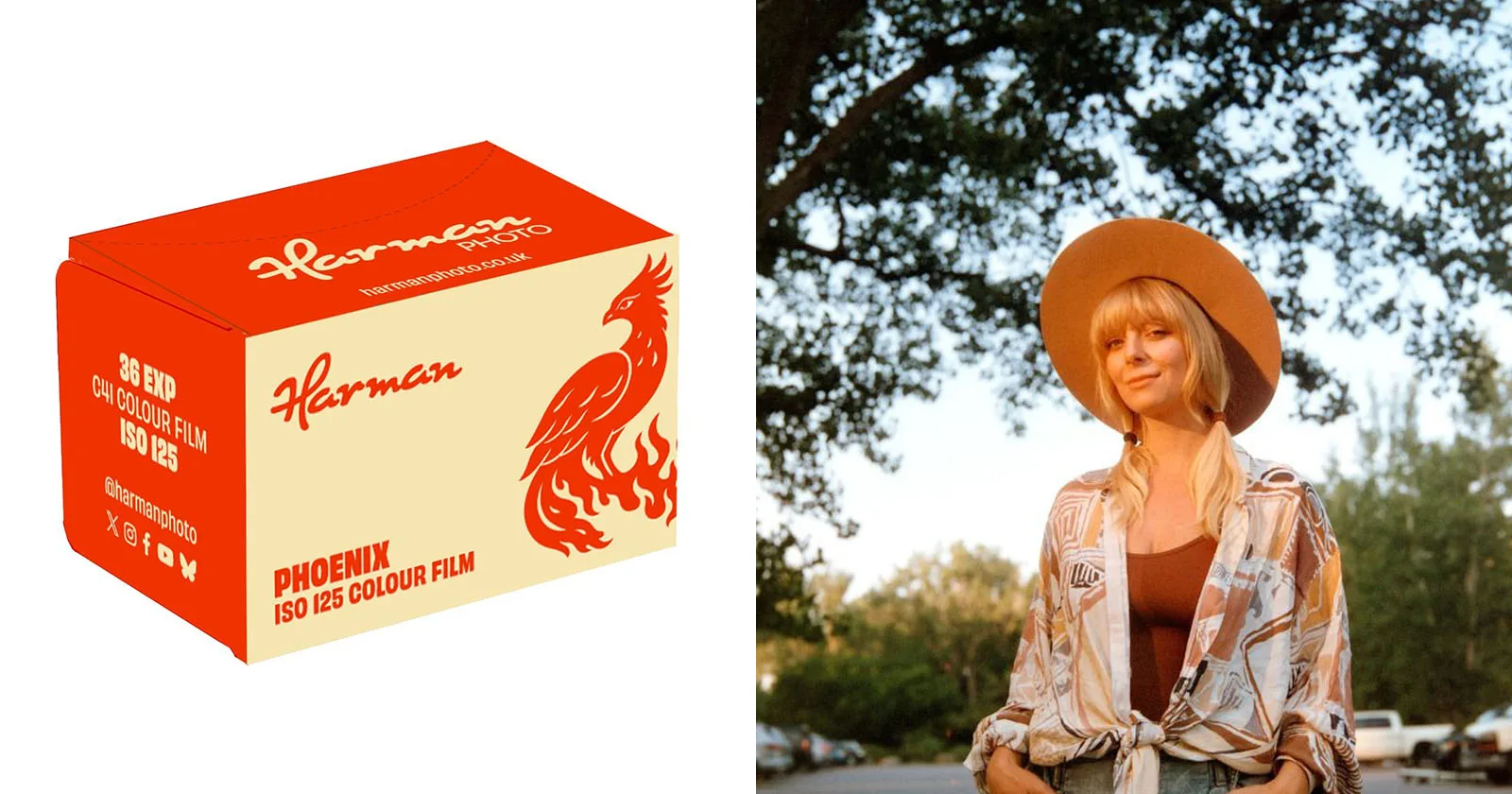
In August 2026, Harman Technology announced Phoenix 125. It is not a new film in the usual sense. It is Phoenix, the first colour film Harman ever made, launched in December 2023 at ISO 200, back in a new box at ISO 125. It reached shops in the UK and the US from late August, and in Canada stock is due in mid-November.
Harman's explanation was unusually candid. "Thanks to your feedback, we've tweaked the formulation and adjusted the speed to match how you like to shoot," it wrote on Instagram. Its product page puts it this way: Phoenix 125 "retains the same characteristics that you loved (or hated) about the original Phoenix 200 but with a new speed of 125 to reflect how you told us you shoot it."
Film makers rarely change a box speed because their customers kept overexposing the film. It is worth understanding what the change means, and where it makes a difference.
Phoenix shooters spent two years setting their meters to 125. Harman has now printed it on the box.
Two Years of Moving Advice
Harman's own guidance on Phoenix has shifted steadily towards more exposure.
| When | What Harman said |
|---|---|
| 2023, Phoenix 200 launch datasheet | Best results at EI 200; "highlight control may be improved by underexposing 0.5 – 1 stop" |
| September 2024 datasheet | Works well from EI 100 to 200, "with many users preferring to shoot at EI 160" |
| August 2026, Phoenix 125 datasheet | Box speed ISO 125; "works BEST in the range EI 100-160" |
Users got there first. Writers on 35mmc described Phoenix in 2025 as "more like an ISO 125 film labeled as ISO 200", and advised that "+⅔ exposure (i.e. metered at 125) is almost always a good idea."
That two-thirds is the whole change in practice. Rating a film at 125 instead of 200 gives every frame about two-thirds of a stop more light. If you already set your meter to 125 for Phoenix, the new box changes nothing about your exposures.
Did Harman Change the Film?
Harman says it tweaked the formulation. It has not said what it tweaked, and its own documents do not show a change.
The Phoenix 125 datasheet, published in August 2026, reuses the characteristic curve, the spectral sensitivity chart and the reciprocity chart of the September 2024 Phoenix 200 datasheet. We compared the embedded images: they are the same files. Apart from the speed and the recommended range, the text is the same too, down to one line that still gives the film's rating as "EI 200".
That does not prove the emulsion is unchanged. The curves are plotted against relative exposure, so a re-rating alone would not alter them, and a small tweak might not either. But Harman has published nothing that shows what changed. The fair reading is Phoenix 200 at a new rating, with at most minor adjustments.
It is also clearly the original Phoenix, not Phoenix II. PetaPixel reported it as a tweaked version of the 2023 film, and Harman's Nordic distributor lists the 120 version as "Phoenix I ISO 125". Harman's Phoenix 200 page is gone. Phoenix II, the redesigned film from 2025, is still on sale.
Where the New Number Matters: the DX Code
On a camera with an ISO dial, Phoenix 125 changes nothing. You could always set 125.
The change matters for cameras that read the DX code on the cassette and give you no way to override it, which covers many autofocus point-and-shoots. Loaded with Phoenix 200, those cameras metered at 200, and you could not ask for the extra exposure. Loaded with Phoenix 125, they meter at 125 automatically. For anyone shooting Phoenix in a compact, that is the real news.
Some simpler cameras read only part of the DX code and round to the nearest full stop. Check your camera's manual. Anything between 100 and 160 is inside Harman's recommended range.
Track this in the app: Light Meter
Phoenix 125 vs Phoenix II
The two Phoenix films are now sold side by side, and they are different products.
Phoenix II came out in July 2025 at ISO 200. Harman's managing director Greg Summers said that "each layer and component has been redesigned and reengineered into a completely new formulation." Harman describes it as less bold and unpredictable than the original, with better contrast, grain, highlight and shadow retention, sharpness and scanning.
Phoenix 125 keeps what made the original divisive. Harman's datasheet describes high contrast and strong visible grain, no orange mask, limited anti-halation, and negatives with a magenta or purple tint. Expect halation when you shoot into bright light.
Prices on 6 October:
| Shop | Phoenix 125, 35mm | Phoenix 125, 120 | Phoenix II, 35mm | Phoenix II, 120 |
|---|---|---|---|---|
| B&C Camera (US) | $9.99 | $8.99 | $11.99 | $11.99 |
| CineStill (US) | $9.99 (on sale) | $8.95 (on sale) | $13.99 | $11.99 |
| Analogue Wonderland (UK) | £10.95 | £10.95 | £9.75 (sold out) | £8.25 |
| Fotoimpex (Germany) | €11.36 | not listed | €15.15 | €12.97 |
So Phoenix 125 is the cheaper Phoenix in the US and in Germany, and the dearer one in the UK, where Harman cut Phoenix II prices in August.
Choose Phoenix 125 if you liked the original's look, or if you shoot a DX-only compact. Choose Phoenix II if you want a Harman colour film that behaves more like a conventional colour negative and scans more easily.
How to Shoot Phoenix 125
Harman's datasheet is short on rules but clear on these:
- Bracket at first. Harman says the film works best between EI 100 and 160 and recommends bracketing to find what suits you.
- Meter for the mid-tones in even, consistent light. Harman's product page is blunt: "over or under exposure is not Phoenix's friend."
- Do not push it. "Push processing is not recommended."
- Correct long exposures. Beyond one second, Harman's formula is adjusted time = metered time to the power 1.31. A 10-second reading becomes about 20 seconds.
- Expect odd-looking negatives. Without an orange mask, standard scanner presets will misread them. Our guide to negative inversion apps covers the tools that let you set the colour yourself.
If you are curious about Harman's other experiments, our Harman Switch Azure review covers its other ISO 125 colour film from this year.
Frequently asked questions
Is Harman Phoenix 125 a new film?
Not really. It is the original Phoenix, Harman's first colour film from 2023, in a new box rated at ISO 125 instead of 200. Harman says it tweaked the formulation but has not said what changed, and its new datasheet reuses the 2024 Phoenix 200 charts.
What ISO should I shoot Phoenix 125 at?
The box speed is ISO 125, and Harman says the film works best between EI 100 and 160. It recommends bracketing your first rolls and metering for the mid-tones.
Is Phoenix 125 the same as Phoenix II?
No. Phoenix II, launched in July 2025 at ISO 200, is a redesigned film with a completely new formulation according to Harman. Phoenix 125 comes from the original 2023 Phoenix, and both are on sale.
Can you push Harman Phoenix 125?
Harman's datasheet says push processing is not recommended. Process it as standard C-41.
Write Down the Speed You Used
The story of Phoenix 125 is a story of notes. Thousands of rolls shot, compared and discussed, until the box speed moved two-thirds of a stop. Your own rolls can tell you the same thing about your camera, your lab and your light, if you record the speed you actually used.
Pellica's light meter covers ISO 25 to 6400 in third stops, so 125 and 160 are both a tap away, and the film roll tracker lets you add Phoenix 125 as your own stock and keep the rating with each roll.