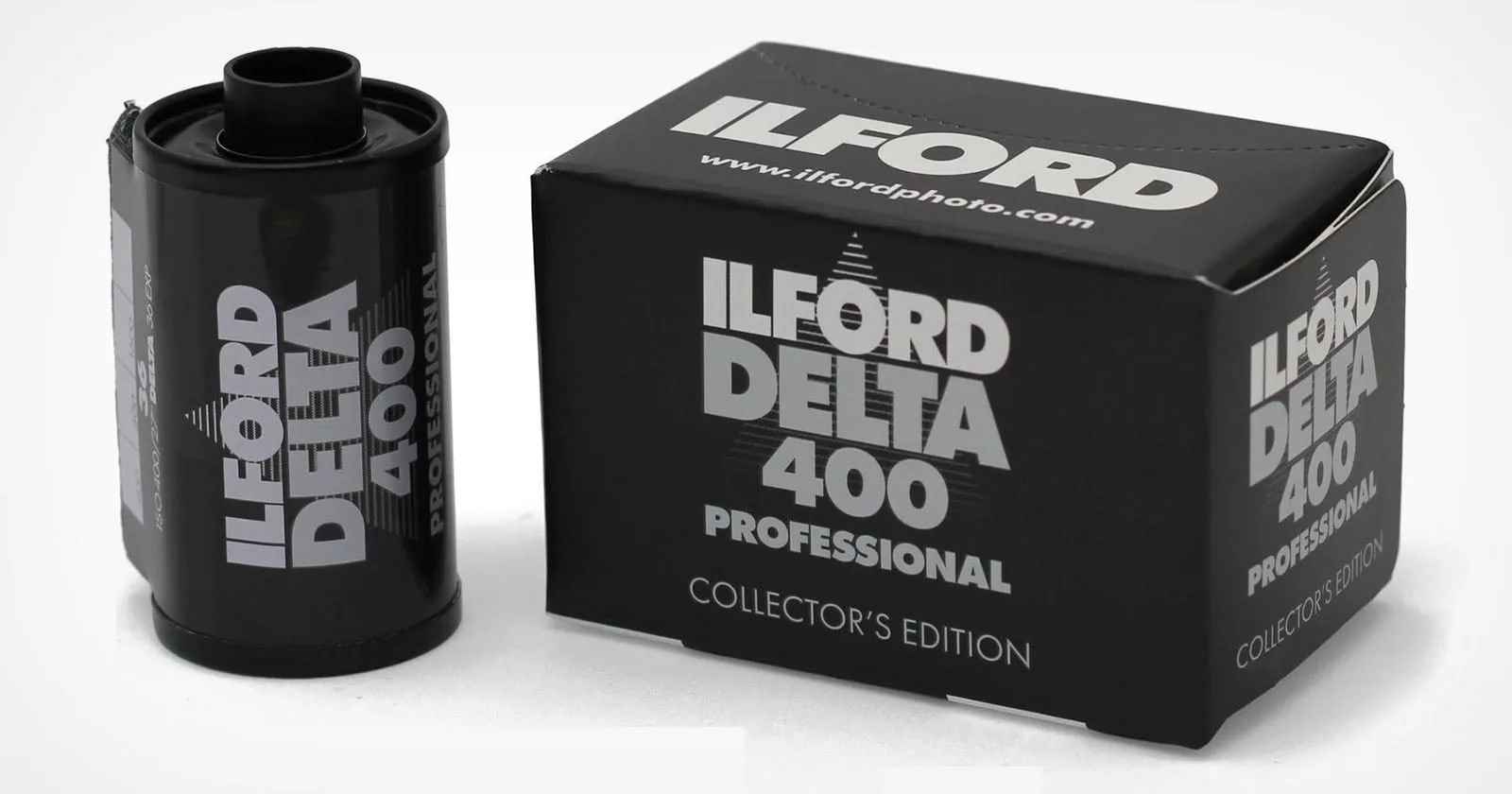
In mid-September 2026, Harman Technology released a limited run of Ilford Delta 400 Professional in 35mm, in an all-black cassette and a black box marked "Collector's Edition". The packaging is the obvious change. The one that matters is underneath it.
"For the first time, one of our B&W 35mm films has been coated onto our clearer roll film base with its anti-halation protection," Harman said in the product text that Kosmo Foto published. Kosmo Foto went a step further: the clear base, it wrote, "means the film could be developed as a black-and-white slide – which cannot currently be done with any films in the Ilford Photo line-up."
That second claim spread quickly. Ilford's own technical documents say something different.
The base is new. The emulsion's contrast, which is why Ilford advises against reversing Delta 400, is not.
What Harman Changed, and What It Didn't
Changed: the base and the box. The film is coated on the clearer base Harman uses for roll film, with an anti-halation layer on the back. Harman claims "subtle" gains in dynamic range, shadow detail, scanning, halation and sharpness.
Unchanged: the speed, ISO 400, and the processing times. Harman says the film keeps the same characteristics as standard Delta 400, so you develop it exactly as you always have, in the same developer, for the same time.
Quantity: "very limited", while stocks last. Harman has not said how many rolls exist.
Price: the same as standard Delta 400, which Ilford confirmed on Instagram and retailers bear out. In early October, Analogue Wonderland listed both versions at £13.95, Fotoimpex at €13.99, and US shops such as Glazer's at $15.99.
It is 35mm only. Delta 400 in 120 already sits on a clear base with an anti-halation backing, which is exactly the recipe now carried over to 35mm.
Why the Base Matters at All
The base is the plastic strip the emulsion is coated on. According to Ilford's Delta 400 datasheet, the 35mm film uses a 0.125 mm acetate base, while the 120 film uses a 0.110 mm clear base with an anti-halation backing that clears during development.
In 35mm, black-and-white films commonly use a grey-tinted base, and Harman's own word, "clearer", implies its regular 35mm base is less clear than this one. The tint soaks up stray light inside the film: light that would otherwise bounce back into the emulsion and leave a glow around bright points (halation), or travel along the strip from the exposed leader into the cassette (light piping). The cost is that the grey stays in every negative, forever.
A clear base with a backing layer moves that protection into a coating that washes out in the developer. What is left after processing is a clearer negative. For you, that shows up in two places.
- Scanning. A scanner or a camera rig has less base density to shine through. Fotoimpex's listing gives base density figures of 0.12 for the new film against 0.30 for the regular one. If those figures are right, the new base passes about one and a half times as much light, roughly two-thirds of a stop. That is consistent with the scanning gain Harman claims. Note that the figures come from a retailer's listing, not from a Harman datasheet.
- Printing. A lower base density slightly shortens enlarger exposures. It does not change print contrast, because the base adds the same density everywhere.
Harman has not said whether the clear base calls for extra care when loading. Loading and unloading in shade costs nothing, so do it.
The Slide Claim
Black-and-white slides are made by reversal processing: you develop the negative image, bleach it away, re-expose the film to light, then develop the silver halide that was left unexposed the first time, which gives you a positive. A clear base matters for that. Adox, which sells a reversal kit, puts it plainly: any black-and-white film can be reversed, but only films with a high silver content and a clear base make really good slides, because a greyish base dulls the highlights.
So the clear base removes one obstacle. It does not remove the other. Ilford's own reversal processing guide says: "We do not recommend reversal processing HP5 Plus or DELTA 400 PROFESSIONAL film stock as results are likely to exhibit unacceptably low contrast."
The objection is contrast, not the base. The same guide explains that a film's suitability for reversal "depends largely on its inherent contrast", and that little can be done to change it in processing. Harman says the Collector's Edition keeps Delta 400's characteristics, so on paper the contrast objection still stands.
Kosmo Foto's other claim, that no Ilford film can currently be made into slides, does not hold either. Ilford's guide particularly recommends Pan F Plus, which "gives bright, high contrast positives", and says FP4 Plus and Delta 100 can also be used.
This does not make slides from the new Delta 400 impossible. Rollei lists Delta 400 among the films suited to its own reversal kit. But you should expect flat positives and plan a test roll before shooting anything that matters. Ilford's guide suggests overexposing by about one stop as a starting point for the films it does recommend.
Track this in the app: Film Roll Tracker
If You Want Black-and-White Slides
If slides are the goal rather than a side experiment, start where the manufacturers point you:
| Route | Film | Chemistry | Price seen, October 2026 |
|---|---|---|---|
| Made for reversal | Fomapan R100 | Foma processing set for R100 | £58 at First Call |
| Ilford's own recipe | Pan F Plus, or FP4 Plus, Delta 100 | Mixed from Ilford's published formula | Chemicals bought separately |
| General kit | Films listed by the kit maker | Adox Scala reversal kit | €45.01 at Fotoimpex |
| General kit | Pan F, FP4 Plus and others | Bellini B&W reversal kit, 1 litre | €47.60 at Macodirect |
Reversal uses a strongly acidic bleach that needs more care than ordinary developer and fixer, so read the kit's safety sheet before you start. Our guide to developing film at home covers the tank, the timing and the agitation, which are the same for both processes.
Should You Buy It?
If you already shoot Delta 400 and you see the Collector's Edition on a shelf, there is little reason not to. It costs the same, develops the same and should scan more easily.
Finding it is the hard part. In early October, Analogue Wonderland had sold out, Fotoimpex had run out for mail order, and Canadian stock was not due until mid-October.
There is also a reason to care beyond the box. According to PetaPixel, Ilford described the release on Instagram as a test of whether the market wants it, and said a permanent version would probably cost more than the current film. If you shoot a roll and like the scans, telling Ilford so is how a limited edition becomes a regular one.
The word "collector's" is on the box, not in the film. Shoot it. If you are putting rolls aside instead, our guide to storing film properly covers how to keep them fresh.
Frequently asked questions
Is the Delta 400 Collector's Edition a new emulsion?
Harman says it keeps the same characteristics, speed and processing times as standard Delta 400. What changed is the base, now the clearer roll-film base with an anti-halation backing, and the all-black packaging.
Can you develop the Delta 400 Collector's Edition as black-and-white slides?
You can try, and the clear base helps. But Ilford's reversal guide does not recommend Delta 400 for reversal because results are likely to show unacceptably low contrast. Ilford recommends Pan F Plus first, with FP4 Plus and Delta 100 as alternatives.
How much does the Delta 400 Collector's Edition cost?
The same as regular Delta 400. In early October 2026 that was £13.95 at Analogue Wonderland, €13.99 at Fotoimpex and $15.99 at US retailers.
Do you develop it differently from regular Delta 400?
No. Harman says development times are unchanged, so use your usual Delta 400 developer and time.
Keep the Two Versions Apart
If you shoot both versions this autumn, the scans will be easy to mix up a year from now. Note which roll was which when you load it, so that any difference you see later has a cause you can name.
Pellica's film roll tracker lets you add your own film stocks, so "Delta 400 Collector's Edition" can sit next to your regular Delta 400 rolls with its own notes, and every frame stays attached to the roll it came from.