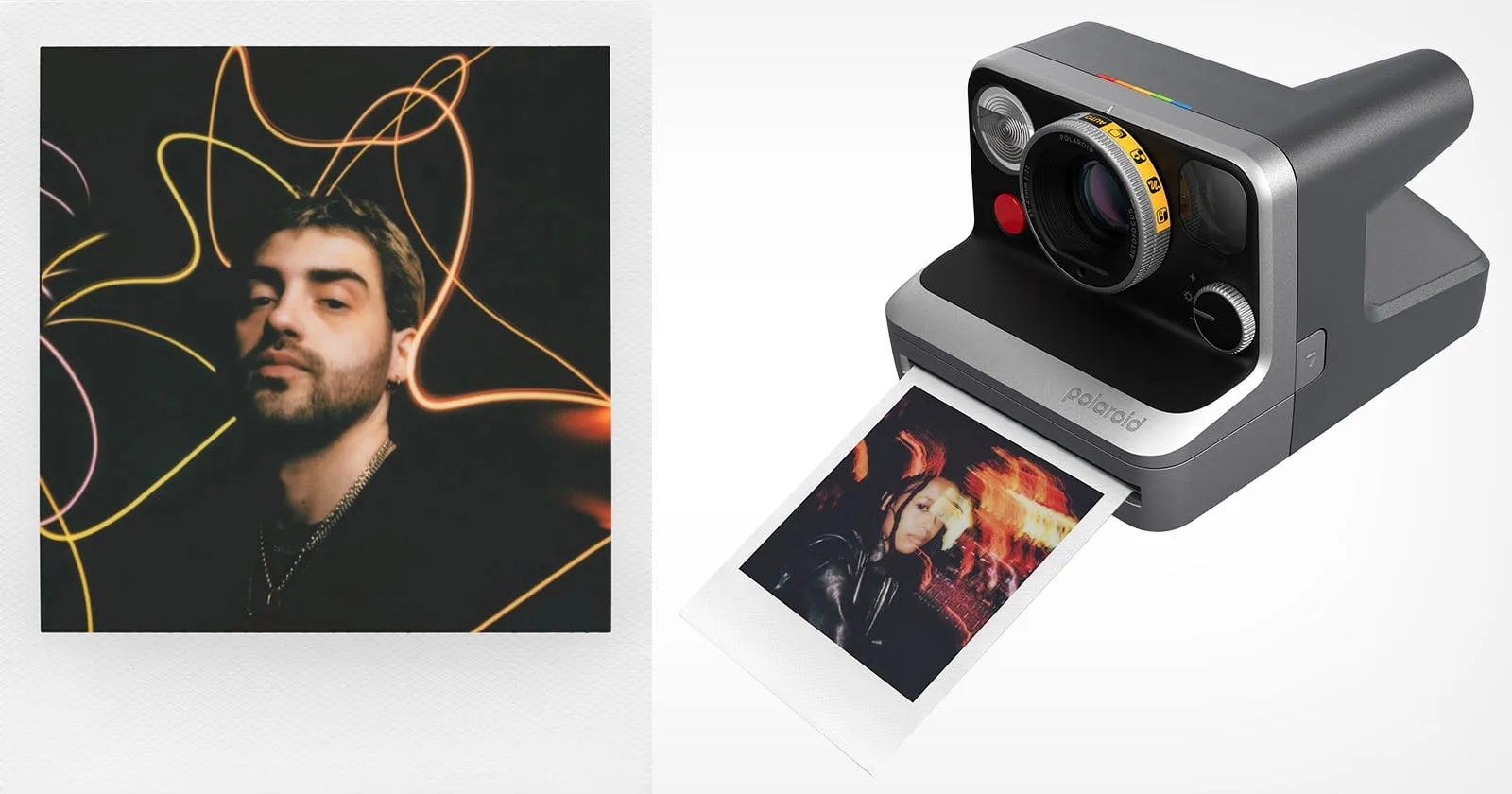
On 29 September 2026, Polaroid launched the Mod: an i-Type instant camera with four creative modes printed on a yellow ring around the lens. It costs $169.99, £149.99 or €169.99, and it is sold on Polaroid's own store first, with other shops to follow.
The Mod raises an awkward question for anyone shopping, because Polaroid already sells two cameras that look a lot like it. The Now Gen 3 costs $129.99 and shares the Mod's lens and focus system. The Now+ Gen 3 costs $149.99, and its phone app unlocks more control than the Mod offers. So what does the Mod's extra money actually buy?
The Mod does very little that a Now+ cannot. It does it without a phone, and that is the whole product.
What the Mod Is
Underneath the ring, the Mod is close to a Polaroid Now. According to Polaroid's product page, it uses the same two-lens autofocus system as the Now Gen 3: the camera switches automatically between two fixed focus zones, 0.4 to 1.3 m and 1 m to infinity, with apertures from f/11 to f/64. Polaroid's manual asks you to stay at least 55 cm from your subject, so treat the 0.4 m figure as optimistic.
It takes both i-Type and 600 film, in colour and black and white, though Polaroid says the camera is tuned for i-Type. There is no manual mode. Exposure is automatic, with a brightness dial that shifts it half a stop either way. The battery charges over USB-C and is rated for about 15 packs.
The Mod is not small. It weighs 520 g without film, against 448 g for the Now Gen 3, and it has no Bluetooth. The Polaroid app is only there to scan and share your prints.
The Four Modes, and What Each One Does
The ring around the lens is also the power switch: Off, Auto, then the four modes. Polaroid's manual and tip sheet describe them precisely, and the details matter more than the names.
- Double Exposure puts two shots on one frame. The counter shows "1." then "2." so you know where you are. Polaroid's advice is to make the first exposure the darker of the two, but the camera does not do that for you.
- Split Shot uses an included clip-on cover that blocks half the lens. You take the first shot, take the cover off, turn it 180 degrees, put it back and take the second. The result is two scenes side by side on one print. Polaroid warns that because the mode ring is the lens ring, twisting the cover can change the mode by accident.
- Motion Freeze is a long exposure with the flash firing at the end, after about 3 seconds. In a dark room it leaves light trails behind a sharp subject, the effect photographers call rear-curtain sync.
- Light Painting opens the shutter when you press the button and closes it automatically after 6 seconds. Polaroid recommends a tripod or a steady surface and a moving light, a sparkler or a phone torch. (One early hands-on said 7 seconds. Polaroid's own tip sheet says 6.)
The pattern is that the Mod decides the durations for you. That is the design choice to understand before buying. A fixed 6-second light painting is easy to get right the first time. It is also the only light painting the camera can do.
Track this in the app: Film Roll Tracker
The Mod Against the Polaroids It Competes With
Prices are from Polaroid's and Fujifilm's own stores in October 2026.
| Polaroid Mod | Polaroid Now Gen 3 | Polaroid Now+ Gen 3 | Instax mini 99 | |
|---|---|---|---|---|
| Price (US / UK / EU) | $169.99 / £149.99 / €169.99 | $129.99 / £119.99 / €129.99 | $149.99 / £139.99 / €149.99 | $234.95 / £174.99 / €199 at launch |
| Film | i-Type and 600 | i-Type and 600 | i-Type and 600 | Instax mini |
| Focus | Two lenses, two auto zones | Same as Mod | Two-lens autofocus | Fixed lens, close-up range |
| Creative modes | Double Exposure, Split Shot, Motion Freeze, Light Painting on a dial | Double exposure, self-timer | Through the app: aperture priority, manual, double exposure, remote | Colour effects, vignette, double exposure, bulb up to 10 s |
| Phone needed | No | No | For the extra modes | No |
| Weight | 520 g | 448 g | 452 g | 305 g |
Read the Mod and Now Gen 3 columns together. Same lens, same focus zones, same film, and the Now Gen 3 already does double exposures. The $40 difference buys three modes, the split cover, and a dial that makes all of them one turn away.
The Now+ Gen 3 is the more capable camera on paper. Its app adds aperture priority and a manual mode, which the Mod has no equivalent for, and it costs $20 less. Its predecessor, the Now+ Gen 2, also offered light painting through the app with an exposure you start and stop yourself. Polaroid's Gen 3 page does not list light painting by name, so check the app before buying the Now+ for that alone.
What Each Experiment Costs in Film
Instant cameras are cheap compared with their film. At Polaroid's store prices in October 2026:
- i-Type, 8 shots: $18.99, £16.99 or €17.99, which is $2.37, £2.12 or €2.25 a frame
- 600, 8 shots: $20.99, £18.99 or €19.99, which is $2.62, £2.37 or €2.50 a frame
- Instax mini, for comparison: about $1.20 a frame on the US twin pack
Double Exposure and Split Shot put two exposures on one frame, so they cost no extra film. They do cost more failed frames while you learn, because lining up two shots through an offset viewfinder is hard. Digital Camera World's reviewer kept roughly half of the shots from two packs. At that rate, every print worth keeping costs closer to $4.75 than $2.37.
That is the real price of a creative camera. A mode you have not mastered is a mode that burns film. Our guide to double exposure techniques covers the framing habits that make the second shot land where you meant it to.
What Reviewers Complained About, and One Fix They Missed
Only one full review was out in the first week, from Digital Camera World. Its complaints are worth knowing, along with what Polaroid's manual says about each.
- The flash switches back on after every shot. True if you press the flash button once. The manual documents a double press that keeps the flash off until you turn the camera off.
- Framing is imprecise. The viewfinder sits apart from the lens, and parallax makes close shots and two-part shots hard to line up. Polaroid's manual suggests aiming slightly up and to the left for subjects closer than 1.2 m.
- It is big. At 520 g it is a bag camera, not a pocket one.
- Long exposures can come out dark. The fixed durations do not adapt to the scene, so a dim room can underexpose a light painting.
Where You Can Buy It
Polaroid's store has sold the Mod since 29 September in the US, the UK and much of the EU, including France, Germany, Italy, the Netherlands and Belgium, at the prices above. Other US retailers were due to get it from 6 October. Polaroid says shops elsewhere will follow in early 2027, so outside the US the brand's own store is the only route for now.
Verdict: Which One for Which Photographer
Buy the Mod if you want in-camera effects without a phone and you will actually use them. Putting the modes on a dial is not a gimmick. An effect you can reach in one turn is an effect you will try, and the fixed durations mean your first light painting is likely to work.
Buy the Now Gen 3 if you mostly shoot portraits and snapshots. It has the same lens and focus, it does double exposures, it is 72 g lighter, and it costs $40 less.
Buy the Now+ Gen 3 if you want control more than effects. Aperture priority and manual mode do more for your pictures than a split cover, and it costs $20 less than the Mod. The trade is that you need your phone to use them.
Look at the Instax mini 99 if film cost decides it. Its prints are smaller and the camera costs more, but each frame costs about half as much, and it has its own creative toolkit. Our Polaroid Go vs Instax mini comparison runs the long-term film math between the two systems.
Frequently asked questions
Does the Polaroid Mod use i-Type or 600 film?
Both, in colour and black and white. Polaroid says the camera is optimised for i-Type, which costs $18.99 for 8 shots on Polaroid's US store in October 2026, against $20.99 for 600.
What is the difference between the Polaroid Mod and the Now Gen 3?
They share the same two-lens focus system, apertures and film. The Mod adds Split Shot, Motion Freeze and Light Painting on a dial around the lens, plus an included split cover. It weighs 520 g against 448 g and costs $169.99 against $129.99.
Can you buy the Polaroid Mod in Europe?
Yes, from Polaroid's own store in the UK at £149.99 and in several EU countries, including France and Germany, at €169.99. Polaroid says other retailers outside the US will stock it from early 2027.
How long is the Polaroid Mod's light painting exposure?
Six seconds, fixed. The shutter opens when you press the button and closes automatically. In Motion Freeze mode, the flash fires at the end of an exposure of about 3 seconds.
Track Which Modes Earn Their Film
Instant film leaves no negative. Once a pack is shot, the prints are the only record, and with four modes it is easy to forget which setting made the keeper and which made the four dark frames before it. Note the mode, the light and the result for each frame, and after two packs you will know which effects work for you.
Pellica's film roll tracker logs instant packs the same way it logs 35mm rolls: the film, the camera, what the pack cost, and a note on every frame. At $2.37 a print, knowing which mode wastes film is worth a few seconds per shot.