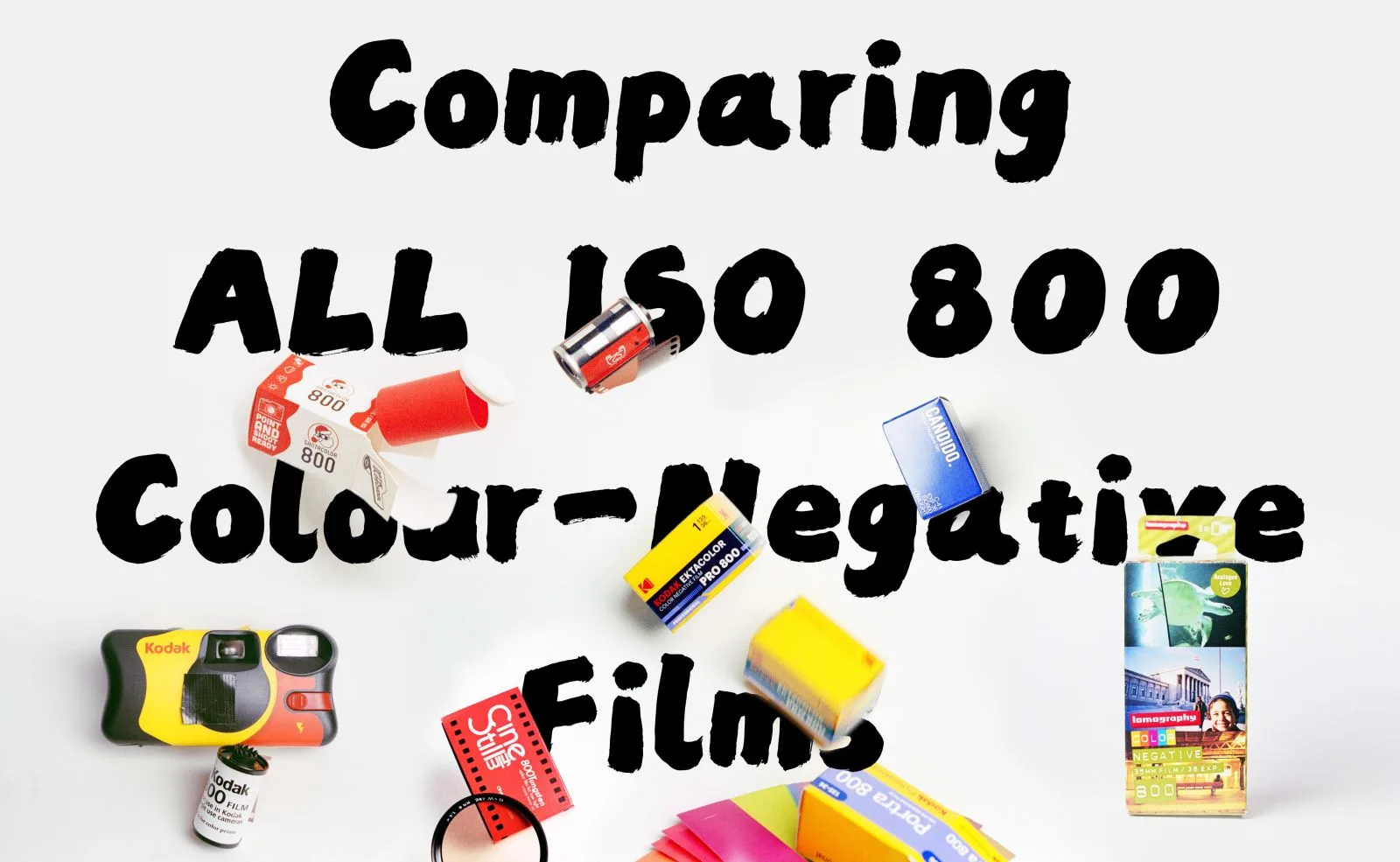
On May 14, 2026, Analog.Cafe published the only controlled comparison of every fresh ISO 800 color-negative film on the market: 58 staged frames across eight film stocks, each shot at normal exposure, two stops under, and two stops over, developed in one batch of chemistry and scanned on the same machine. If you want to know which fast color film to load in 2026, that test is the closest thing the community has to hard data — and this guide is built on it.
The headline finding is worth stating plainly before any ranking: exactly one company in the world still manufactures ISO 800 color-negative film, and it is Kodak. Every roll in the test — from the film inside a drugstore disposable to a premium professional stock — started life on a Kodak coating line.
Every fresh roll of ISO 800 color negative you can buy in 2026 comes from a single manufacturer. What you are really choosing between is packaging, price, and what happens to the film after coating.
One Factory, Eight Boxes
Analog.Cafe's test covered Amber T800, Candido 800, CineStill 800T, the film inside Kodak FunSaver disposables, Lomography Color Negative 800, Kodak Portra 800, the film inside Fujifilm's QuickSnap Underwater disposable, and Optik Oldschool SantaColor 800. Two of them turned out to carry identical "CN 800-1" edge markings — Lomography 800 and the QuickSnap film — meaning they are, for practical purposes, the same emulsion in different clothes.
One naming note before the comparison: since March 24, 2026, Kodak has been renaming Portra to Ektacolor Pro as part of its distribution overhaul. PetaPixel's coverage confirms the 160, 400, and 800 emulsions themselves are unchanged. Both boxes are on shelves as of July 2026, so this guide uses the name you will still see most often: Portra 800.
The Contenders, Compared
Prices below were checked on July 3, 2026 against CineStill's own store, Analogue Wonderland, and Kodak's March 2026 pricing reported by PetaPixel. Fast color film moves with the broader market, so treat them as a snapshot — our film prices guide tracks the trend.
| Film | Price per roll (July 2026) | Character | Latitude in the May 2026 test | Best for |
|---|---|---|---|---|
| Kodak Portra 800 (Ektacolor Pro 800) | $19.95 US · £20.00 UK | Daylight-balanced, finest grain here, natural skin tones | Best of all eight from −2 to +2 stops | Portraits, any low light |
| CineStill 800T | $16.99 US · £19.49 UK | Tungsten-balanced, red halation glow, cinematic | Strong at +2, weakest at −2 | Night street, neon, tungsten interiors |
| Lomography Color Negative 800 | ~$19.30 US (three-pack $57.90) | Daylight-balanced, warm, thin curling base | Close to Portra at normal and +2 | Everyday low light, travel |
| Candido 800 | ~$18 US · £16.00 UK | Respooled Vision3 500T, persistent green cast | Retains shadow and highlight detail well | Budget night shooting, experiments |
| Amber T800 | ~$16 US (27 exposures) | Respooled Vision3 500T, tungsten-balanced | Underexposed at box speed throughout | Bright scenes; not a true 800 |
Track this in the app: Film Roll Tracker
Kodak Portra 800: Still the Benchmark
Analog.Cafe's verdict was unambiguous: Portra 800 reproduced skin tones better than every other film across all exposure conditions, separating subtle hue transitions — lip to chin, shadow to midtone — that the cheaper stocks flattened. The most telling head-to-head was against the FunSaver disposable film: identical at normal exposure and at +2, but two stops under, Portra kept skin looking human while the FunSaver rendered it uniformly red.
That margin is exactly what you pay for. At $19.95 per 36-exposure roll as of March 2026, Portra 800 is the most expensive film in the group, and in evenly lit scenes you may not see the difference. In complex light, and especially for faces, you will — which is why it also features in our best film for portraits comparison.
CineStill 800T: Read the Tungsten Caveat First
CineStill 800T is Kodak Vision3 500T motion-picture film with its remjet backing removed, rated at EI 800 for tungsten light. Removing remjet is also what creates its signature red halation around light sources — the look that made it famous on neon-lit streets.
The caveat is in the T. This film is balanced for 3,200 K tungsten light, and Analog.Cafe's test found that in daylight, without an 85-series warming filter, a green-cyan cast survives even after gray-balancing the scan. Under actual tungsten light it was one of the best-looking films in the test. At $16.99 per roll as of July 2026 it is also the cheapest of the major options, though CineStill currently caps orders at five rolls per customer. Its future is a separate story: Kodak is phasing remjet out of Vision3 stocks, which could reshape CineStill's entire product line.
Lomography 800 and the Disposable-Camera Secret
Lomography Color Negative 800 was one of the tester's favorites — warm, consistent, and close to Portra's rendering at normal exposure and above. The physical stock is the weak point: the negatives are noticeably thin, curl as they dry, and can be frustrating to load onto developing reels.
The price math has shifted, though. At $57.90 for the standard three-pack as of July 2026 (per Film Supply Club's listing), Lomography 800 works out to roughly $19.30 per roll — about 65 cents less than Portra 800. Its edge-marking twin inside the Fujifilm QuickSnap Underwater camera makes for a fun bit of trivia, but as a value proposition the gap between "budget" and "premium" ISO 800 film has nearly closed.
The Respooled Vision3 500T Crowd
Amber T800 and Candido 800 are both Kodak Vision3 500T cinema film with the remjet layer removed by third parties, respooled into 35mm cassettes. They are the cheapest route to a fast color negative, and the test explains what that discount buys.
Amber T800 consistently underexposed at box speed — Analog.Cafe concluded it "probably should not be rated ISO 800," a finding consistent with its earlier Amber T800 review. Candido 800 held shadow and highlight detail nearly as well as Portra, but carried a green cast that could not be corrected without unbalancing the rest of the frame; at roughly $18 per roll in the US and £16 in the UK as of July 2026, it undercuts Portra without matching it. There are also at least two versions of Candido in circulation, one with halation and one without, so two rolls bought months apart may not behave identically.
Best 800 Film for Low Light
For general low-light shooting — dusk, window light, dim interiors, mixed sources — the test supports a simple answer: Portra 800, with Lomography 800 as the close second when you find it cheaper. Color negative film handles overexposure gracefully but punishes underexposure, and the −2 frames were where the eight films separated most. A fast film only helps if you expose it generously, so meter for the shadows and let the highlights take care of themselves — our film ISO guide covers when 800 is genuinely necessary and when 400 will do.
Best 800 Film for Concerts and Night Street
Night street photography under artificial light is CineStill 800T territory. Sodium lamps, neon, and tungsten storefronts sit close to its native balance, and the halation glow flatters exactly these scenes.
Concerts are harder than they look. Modern stage lighting is mostly LED, rapidly changing, and matches no film's balance, so the forgiving choice is Portra 800 pushed one stop to 1600 in development if the venue is truly dark. Whether to push a 400 stock to 800 instead — often the cheaper path — depends on how much shadow detail you can afford to lose; our push and pull guide walks through that trade. And since in-camera meters struggle in dark venues, a phone-based meter is worth having ready — see our comparison of the best light meter apps for film photography.
Frequently asked questions
What is the best ISO 800 color film in 2026?
Kodak Portra 800, now also sold as Ektacolor Pro 800, came out on top in Analog.Cafe's May 14, 2026 comparison of all eight ISO 800 color-negative films, with the most accurate skin tones from two stops under to two stops over. It costs $19.95 per 36-exposure roll in the US as of July 2026.
Can I shoot CineStill 800T in daylight?
Yes, but it is tungsten-balanced. Analog.Cafe's 2026 test found that in daylight without an 85-series warming filter, a green-cyan cast remains even after color correction. It performs best under artificial light at night.
Should I push Portra 400 to 800 instead of buying Portra 800?
Pushing Portra 400 one stop adds contrast and grain and sacrifices shadow detail, while a native ISO 800 film keeps more natural tones in dim light. For genuinely dark scenes, true 800 film is the safer choice; for scenes that are only slightly underlit, a pushed 400 can look great and cost less.
Meter the Dark, Log Every Frame
Low light is where exposure discipline decides whether a roll comes back usable. Whichever stock you load, the workflow is the same: meter carefully for the shadows, note what you did, and compare the results when the scans come back — that is how you learn what your favorite 800 film actually tolerates.
Pellica's built-in light meter gives you a reliable reading when a dim venue defeats your camera's meter, and the film roll tracker logs every frame with settings, GPS, and weather, so your first roll of 800T or Portra 800 becomes reference data instead of guesswork. If you push a roll, the lab map helps you find a lab nearby that handles push processing.
One factory makes every fast color film on this list. The differences that matter are made by you, one exposure at a time.