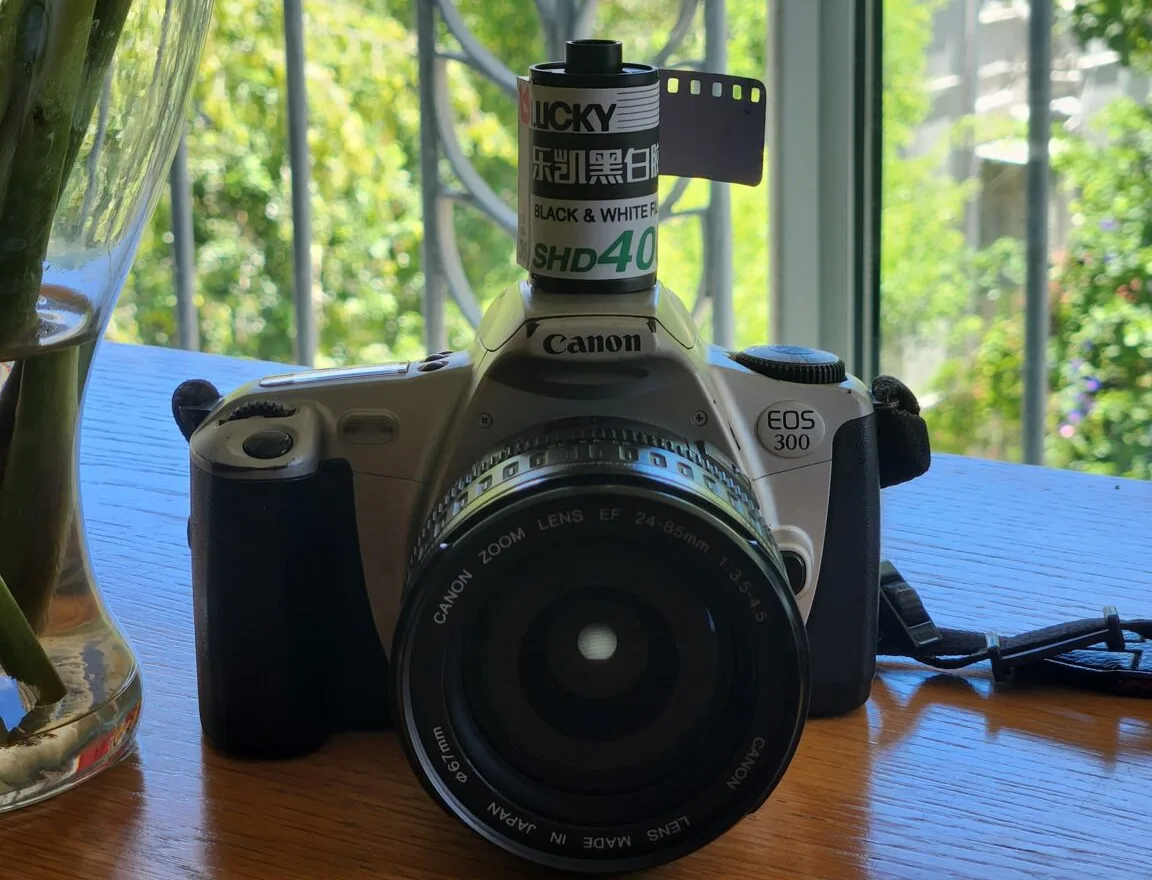
In February 2024, China's Lucky Film put SHD400 — its ISO 400 black and white negative stock — back into production after years off the market, a relaunch first reported by Kosmo Foto. It came back as one of the cheapest fresh 35mm black and white films sold anywhere: as of July 2026, a single roll costs $9 at Brooklyn Film Camera, a three-pack runs $19.99 at Reflx Lab, and UK shops list it around £7.50.
The price is only half the story. Read enough coverage of this film and one piece of community shorthand keeps surfacing: the box says 400, the negatives say something slower. Reviewers at 35mmc, Random Camera Blog, and the German darkroom site Bonnescape have all landed, independently, on some version of the same advice — give SHD400 more light than box speed suggests, then hold back the development. Here is what the published tests actually show, and where this film fits in the 2026 budget black and white landscape.
The box says ISO 400. The published tests keep saying EI 200 — and the reasons are written into this film's contrast curve.
What Lucky SHD400 Actually Is
Lucky Film operates out of Baoding, in China's Hebei province, and is the same manufacturer behind the Lucky C400 color negative stock that surprised budget shooters in 2026, plus its slower sibling Lucky C200. SHD400 is the company's fast panchromatic black and white emulsion, sold in 35mm 36-exposure cassettes and 120 rolls. Reflx Lab also lists a second-generation SHD400 GEN2 100 ft bulk roll at $65 — roughly $3.40 per 36-frame roll for bulk loaders, when it is in stock.
Do not expect premium packaging. The 35mmc review describes a plain canister with a white sticker label, and Random Camera Blog's May 2024 test noted the film carries no edge markings and sits on a thin PET base rather than triacetate — possibly converted from an industrial or aerial-type coating, though Lucky has not confirmed that. Batch variation is real enough that Reflx Lab's own GEN2 listing warns of a relatively fragile emulsion layer and occasional dark spots on the film surface.
Grain, Contrast, and a Thin Base
The look is distinctive rather than clean. 35mmc's Yuval Peleg, who shot multiple rolls through 2025, put it this way: "The grain is noticeable but quite pleasing, and surprisingly sharp for being so cheap." His scans show crushed blacks, muted mid-greys, and what he calls an 80s look — flattering for street scenes and concert light, less so for anything that needs open shadow detail.
Shot at box speed, contrast runs hot. Bonnescape's February 2026 test in 120, republished by Reflx Lab, found that exposing at ISO 400 and developing in Rodinal 1+25 for 9:30 produced excessive contrast with weak shadows, though in medium format the reviewer called the grain quite fine and unobtrusive. The base is thin, dries faster than Ilford or Kodak stocks, and curls slightly. And there is the quality-control lottery: the 35mmc review documents random black specks — a "dot plague" — that ruined a handful of frames across his rolls.
Track this in the app: Film Roll Tracker
Should You Shoot It at EI 200?
Rating a 400-speed film at EI 200 means setting your meter one stop slower than box speed, so every frame gets twice the light. Pair that with a shortened development time and you are pull-processing by one stop — the standard move for taming a contrasty film, explained in detail in our push and pull processing guide. If exposure index versus box speed is new territory, our film ISO guide covers the difference.
For SHD400, the evidence for doing exactly that is unusually consistent across sources:
- Bonnescape ran the comparison directly in February 2026: at EI 200 with Rodinal 1+25 cut to 8 minutes, "the film's contrast is now softer, with more defined shadows without any blowouts."
- 35mmc's long-term report found little latitude in the blacks and concluded the film needs to be shot at ISO 200, or even 100, for the best results.
- Random Camera Blog shot its test roll at 200 and suggests rating the film at 160–200.
- Retailers say it themselves: Brooklyn Film Camera's product page recommends rating SHD400 at ISO 200 for more optimal results, and customer reviews on Analogue Wonderland repeat the same advice.
The counterpoint is worth stating: this is a preference, not a law. The 35mmc author shot plenty at 400 and liked the deep, graphic contrast for the right scenes. Box speed gives you punchy negatives with inky blacks; EI 200 with reduced development gives you fuller shadows and a gentler curve. Meter at 200 when you need printable shadow detail; stay at 400 when you want the harsh look this film is known for.
Development Times That Work
These are the developer combinations published by the sources above, all at 20°C:
| Developer | Dilution | EI | Time | Source |
|---|---|---|---|---|
| Kodak D-76 | Stock | 400 | 8:30–9:00 | Lucky's spec is 8:30; Random Camera Blog used 9:00 (May 2024) |
| Rodinal | 1+25 | 400 | 9:30 | Bonnescape (February 2026) |
| Rodinal | 1+25 | 200 | 8:00 | Bonnescape (February 2026) |
| HC-110 | 1+19 | 400 | 14:00 | 35mmc (August 2025) |
The Massive Dev Chart carries additional combinations under Lucky SHD 400 and is the right cross-reference before you commit a roll. Given the batch-to-batch variation reviewers report, treat your first roll from any new batch as a test: bracket a few frames, pick one developer, and write down exactly what you did.
Price Check: SHD400 vs HP5 Plus, Tri-X, and Kentmere 400
Prices below were sampled from US retailers in early July 2026 and will move — treat them as a snapshot.
| Stock | Street price, 36 exp (July 2026) | Character in one line |
|---|---|---|
| Lucky SHD400 | ~$6.66 in 3-packs; $9 single | High contrast, visible grain, batch lottery |
| Kentmere 400 | ~$7 | Harman's budget line; predictable and forgiving |
| Kodak Tri-X 400 | ~$10 | The classic; price trimmed after Kodak went direct in January 2026, per PetaPixel |
| Ilford HP5 Plus | ~$12 | The benchmark; huge latitude, pushes to 3200 |
That table reframes the value question. SHD400 undercuts HP5 Plus by roughly half, but Kentmere 400 sits within a dollar of it and behaves far more predictably. The case for Lucky is not pure economics — it is the specific hard-contrast character, the cheap bulk rolls, and the fun of an oddball stock. For how it stacks up frame-for-frame against the other cheap emulsions, see our 2026 budget black and white shootout.
Where to Buy It, and What to Expect
Availability comes in waves. As of July 3, 2026: Brooklyn Film Camera has single rolls in stock at $9; Reflx Lab's $19.99 three-pack and $65 GEN2 bulk roll are both listed as sold out; Analogue Wonderland's £7.50 listing is out of stock. The cheapest route has been ordering multi-packs direct from China — 35mmc reported paying $39 for ten rolls on AliExpress in 2025, about $3.90 each — at the cost of shipping time and batch uncertainty.
One practical warning from the published tests: this is a film for home developers. Between the thin curling base, occasional emulsion defects, and non-standard behavior, reviewers consistently frame SHD400 as a stock you develop and scan yourself, accepting that a frame or two per roll may be lost. If you would be heartbroken to lose a shot, load HP5.
Frequently asked questions
What ISO should I shoot Lucky SHD400 at?
The box speed is 400, but most published tests recommend rating it at EI 200 and reducing development. Bonnescape's February 2026 comparison found EI 200 in Rodinal 1+25 for 8 minutes gave softer contrast and defined shadows without blowouts, while box speed produced harsh contrast and weak shadows.
How much does Lucky SHD400 cost in 2026?
As of July 2026 it sells for $9 a roll at Brooklyn Film Camera, $19.99 for a three-pack at Reflx Lab (about $6.66 per roll), and around £7.50 in the UK. Multi-packs direct from China have gone as low as roughly $3.90 per roll.
Is Lucky SHD400 good for beginners?
It is cheap enough to experiment with, but reviewers report batch variation, occasional black spots, and a curling base, and recommend it mainly for people who develop and scan at home. If you want predictable results at a similar price, Kentmere 400 is the safer budget choice.
Turn a Cheap Roll Into Cheap Data
A film like SHD400 rewards exactly one habit: keeping records. Shooting the same stock at 400 and at 200, in different developers, across batches that do not behave identically — none of that teaches you anything unless you can reconstruct what you did when the negatives come out of the tank.
Pellica's film roll tracker lets you log the exposure index you rated each roll at, per-frame settings, and development notes, so your EI 200 roll and your box-speed roll stay comparable instead of blurring together. The built-in light meter lets you set 200 directly and meter for the shadows, which is where this film lives or dies. And if you send film out instead of souping it yourself, the lab finder helps you locate a lab that will pull-process on request.
Cheap film is only a bargain if every roll makes the next one better. Log the experiment, not just the roll.