
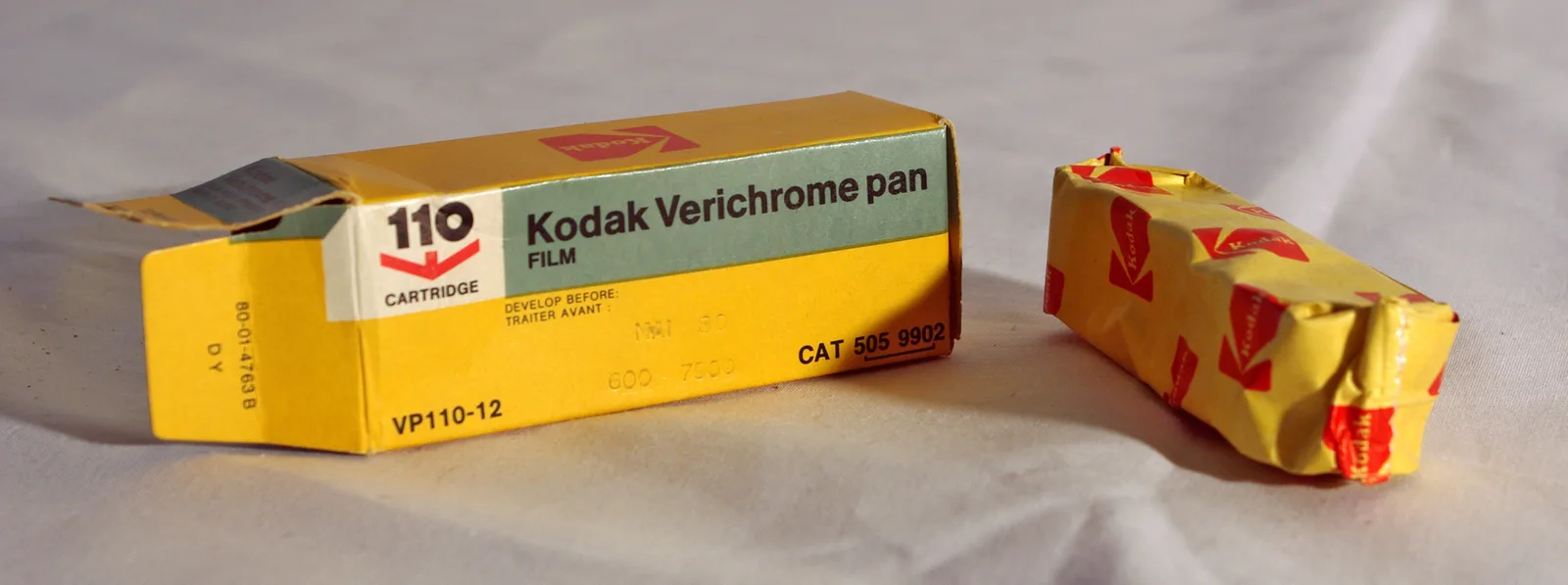
110 was the format nobody was supposed to miss. Kodak launched it in 1972 as pocket photography, a 16mm-wide strip in a drop-in plastic cartridge, and it died in the 1990s having earned a reputation for mushy prints. In 2026 you can buy it new from three companies.
That is genuinely good news for anyone with a pocket camera in a drawer. It is also a story where the press releases and the reality do not quite line up, and the gap is worth understanding before you spend money.
Only two companies actually coat and cut 110 film. The third sells it, and told a reporter it does not know what the emulsion originally was.
Who Is Actually Making It
Per Kosmo Foto's July 2026 report, only two manufacturers produce 110 film: Reflx Lab and Lomography. Flic Film sells a 110 product but is not on that list, and its own account of where the film comes from is unusually candid.
Reflx Lab — the accidental manufacturer
Reflx Lab added two colour 110 films in July 2026:
| Film | Type | Frames | 3-pack price |
|---|---|---|---|
| Fortuna C200 | Colour negative | 24 | $19.99 / £12.70 |
| 100R | Colour reversal (slide) | 24 | $24.99 / £18.65 |
The origin story is the interesting part. Cofounder Yongxiang told Kosmo Foto that "making 110 film was actually a happy accident" — the company was producing 127 format by cutting down 120, which left it with strips of 16mm-wide film. 16mm is exactly the width 110 needs. Fortuna C200 is made from those offcuts. The 100R slide film uses standard 16mm stock.
The engineering is as improvised as the sourcing, and openly so. The cassettes are 3D-printed rather than injection-moulded, because injection moulds are expensive and the volumes are small. There is no backing paper. The clear window has been removed to stop light leaks, which also means there is no frame counter. The film is rolled into the cassettes by hand.
Reflx Lab says Double-X and Verita are planned in 110 next.
Lomography — the one with the cameras
Lomography is the other genuine producer, and it is the only one making 110 cameras to go with the film. In August 2026 it released a 1980s-styled Discomatic version of its Lomomatic 110, which matters more than a colourway: a format revival without new hardware is a slow death, because the surviving cameras are fifty years old and their light seals are not.
Flic Film — sells it, cannot say what it is
Flic Film's 110 is the cheapest of the three at around $7 a roll, or $20 for three. The company announced it as "an all-new film stock."
Asked what the stock actually was, a Flic Film representative gave an answer that deserves credit for honesty even as it undermines the marketing: "The only answer I can honestly give is I don't know." The company knows which manufacturer supplies it, but receives the film identified by a number, with no record of what it was originally sold as.
Why "Not New" Is Not the Same as "Not Worth Buying"
It would be easy to read all this as debunking, and that would be the wrong conclusion. DPReview made the point well: more film options are worth celebrating even when they are not entirely new.
Repackaged and repurposed stock is most of what keeps small formats alive. Cutting 16mm offcuts into 110 cassettes by hand is not a lesser activity than coating a fresh emulsion — it is the only economics under which 110 exists at all. A format with an audience measured in thousands cannot support a dedicated production line.
What the distinction changes is what you should expect:
A film with a known parent stock has predictable behaviour. You can look up how the emulsion responds, because it has a history under another name.
A film sold as "all-new" by a company that does not know its origin has no such reference. You are buying an unknown curve in an unfamiliar format, and the only way to learn it is to shoot it and keep records.
Neither is a reason not to buy. They are different amounts of homework.
What 110 Actually Costs Per Frame
Cartridge prices hide how expensive this format is, because a 110 cartridge holds 24 frames against 36 in a standard 35mm roll.
| Film | Pack price | Frames | Per frame |
|---|---|---|---|
| Reflx Lab Fortuna C200 | $19.99 / 3 | 72 | ≈ $0.28 |
| Reflx Lab 100R (slide) | $24.99 / 3 | 72 | ≈ $0.35 |
| Flic Film 110 | $20 / 3 | 72 | ≈ $0.28 |
Then add development. Most labs charge the same to process a 110 cartridge as a 35mm roll, and many will not take 110 at all, so the real cost per usable frame runs well above these figures. Check your lab before you buy the film, not after — our guide to choosing a film lab covers what to ask.
Should You Shoot 110 in 2026
Shoot it if you already own a working 110 camera and want to use it, or if you want the smallest possible camera in a jacket pocket and accept the image quality that comes with a 13×17mm frame.
Do not shoot it expecting 35mm results at a saving. Per frame it costs roughly what Kodak Gold 200 costs in 35mm, on a negative less than a quarter of the area, through a fixed-focus plastic lens on most surviving bodies.
The reason to do it anyway is that these cameras are pleasant and the results have a look that is hard to fake. That is a legitimate reason. It is just not an economic one.
What to Record If You Shoot It
110 punishes casual note-keeping more than any other format, for two structural reasons.
There is no frame counter on the Reflx Lab cassettes, and no edge printing on the film. When the scans come back, nothing on the strip tells you which frame was which.
Most 110 cameras have no manual controls to record, so the only variables worth tracking are the ones outside the camera: which cartridge, which light, which lab, and which development. Those are exactly the variables that determine whether your next cartridge comes out better.
With three suppliers whose stocks behave differently and at least one that cannot identify its own emulsion, your own notes are the only reliable datasheet that will exist for these films. Pellica logs each frame with its location, time and conditions, so a format with no frame numbers still ends up with a record you can read back.