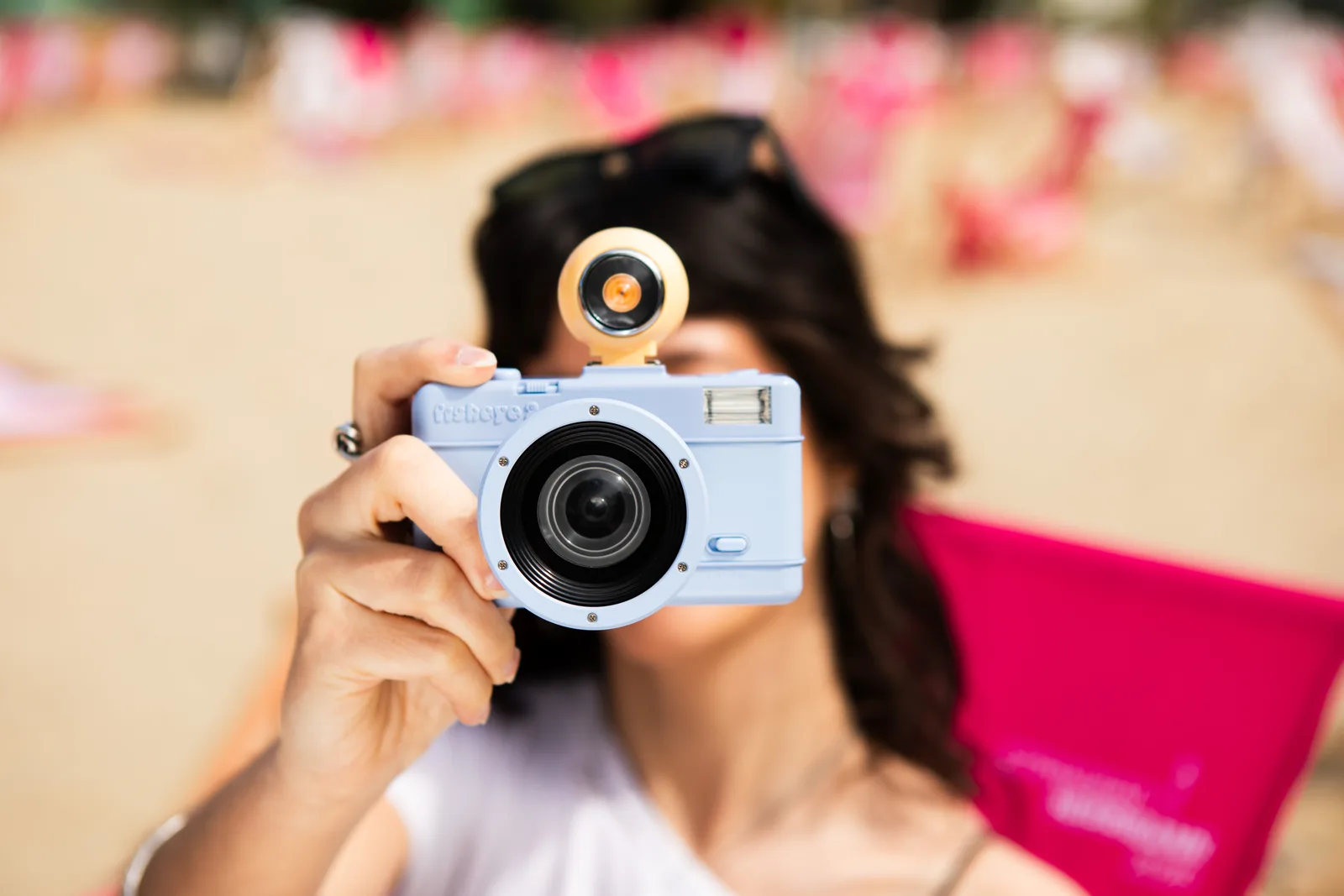
On June 29, 2026, Lomography announced the Fisheye No. 2 La Mer, a seaside-themed edition of its 170-degree 35mm camera — and within days, the release was buried in search results under reviews written back in 2009. That is not an accident. The Fisheye No. 2 has been in production for 17 years, and the "new Fisheye 2" making the rounds in film photography newsletters this summer is the same camera in a new outfit. If you are trying to work out what actually changed, what it costs, and whether it deserves a spot in your bag, here is the sorted version.
The short answer up front: the La Mer is a colorway, not a redesign. The optics, shutter, flash, and controls are identical to the Fisheye No. 2 that Lomography has sold since 2009. What you are paying for is a periwinkle-blue body, a sand-coloured viewfinder, and the small pleasure of a camera that matches the beach it was designed to be carried to.
The 2026 Fisheye is not a new camera. It is a 17-year-old design in a periwinkle-blue shell — and knowing that before you buy is the whole point of this article.
A New Colorway, Not a New Camera
The Fisheye No. 2 La Mer went on sale in late June 2026 at $69 in the US and £69 in the UK, with Digital Camera World listing CA$89 and AU$109 for Canada and Australia, and German outlet photoscala putting the European suggested retail price at €69.90 as of July 3, 2026. It is available now on Lomography's shop, while the standard black-and-silver Fisheye No. 2 sells for $59 — so the nautical styling carries a $10 premium.
According to Kosmo Foto's announcement coverage, the La Mer is made of periwinkle-blue plastic with a sand-coloured detachable viewfinder, and Lomography's press release promises "dreamy bulbous Lomographic snapshots full of vignettes, light leaks and analogue charm." Treat that as marketing copy, but it is honest marketing: vignetting and unpredictability are the product, not defects.
It is also the latest entry in a long tradition. Lomography has kept the Fisheye No. 2 alive with special editions for years — Acapulco, Papaya Pop, Rodeo Denim, and Grape Jam colorways all preceded the La Mer. The June 2026 issue of Analog.Cafe's film photography news recap featured it alongside the Kodak Charmera Millennium Edition and an updated Polaroid Go — a reminder that "new film hardware" in 2026 often means refreshed rather than reinvented.
La Mer vs. the Cameras Google Thinks You Are Searching For
Type "Lomography Fisheye 2" into a search engine and most of what comes back describes the 2009 launch, or even the original 2005 Fisheye One. Here is how the three actually compare, so you know which reviews still apply.
| Fisheye One (2005) | Fisheye No. 2 (2009) | Fisheye No. 2 La Mer (June 2026) | |
|---|---|---|---|
| Lens | 10mm fisheye, 170° view | 10mm fisheye, 170° view | 10mm fisheye, 170° view |
| Aperture | Fixed f/8 | Fixed f/8 | Fixed f/8 |
| Shutter | 1/100 only | 1/100 (N) + Bulb (B) | 1/100 (N) + Bulb (B) |
| Multiple exposures | No | Yes, unlimited (MX switch) | Yes, unlimited (MX switch) |
| Flash | Built-in | Built-in + hot shoe | Built-in + hot shoe |
| Viewfinder | Fixed, conventional | Detachable fisheye "eyeball" finder | Detachable fisheye finder, sand-coloured |
| Body | Plastic | Black plastic with aluminium trim, plus editions | Periwinkle-blue plastic |
| Price (July 2026) | — | $59 / £59 | $69 / £69 |
The real generational leap happened in 2009, not 2026. Per Lomography's own FAQ, the No. 2 added a Bulb setting, a standard hot shoe, and a multiple-exposure switch on top of the original's 170-degree lens and built-in flash. The detachable finder is the cleverest part of the design: it slides onto the hot shoe and shows an approximation of the circular image that will land on the film — and it has to come off if you ever want to mount an external flash.
So a 2009-era review of the Fisheye No. 2 still describes the 2026 camera accurately, mechanically speaking. What those old reviews cannot tell you is today's price, availability, or how the camera holds up against 2026's genuinely new film hardware. That is the gap this piece fills.
Track this in the app: Film Roll Tracker
What the Photos Actually Look Like
The Fisheye No. 2 exposes a circular image inside the 35mm frame, edged by shadows of the lens housing. In Kosmo Foto's February 2026 review, Andrew Long described hanging his negatives to dry and finding round frames staring back at him — and came away surprised by the hit rate, with 32 usable shots from a 36-exposure roll of Kentmere 400, results he called far better than he expected despite the creaky plastic build.
Analog.Cafe's Dmitri, writing in the June 2026 recap, framed the look another way: the 10mm focal length produces wild distortions that recall music and skateboarding videos from the early 2000s, while the short focal length gives the fixed f/8 aperture an enormous depth of field, so nearly everything is in focus and the camera is fast to shoot. Add the 10cm closest focusing distance and you get the signature Fisheye party trick — a face, a dog's nose, or a wave pushed so close to the lens that it balloons across the whole circle.
There is no ISO adjustment, no metering, and no focusing. With one aperture and one shutter speed, your film stock is your exposure control: a 400-speed negative film covers most daylight, and the built-in flash carries you indoors. The MX switch lets you stack as many exposures as you like on a single frame, and Bulb opens the shutter for light trails — the two features that separate it from a disposable camera.
Who It Is For — and Who Should Skip It
The Fisheye No. 2 makes sense as a second camera. It is the one you hand around at a beach barbecue, load with cheap color negative film, and never worry about. At $69 for the La Mer — or $59 for the standard edition — it costs about as much as three or four rolls of film with development, which is the right mental category: an experiment, not an investment.
Skip it if you want sharpness, control, or reliability metered in decades. Andrew Long's review is blunt about the plastic build: a stiff film-door latch, creaks and squeaks while winding, and framing that drifts because the finder sits above the lens. None of that is a scandal at this price, but it is worth knowing that the roughly €450 Analogue aF-1 and the Fisheye No. 2 are different species that happen to share a film format.
For the wider landscape — half-frame compacts, crowdfunded medium format projects like the Beerpan and VZ-6617, and everything in between — see our hub covering all new film cameras 2026. In that company, the Fisheye No. 2's story is longevity: while startups engineer new autofocus systems, Lomography keeps a 2009 design selling by repainting it, and 17 years of continuous production suggests the strategy works.
Frequently asked questions
Is the Lomography Fisheye No. 2 La Mer a new camera?
No. The La Mer, released June 29, 2026, is a special colorway of the Fisheye No. 2 that Lomography has produced since 2009. The 10mm f/8 lens, 1/100 shutter with Bulb, built-in flash, multiple-exposure switch, and detachable viewfinder are unchanged; only the periwinkle-blue and sand colors are new.
How much does the Fisheye No. 2 cost in 2026?
As of July 2026, the standard Fisheye No. 2 sells for $59 (£59) and the La Mer edition for $69 (£69) on Lomography's shop, with Digital Camera World listing CA$89 and AU$109 for the La Mer.
What film should I load in the Fisheye No. 2?
The camera has a fixed f/8 aperture, a single 1/100 shutter speed, and no ISO adjustment, so your film choice sets the exposure. A 400-speed color negative film is the most forgiving all-round pick, with the built-in flash covering indoor scenes.
Track Every Circular Frame
A camera with one aperture and one shutter speed flips the usual workflow: the exposure decision happens before you load the roll, not when you press the button. Reading the light in the places you actually shoot — and choosing 200, 400, or 800 speed film accordingly — is the single biggest thing you control on a Fisheye No. 2.
Pellica's light meter app makes that pre-roll decision measurable instead of guessed: meter your kitchen, your street, your beach, and you will know which stock survives all three. The film roll tracker then logs every frame with location and notes — which matters more than usual here, because MX double exposures and Bulb experiments are unrepeatable, and six months later you will want to know exactly what you did on the frame that worked. When the roll is done, the lab map finds you a lab that will scan those circular negatives properly.
Toy camera or not, film costs the same either way. The photographers who get the most out of a $69 plastic fisheye are the ones who treat its rolls like they came out of a Leica.