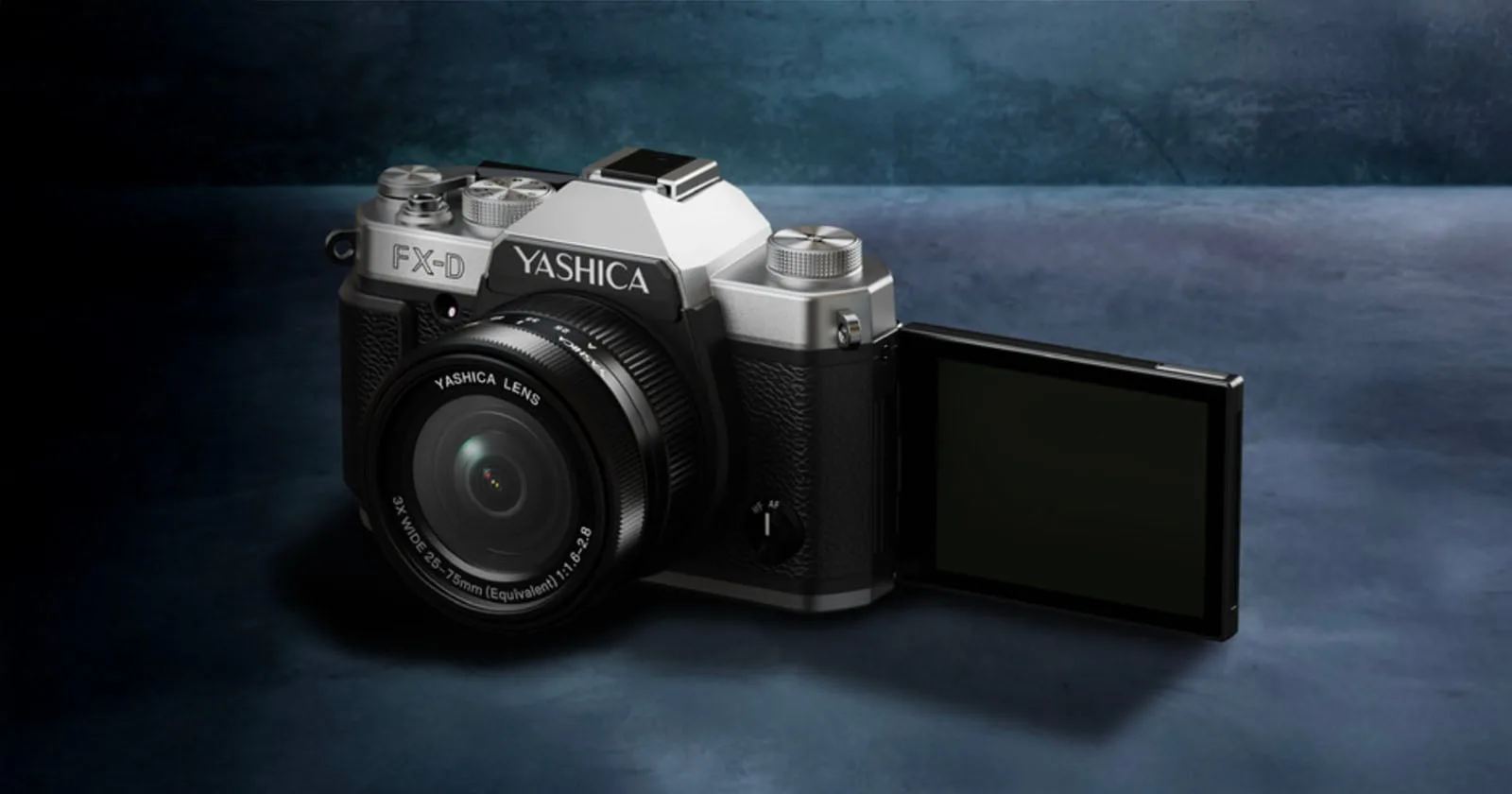
In late May 2025, a camera wearing the body of a 1979 film SLR appeared on Kickstarter. The Yashica FX-D borrows its name and silhouette from the FX-3, the mechanical workhorse that put Yashica in thousands of camera bags, and pairs them with a film advance lever, shutter-speed-style dials, and six built-in "film simulations." The campaign closed at HK$5,911,312 — about US$755,000 at Hong Kong's pegged exchange rate — from 1,923 backers, per the Kickstarter page as of July 2026.
Here is the part the campaign styling works hard to soften: there is no film in this camera. Not a hybrid, not a film back, not a digital insert for an old body. The FX-D is a compact digital camera in vintage clothing, and Yashica says so itself — the name stands for "Film Experience in Digital." A year after launch, with cameras shipped and independent reviews published, we can finally answer the question backers were really asking: is the experience worth it, or is this another chapter in the complicated history of the Yashica name?
The FX-D raised HK$5.9 million by promising the feeling of film without the film. Whether that feeling survives contact with a 640×480 rear screen is another question.
Not a Film Camera: What the FX-D Actually Is
The FX-D is a fixed-lens digital compact that shoots JPEG stills and 4K/30 video, dressed as an SLR. PetaPixel's launch coverage from May 29, 2025 lays out the design: the film advance lever does not advance anything — it arms a deliberate single-shot mode meant to slow you down — and on the two cheaper models the classic viewfinder hump is decorative, covered by a logo plate where the eyepiece would be. Composition happens on a 2.8-inch flip-out LCD.
The film look comes from six presets named like emulsions: Ruby 60s, Sapphire 70s, Yashica 400, Golden 80s, Mono 400, and B&W 400, plus customizable recipes. If that concept sounds familiar, it is the same promise Fujifilm built a decade of X-series marketing on, and the same one we examined in our piece on film simulation recipes versus real film: a digital file processed to evoke a stock, not a negative you can hold.
Three Models, One Idea
The campaign offered two bodies, with a third, viewfinder-equipped variant added to the lineup. All three have been shipping since late 2025 and reached UK and Ireland retail through distributor Transcontinenta, per Digital Camera World's July 30, 2025 report.
| FX-D 100 | FX-D 300 | FX-D S300 | |
|---|---|---|---|
| Sensor | 13MP Type 1/3.06 (Sony IMX458) | 50MP Type 1/1.56 | 50MP Type 1/1.56 |
| Lens | 25–76mm equiv. f/1.6–2.8, 3x zoom | 24mm equiv. f/1.8, stabilized | 24mm equiv. f/1.8, stabilized |
| Viewfinder | None (decorative hump) | None (decorative hump) | Electronic viewfinder |
| Kickstarter launch price | $239 | $339 | Added later in campaign |
| Street price, spring 2026 | ~$339 / £259 | ~$445 / £389 | ~$569 / £479 |
| Shipping since | August 2025 | August 2025 | October 2025 |
Spring 2026 prices are those quoted in Digital Camera World's reviews of each model, published March and April 2026. For context, those sensors are smartphone-class parts: the FX-D 100's Type 1/3.06 chip is physically smaller than the main sensor in most flagship phones sold in 2026.
Track this in the app: Film Roll Tracker
The Name on the Body Is Not the Company That Built It
Yashica was founded in Japan in 1949 and was absorbed by Kyocera, which stopped making cameras entirely in 2005. The trademark then passed to the Hong Kong-based MF Jebsen Group, which has licensed the name onto a series of crowdfunded products since — a history PetaPixel notes directly in its FX-D coverage.
The most infamous of those products is the 2017 Yashica Y35 digiFilm, a digital camera with swappable "digiFilm" cartridges that raised HK$10,035,296 — about US$1.28 million — from 6,935 backers, per DPReview's campaign report. When it shipped in 2018, backers reported unreliable shutters, jamming winders, and parts coming loose, and Casual Photophile had already called the concept out during the campaign itself. The Y35 remains a standard cautionary tale in camera crowdfunding.
That context matters for reading the FX-D numbers. The Y35 attracted 6,935 backers in 2017; the FX-D drew 1,923 in 2025 — less than a third — for a far more polished pitch. The audience that got burned once appears to have priced the Yashica name accordingly. Meanwhile the concept itself is clearly commercial: RewindPix, a screen-free digital compact that fakes film, closed at $1,143,077 from roughly 7,589 backers in 2026 — four times the FX-D's backer count, without a heritage name on the body.
What Reviewers Found Once Cameras Shipped
Credit where due: unlike the Y35's troubled rollout, the FX-D shipped roughly on schedule, with backer units going out from August 2025. The independent verdicts arrived in spring 2026, and they are consistent.
Digital Camera World's FX-D 300 review (March 27, 2026) called the camera "style over substance," finding that 50MP files "looked very much like they'd been digitally interpolated, taking on a pixelated and blotchy appearance," and describing the body as "relatively plasticky." The S300 review (April 3, 2026) reached a similar conclusion, with fine detail taking on "the appearance of being treated with a mosaic or watercolor artistic effect."
The surprise came at the bottom of the range. In its FX-D 100 review (April 12, 2026), the same reviewer found that "image quality is arguably better from the FX-D 100, with pictures looking less pixellated and with better retention of fine detail" — the honest 13MP sensor outperforming the interpolation-heavy 50MP chips, though its zoom lens showed more color fringing.
Buy, Wait, or Skip
The campaign is over, so the crowdfunding gamble no longer applies — these are retail products you can read reviews of before paying. That clarifies the decision considerably.
A case for buying exists if you want a casual, retro-styled digital compact for social photography, you value the slowed-down single-shot mode, and you accept smartphone-grade image quality at compact-camera prices. Reviewers consistently found the FX-D 100 the most defensible of the three on price and output.
Wait if you are tempted by the concept but not the execution. The retro-digital category is moving fast, and the FX-D's shortcomings — small sensors, low-resolution screens, decorative hardware — are exactly the things a second generation would fix.
Skip it entirely if what draws you is the film part of "Film Experience in Digital." A clean used SLR — an actual Yashica FX-3, even — costs less than an FX-D 300 and produces real negatives. Our guide to the best new film cameras of 2026 covers current-production options at every budget, the crowdfunding scene has genuine analog innovation in the BeerPAN and VZ-6617, and if you want digital convenience inside a film body rather than film cosplay on a digital one, I'm Back's APS-C digital film roll approaches the hybrid idea from the opposite direction.
Frequently asked questions
Is the Yashica FX-D a film camera?
No. The FX-D is a fully digital compact camera styled after the 1979 Yashica FX-3 film SLR. The film advance lever arms a single-shot mode and six presets imitate film looks, but the camera takes no film of any kind.
How much did the Yashica FX-D raise on Kickstarter?
The campaign closed at HK$5,911,312, about US$755,000, from 1,923 backers, per the Kickstarter campaign page as of July 2026. Backer units began shipping in August 2025.
Is today's Yashica the same company that made the FX-3?
No. Kyocera stopped producing Yashica cameras in 2005, and the trademark is now licensed by the Hong Kong-based MF Jebsen Group, which also ran the widely criticized Y35 digiFilm Kickstarter in 2017.
Keep the Ritual, Keep the Negatives
The FX-D's HK$5.9 million says something real: photographers want deliberateness back — the wind-on pause, the committed frame, the look of a specific stock. The camera delivers the gestures. Film delivers the gestures and a negative.
If the ritual is what you are after, a used SLR and a methodical logging habit get you there with better image quality than any simulation. Pellica's film roll tracker records every frame with your settings, GPS, and weather, so each roll becomes the kind of deliberate, reviewable practice the FX-D can only imitate. The built-in light meter replaces the exposure guesswork that scares people toward auto-everything digital, and when the roll is done, the lab map finds a developer among more than 1,200 listed labs.
Simulated film teaches you what film looks like. Shooting film teaches you why.