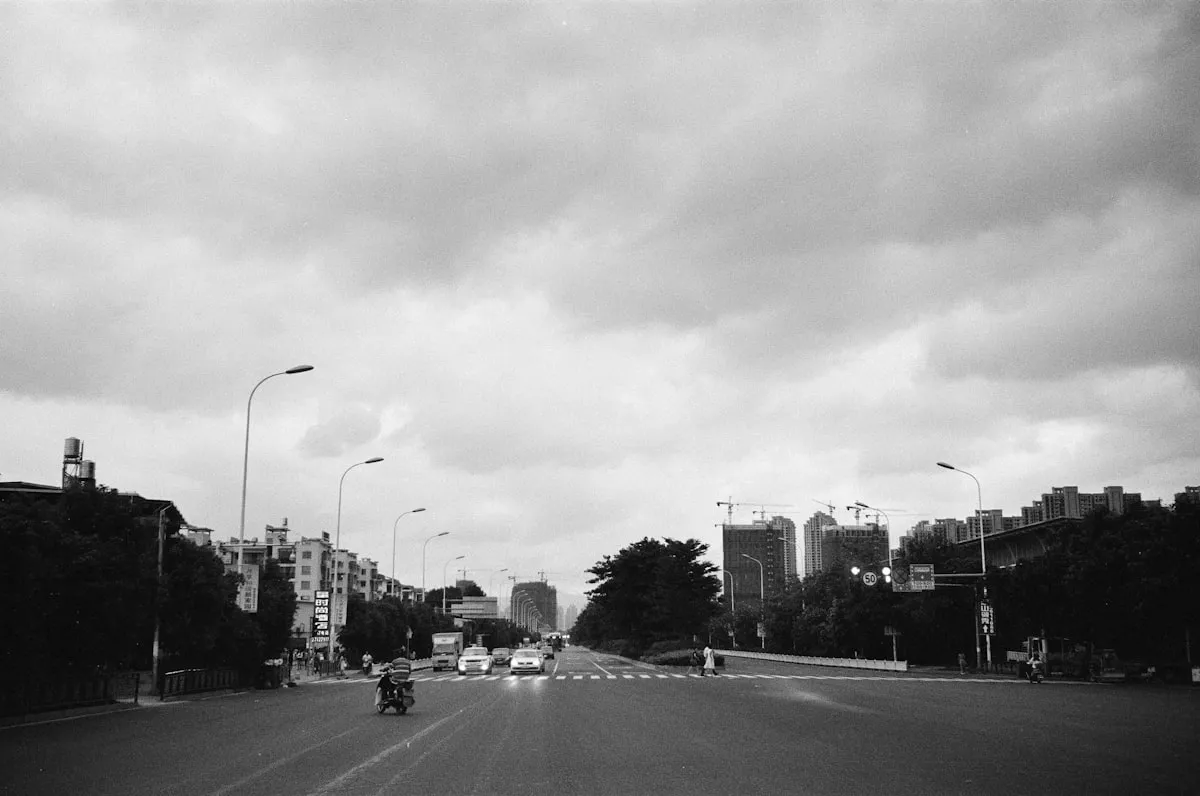
Street photography and film have been intertwined since the beginning. Henri Cartier-Bresson loaded Tri-X into his Leica and defined the “decisive moment.” Vivian Maier shot thousands of rolls through her Rolleiflex, unseen until after her death. Garry Winogrand left behind 2,500 undeveloped rolls when he died — each one a bet that something interesting was about to happen on the next block. The genre was born on film, and despite the convenience of digital, film remains deeply suited to how street photography actually works.
The reason is partly practical and partly philosophical. A small mechanical camera draws less attention than a modern mirrorless body with a grip and an electronic viewfinder. The finite frame count sharpens your eye. And the look — punchy grain, organic tonality, baked-in contrast — gives street images a texture that digital shooters spend hours trying to recreate in post.
Street photography was born on film. The finite frame count, the mechanical simplicity, the grain — it all serves the genre in ways that go beyond nostalgia.
Best Cameras for Film Street Photography
The ideal street camera is small, quiet, fast to operate, and inconspicuous. You want something you can carry all day without fatigue and bring to your eye (or hip) in under a second. Here are the categories that work best.
Compact Rangefinders
Rangefinders are the classic street tool. The viewfinder shows you more than the frame lines, so you see subjects entering the composition before they're in frame. Focusing is fast once you learn the coupled mechanism, and the leaf shutters are whisper-quiet.
- Leica M6: The gold standard, for good reason. Fully mechanical, built-in meter, accepts the best 35mm and 50mm lenses ever made. The downside is the price — clean bodies go for $2,500-4,000. But they last forever and hold their value.
- Contax G2: Autofocus rangefinder with Carl Zeiss lenses. The 45mm Planar is one of the sharpest lenses you can mount on a 35mm body. Prices have climbed to $1,000-1,800, but it's a fraction of a Leica for comparable optical quality.
- Olympus 35 SP: The affordable sleeper. Fixed 42mm f/1.7 Zuiko lens, spot metering, compact body. You can find clean examples for $150-300. The lens holds its own against cameras costing ten times as much.
Point-and-Shoot Cameras
The ultimate “always have it with you” cameras. They slip into a jacket pocket and let you react to fleeting moments without fiddling with settings.
- Ricoh GR1: A sharp 28mm f/2.8 lens in a body the size of a deck of cards. Snap focus mode pre-sets the lens to a fixed distance for instant shooting. Prices sit around $400-700.
- Yashica T4 (Kyocera T4): Carl Zeiss T* 35mm f/3.5 lens, weatherproof body, dead-simple operation. Prices run $300-500.
- Olympus MJU II (Stylus Epic): 35mm f/2.8, weatherproof, fits in your palm. Takes excellent photos, but prices have ballooned to $250-400. If you find one cheap, grab it.
SLRs
Bigger and louder than rangefinders, but the through-the-lens viewfinder makes composition precise. A lightweight SLR with a fast prime is a perfectly viable street setup.
- Nikon FM2: Mechanical, reliable, accepts the enormous Nikon F-mount lens system. Pair it with a 35mm f/2 or 50mm f/1.4 for a serious street kit at $200-350 total.
- Pentax K1000: Fully manual, no frills, extraordinarily reliable. Available for $80-150 with a 50mm f/2.
The New Option: Pentax 17
Pentax released the 17 — a brand-new half-frame film camera — and it's a compelling street tool. Half-frame means each standard 36-exposure roll gives you 72 shots. That changes the economics of street shooting dramatically. The vertical default orientation feels natural for portraits and tall urban scenes. At around $500 new, it's the most accessible entry point for someone who wants a reliable, modern film camera without hunting the used market.
Best Film Stocks for Street Photography
Street photography demands speed, versatility, and a look that complements the grit and energy of public spaces. These stocks deliver.
Kodak Tri-X 400
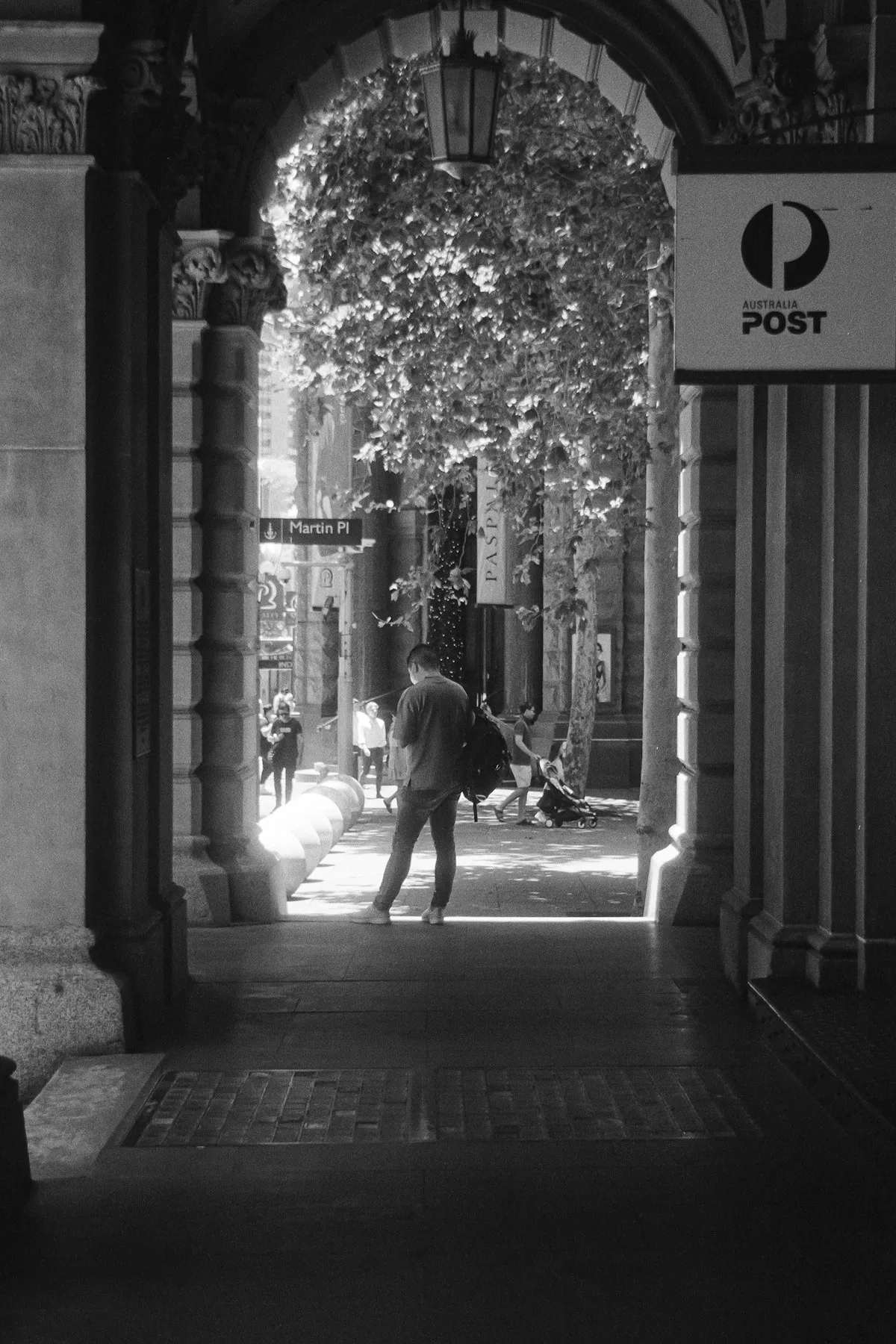
The street film. Tri-X has a punchy, contrasty tonality with grain that adds energy without overwhelming detail. Shadows go deep, midtones have snap, and highlights hold up well. Shot at box speed, it's a classic. Pushed to 1600, it becomes something else entirely — grittier, more graphic, with the dense blacks and visible grain that defined the look of 20th-century photojournalism. Many street shooters load Tri-X at 1600 by default and push-process every roll.
Ilford HP5 Plus 400
HP5 is Tri-X's closest competitor, and some photographers prefer it. The grain is slightly smoother, the tonal curve a touch less contrasty, and the shadow detail holds up marginally better when pushed. At 800 and 1600, HP5 retains a bit more nuance in the midtones than Tri-X does. The choice between them is personal — shoot a roll of each and see which speaks to you.
Kodak Gold 200
Underrated for color street work. Gold's warm palette and visible grain give images a nostalgic, lived-in quality that suits urban environments. It's not trying to be neutral or “accurate” — it has a point of view, and that point of view happens to pair beautifully with afternoon light on city sidewalks. At roughly $8-10 per roll, it's also one of the most affordable options available.
Kodak Portra 400
If your street photography includes candid portraits — faces, interactions, fleeting expressions — Portra's skin tone rendition is hard to beat. The colors are natural without being flat, the grain is fine for a 400-speed stock, and the exposure latitude gives you a safety net on the fly. It's more expensive than Gold, but if people are your primary subject, the results justify the cost.
Technique: Working Fast on Film
Street photography is reactive. Moments appear and vanish in fractions of a second. Here's how film shooters keep up.
Zone Focusing
This is the single most important technique for film street photography. Set your lens to a fixed distance — typically 2 to 3 meters — and stop down to f/8 or f/11. At those settings on a 35mm or 50mm lens, your depth of field covers roughly 1.5 meters to infinity. Everything in that zone is acceptably sharp. No focusing required. Just frame and shoot.
Zone focusing eliminates the biggest time sink in street shooting. No hunting for focus, no waiting for autofocus to lock, no missed moments. You see something, raise the camera, click. Done.
The Sunny 16 Rule
In consistent outdoor light, you can skip metering entirely. The sunny 16 rule: on a bright sunny day, set your aperture to f/16 and your shutter speed to the reciprocal of your ISO. Shooting ISO 400 film? f/16 at 1/500s (or the nearest setting). Overcast? Open up to f/8. Heavy shade? f/4. Once you internalize this, you can set your exposure before you even see the shot.
For trickier or fast-changing light, a light meter on your phone gives you an accurate reading in seconds without breaking your rhythm.
Shooting from the Hip
Pre-focus with zone focusing, pre-expose with sunny 16 or a quick meter reading, and shoot without raising the camera to your eye. You lose precise composition but gain invisibility. People don't notice a camera held at waist level the way they notice one pointed at their face. A wide lens — 28mm or 35mm — gives you enough coverage to crop later if your framing is slightly off.
One Camera, One Lens, One Film
Consistency builds style. When you shoot with the same focal length for months, you start previsualing compositions at that angle of view before you even raise the camera. When you shoot the same film stock, you learn its personality — how it handles shade, how it renders neon light, how much you can push it. Limiting your variables lets you focus on the only thing that really matters: seeing.
Dealing with 36 Frames
Coming from digital, 36 frames feels like nothing. But the limit is the discipline. Be selective without being precious — if a scene catches your eye, shoot it. But don't fire three frames of the same composition hoping one is sharp. Trust your technique. One frame, maybe two if the moment is evolving, then move on.
Some days the street gives you everything; some days it gives you nothing. The constraint teaches you to recognize the difference. And if 36 frames feels too tight, the Pentax 17's half-frame format doubles your capacity to 72 shots per roll — enough to shoot freely while staying within analog constraints.
Track Your Street Sessions with Pellica
Street shooting on film produces data worth keeping. Which intersections gave you the best light at 4pm in November? What did Tri-X pushed to 1600 look like under fluorescent store lighting? Which aperture kept your zone focus sharp enough at 3 meters?
Pellica's film roll tracker logs this automatically — GPS tags where each shot happened, frame-by-frame settings record your exposure decisions, and roll-level notes capture the push/pull instructions you gave the lab. When your scans come back, the data is waiting to help you understand what worked and why.
Pair that with the built-in light meter for those moments when you duck from bright sun into a shadowed alley and need a quick reading, and the lab finder for when you're shooting in a new city and need to find somewhere to process your rolls. The film constraints are part of the art. The logistics don't have to be.