Every roll of film comes with a number on the box — ISO 100, 400, 800. That number tells you (and your camera) how sensitive the film is to light. But here's the thing: you don't have to shoot at that speed. You can deliberately set your camera to a different ISO, then adjust the development to compensate. This is pushing and pulling, and it's one of the most powerful tools in a film photographer's toolkit.
Pushing gives you extra speed when the light runs out. Pulling tames harsh contrast when the light is too much. Both change the character of the image in ways that go beyond simple exposure correction. Once you understand the mechanics, you'll reach for push and pull deliberately — not as a rescue technique, but as a creative choice.
Pushing and pulling aren't rescue techniques. They're creative choices that change the character of your images in ways no amount of scanning adjustment can replicate.
What Pushing Means
Pushing film means shooting it at a higher ISO than the box speed, then telling your lab to overdevelop the roll to compensate for the underexposure. You're essentially underexposing every frame on purpose, then asking the chemistry to make up the difference.
The most common example: loading a roll of Tri-X 400 and setting your camera's meter to ISO 1600. That's a 2-stop push. Every frame on the roll receives two stops less light than the film was designed for. When the roll goes to the lab, you mark it “push +2” and they extend the development time. The extra time in the developer builds up more density in the negatives, bringing the exposure closer to where it should be.
Closer, but not identical. Pushing doesn't perfectly replicate what you'd get at a true higher ISO. Highlights gain more density than shadows do, which means contrast increases. Grain becomes more pronounced. Shadow detail thins out. These aren't flaws — for many photographers, this look is exactly the point.
What Pulling Means
Pulling is the opposite. You shoot the film at a lower ISO than box speed, then underdevelop to compensate for the overexposure. Shoot Portra 400 at ISO 200, mark the roll “pull -1,” and the lab shortens development time.
The result is lower contrast, smoother tonal transitions, and finer grain. Highlights come down, shadows open up, and the overall image has a gentler, more even-toned quality. Pulling is less common than pushing because most photographers want more speed, not less. But it's a valuable technique when you're shooting in harsh midday sun or want a specific softness in your images.
The Chemistry Behind It
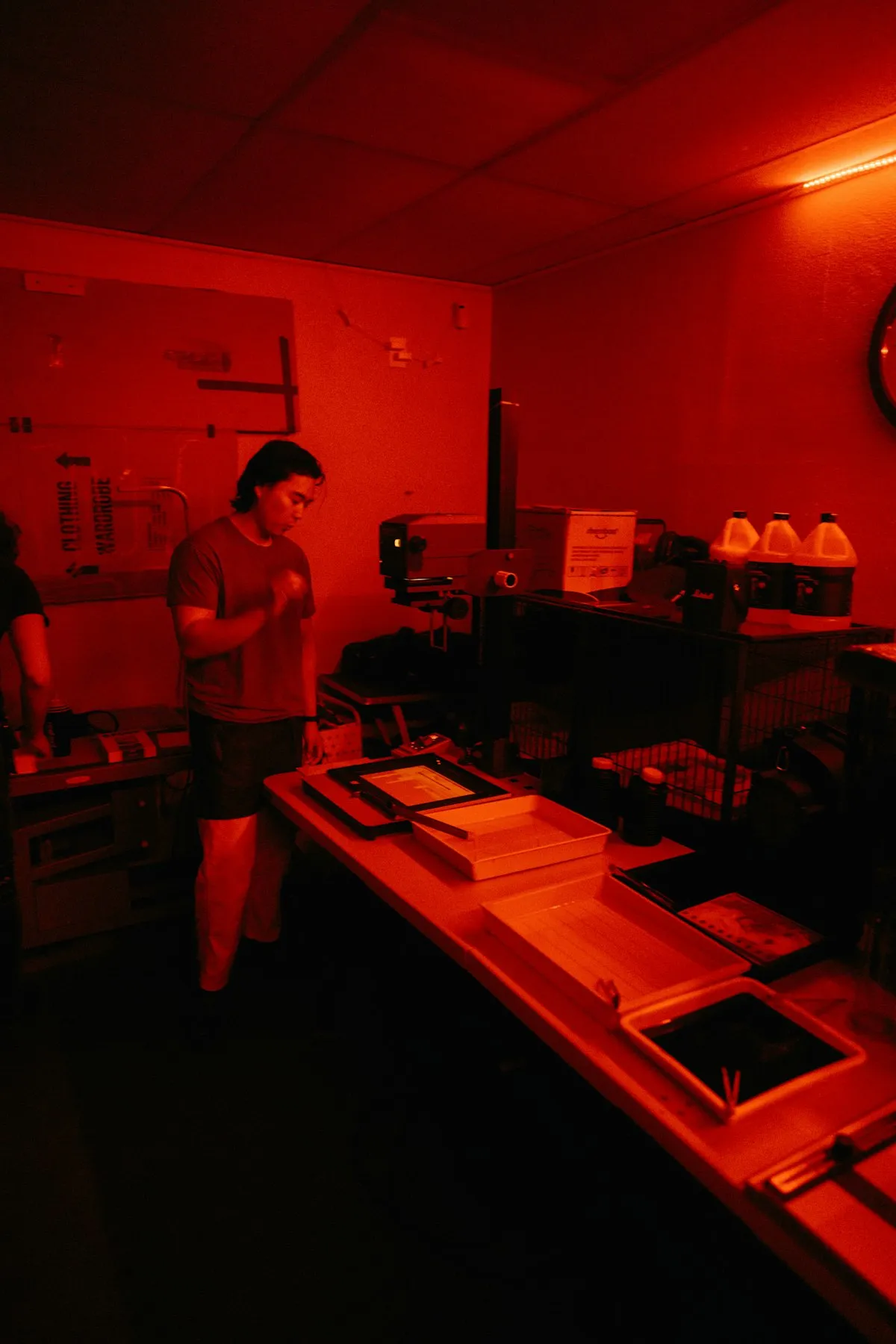
Film development is a chemical reaction between the developer solution and the silver halide crystals in the emulsion. When light hits those crystals during exposure, it creates a latent image — an invisible pattern of activated silver. Development converts those activated crystals into metallic silver, which forms the visible image.
Longer development time means more of the silver halide gets reduced to metallic silver. Heavily exposed areas (highlights) already have abundant activated crystals and develop quickly. Shadow areas have fewer activated crystals and need more time to build up density. When you extend development for a push, the highlights keep building while the shadows struggle to catch up. That's why pushed film has higher contrast — the gap between highlights and shadows widens.
Shortened development for a pull does the reverse. You stop the process before the highlights reach full density, compressing the tonal range. Shadows still get enough development to hold detail, but the overall contrast flattens out.
Why Push Film
The practical reason is simple: you need more speed. You're shooting indoors, at a concert, on a dark street at night, and your ISO 400 film isn't fast enough to get a usable shutter speed handheld. Pushing to 800 or 1600 buys you one or two extra stops, which can mean the difference between a sharp frame at 1/60s and a blurry one at 1/15s.
The creative reason is equally compelling. Pushed black and white film has a punchy, graphic quality — deep blacks, bright highlights, prominent grain. It's the look of classic photojournalism and street photography. Tri-X pushed to 1600 doesn't just look faster; it looks different. Grittier, more immediate, more raw. Some photographers push even in good light specifically for that aesthetic.
Why Pull Film
Pulling is about control. When you're shooting in contrasty conditions — bright sun with deep shadows, a scene with extreme dynamic range — pulling reduces contrast and helps retain detail across the entire tonal range. The classic Zone System mantra applies here: expose for the shadows, develop for the highlights. Pulling is how you develop for the highlights.
It also produces noticeably finer grain and smoother tonal gradations. Portra 400 pulled to 200 has an almost medium-format smoothness to it, with pastel-like colors and seamless transitions between tones. For portraiture and fashion, that softness can be exactly what you want.
Best Films for Pushing
Not all films take kindly to being pushed. Stocks with a robust emulsion and good reciprocity characteristics handle it best:
- Kodak Tri-X 400: The gold standard for pushing. Tri-X at 1600 is practically its own film stock — high contrast, bold grain, unmistakable character. Pushes cleanly to 800, beautifully to 1600, and acceptably to 3200 if you're desperate.
- Ilford HP5 Plus 400: HP5 pushes with slightly less contrast than Tri-X, retaining more shadow detail. Excellent at 800 and very good at 1600. Some photographers prefer it over Tri-X for pushed work precisely because it's a bit more restrained.
- Kodak Portra 400: On the color side, Portra handles a 1-stop push remarkably well. At 800, it gets a touch more contrast and saturation but retains its smooth skin tones. A 2-stop push to 1600 is possible but starts showing strain in the shadows.
- CineStill 800T: Already a fast film, and it pushes to 1600 or even 3200 for truly dark environments. The grain gets heavy, but paired with the halation glow, the results have a distinctive cinematic atmosphere.
- Ilford Delta 3200: Technically a 1000-speed film designed to be pushed. At its rated 3200, it's already being pushed, and it can go to 6400 or beyond for extreme low-light work.
Best Films for Pulling
Pulling is less commonly discussed, but certain stocks respond to it beautifully:
- Kodak Portra 400: Pulled to 200, Portra becomes even smoother and more pastel. The already-fine grain virtually disappears, and the tonal range compresses into something dreamlike. Many portrait photographers swear by this combination.
- Kodak Ektar 100: Pulled to 50, Ektar's famously saturated colors mellow out slightly, and the grain — already the finest of any color negative film — becomes almost invisible. Gorgeous for landscapes in bright conditions where you want maximum smoothness.
- Ilford FP4 Plus 125: Pulled to 64 or 80, FP4 delivers incredibly smooth tones with gentle contrast. A classic choice for large-format and architectural photography where you want every tonal nuance preserved.
How to Tell Your Lab
Communication with your lab is critical. When you drop off a push or pull roll, you need to clearly mark the canister or bag with the processing instruction. Write “PUSH +1” or “PUSH +2” for pushing, and “PULL -1” for pulling. Most labs use the plus/minus notation, where each number represents one stop of adjusted development.
Expect to pay a small surcharge — typically $1 to $3 per roll for push or pull processing. The lab has to process your roll separately from their standard batches, which takes extra time and handling. This is normal and not something to negotiate around.
One absolutely essential rule: the entire roll must be pushed or pulled by the same amount. You cannot push frames 1-18 by one stop and frames 19-36 by two stops. The whole roll goes into the same developer bath for the same duration. Decide your push or pull before you start shooting the roll, set your camera's ISO accordingly, and keep it there for all 36 frames.
Common Mistakes
Forgetting to tell the lab. You shoot an entire roll at 1600 on a 400-speed film, then drop it off without marking it. The lab processes it normally, and you get back a roll of badly underexposed negatives. Always, always label your push/pull rolls.
Changing ISO mid-roll. You start shooting at 400, then realize you need more speed and switch to 1600 partway through. Now half your roll needs normal processing and half needs a 2-stop push. There's no good fix for this. Pick your speed at the start and commit.
Pushing color negative too far. Black and white film handles aggressive pushing much better than color. Pushing Portra 400 to 3200 will give you muddy shadows, heavy color shifts, and harsh grain. Stick to 1-stop pushes for most color negatives, 2 stops at the absolute maximum.
Expecting pushed film to look like higher-speed film. Pushing Tri-X 400 to 1600 doesn't give you the same results as shooting Delta 3200 at 1600. The tonal response, grain structure, and overall look are different. Pushing is its own aesthetic, not a simulation.
Track Your Push/Pull Experiments
Push and pull processing is inherently experimental. Your results depend on your specific camera, your metering habits, your lab's chemistry and timing, and the look you personally prefer. What works for another photographer might not work for you, and vice versa.
This is where systematic tracking pays off. Pellica's film roll tracker lets you log your shooting ISO alongside the box speed for each roll, so you always know which rolls were pushed or pulled and by how much. When your scans come back, you can compare pushed and standard-processed rolls of the same stock side by side and see exactly how the development adjustment affected your images.
After a few experiments, you'll build a personal reference: “Tri-X at 1600 with my Nikon FM2 in available light looks like this. HP5 at 800 with the same conditions looks like that.” Use the built-in light meter to get consistent readings before each shot, and over time your push/pull data becomes a genuine resource — not just notes, but a visual record of how different films respond to modified processing. Find a reliable lab that handles push processing well, and you're set to experiment with confidence.