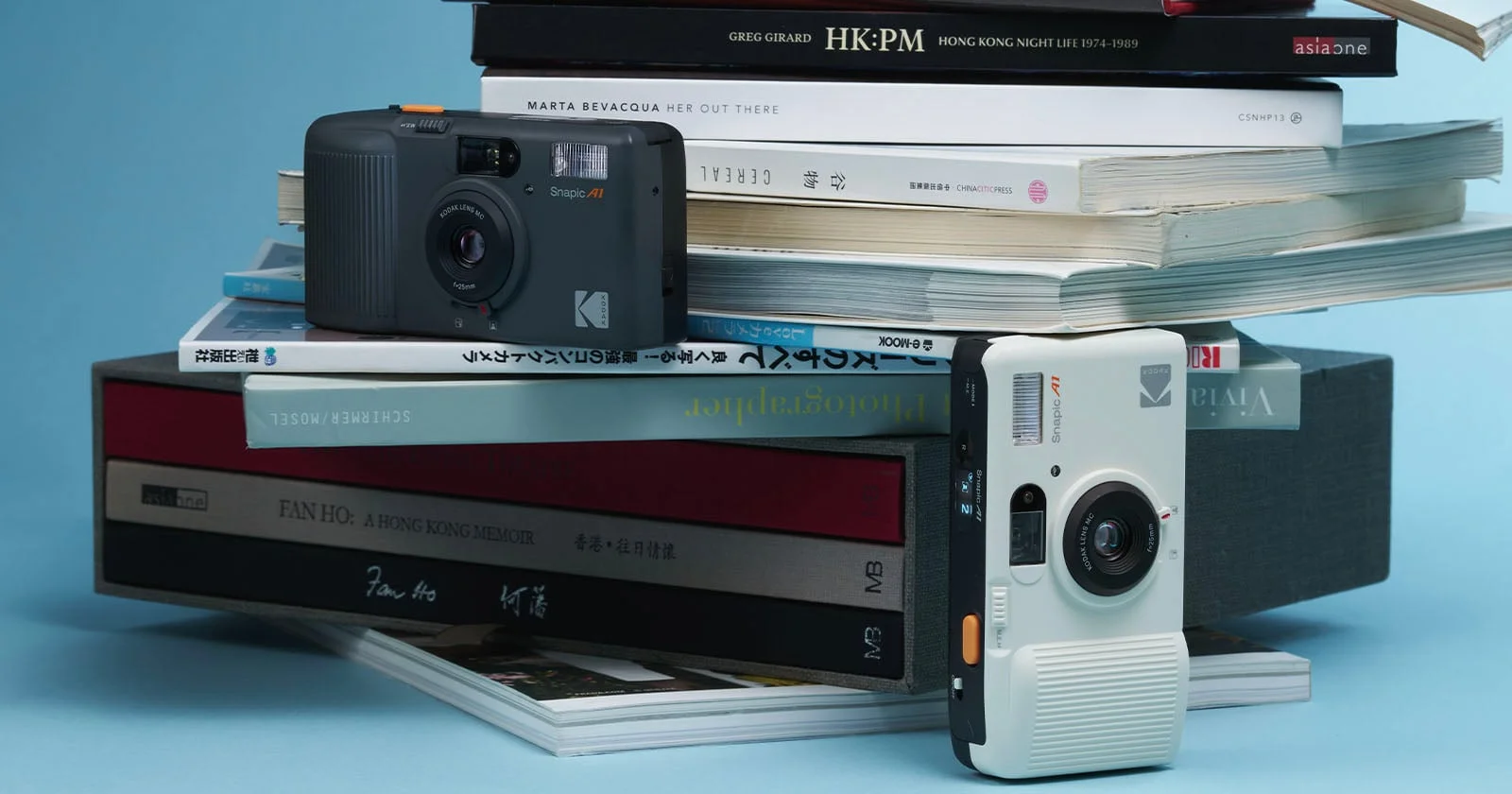
For $99, what corners did they cut? Fewer than you'd think. The Kodak Snapic A1 isn't made by Kodak — the company hasn't manufactured a camera in decades. It's built by Reto, the Hong Kong outfit behind the $50 Charmera that turned “reusable disposable” into an actual product category. This time, Reto licensed the yellow badge and stepped up: a 35mm point-and-shoot with a Kodak-branded 3-element lens, an OLED frame counter, and a dedicated double exposure switch. Available now in Rhino Grey and Ivory White.
When was the last time you bought a brand-new film camera for less than the cost of developing three rolls of Portra? Reto just made it possible — and threw in an OLED screen for good measure.
What $99 Actually Buys You
A zone-focus 35mm camera with a fixed 25mm f/9.5 ultra-wide lens. That aperture is slow — there's no sugarcoating it. But f/9.5 is a calculated tradeoff, not a cost-cutting shortcut. A tiny aperture produces massive depth of field, which means zone focusing actually works. You get three zones — 0.5m, 1.5m, and infinity — dialed manually on the lens barrel. Miss your distance estimate by 30cm? Doesn't matter. At f/9.5, your subject stays sharp anyway. That forgiveness is the whole point.
The shutter is locked at 1/100s. No aperture priority, no program mode, no negotiation. This camera is calibrated for one scenario: daylight with ISO 200–400 film. Indoors, an auto flash kicks in when the sensor reads low light. You can't force the flash on or off — it decides for you. Is that limiting? Absolutely. Does it mean you never fumble with settings and miss the moment? Also yes.
The body measures 118 × 62 × 35mm and weighs 117g — lighter than an iPhone, genuinely pocketable. Two AAA batteries power roughly 10 rolls before dying. Auto wind and rewind handle film advance, so there's no manual lever. It ships with a wrist strap and a fabric pouch.
The OLED That Solves a 50-Year Problem
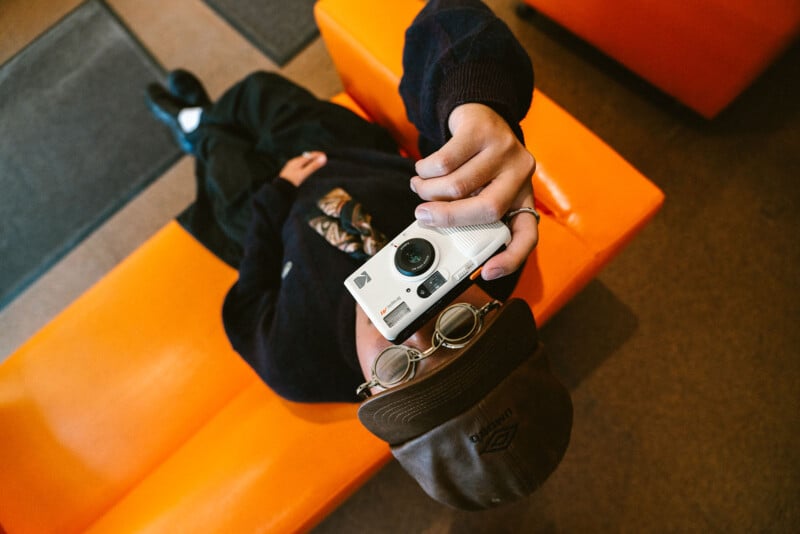
Every film photographer has a horror story: you open the camera back at frame “36” and find the film never advanced. Mechanical frame counters lie. They stick, they skip, they give you false confidence for 24 exposures before revealing the truth. The Snapic A1 replaces the mechanical counter with a tiny OLED display on the top plate — powered by the same electronics that drive the auto-wind motor. Because the motor physically advances the film and the OLED tracks motor activations, the count is accurate. Not approximately accurate. Accurate.
It's a crisp, high-contrast readout on an otherwise minimalist body. A small detail, but the kind that tells you Reto is thinking about what actually frustrates film shooters — not just what looks good on a spec sheet.
Double Exposures Without the Hack
On most budget 35mm cameras, double exposures require a workaround: hold the rewind button while cocking the shutter, pray you don't accidentally advance the film, repeat. The Snapic A1 skips all of that. You flip a dedicated switch on the body. The next two frames layer onto each other. Done. No tricks, no guesswork.
Here's where f/9.5 actually becomes interesting. With that much depth of field, both exposure layers stay sharp across the entire frame. You get dense, graphic overlaps — architectural lines cutting through foliage, silhouettes stacked against texture. It's a different aesthetic from the dreamy, bokeh-blended doubles you'd get at f/2.8, and arguably a more versatile one. The physical switch lowers the barrier to trying it on a whim — which is exactly when the best double exposures happen.
New to the technique? Start with our complete guide to double exposure on film.
Not a Contax T2 — And That's the Point
The Snapic A1 doesn't compete with an Olympus Stylus Epic, a Contax T2, or a Yashica T4. Those had autofocus, faster lenses, and program auto-exposure. They were precision instruments in compact bodies — and they now sell for $300–$1,500 on eBay with no warranty and questionable shutter counts.
The Snapic A1 belongs to a different class entirely: the fixed-everything camera. Think early Lomo LC-A, the Olympus XA's budget siblings, or Reto's own Charmera. You point, you shoot, you accept what the optics and the light conspire to produce. The 25mm lens is notably wider than the 35mm standard of most vintage compacts, giving images a distinct ultra-wide character — more environmental context, visible barrel distortion at the edges, and a sense of being inside the scene rather than observing it.
At $99, this camera occupies a niche that barely exists anymore: a brand-new, warrantied 35mm body for less than what you'd spend on a single roll of Portra 400, development, and scanning at most labs. You're not buying optical perfection. You're buying reliability, simplicity, and a few features that have no business being this thoughtful at this price.
Three Shooters, One Camera
The beginner. You want to try film without gambling $300 on a used camera that may or may not fire its shutter. The Snapic A1 is new, warrantied, and simple enough to hand to someone who has never loaded a roll — they'll figure it out in under a minute.
The beater-camera veteran. You need something for jacket pockets, parties, beach days, and rainy hikes — situations where an expensive body stays home. At 117g, you forget the Snapic A1 exists until a moment worth capturing shows up.
The experimenter. Load Cinestill 800T, shoot neon-lit streets at night with flash, and stack double exposures of architecture on foliage. Push cheap Kodak Gold through it and embrace the grain. This camera rewards you for not being precious — and that freedom is the entire point.
You shot 5 rolls at a weekend festival, hit the double-exposure switch on 3 of them, and mixed two film stocks. Which frames were doubled? Which roll was the Portra? Without a log, good luck sorting that out.
Track Every Roll — Especially the Experimental Ones
A $99 camera removes the anxiety of wasting frames. You shoot more, experiment more, care less about each individual click. But volume without tracking is just noise. When your scans come back three weeks later and you can't remember which double exposures used the 0.5m zone versus infinity, or which rolls were daylight versus flash — that's learning you'll never recover.
Pellica's film roll tracker lets you log each roll as you shoot it — film stock, camera body, date, and per-frame notes. Tag your double exposures. Note your focus zone. When the scans arrive, you'll know exactly which decisions produced which results. The built-in light meter helps you pick the right ISO before you leave the house — critical when the camera offers zero exposure control. And the lab map finds development services near you when your rolls are ready.
The simplest camera in your bag still deserves intentional shooting. Tracking is what turns 200 snapshots into a body of work you can actually learn from.