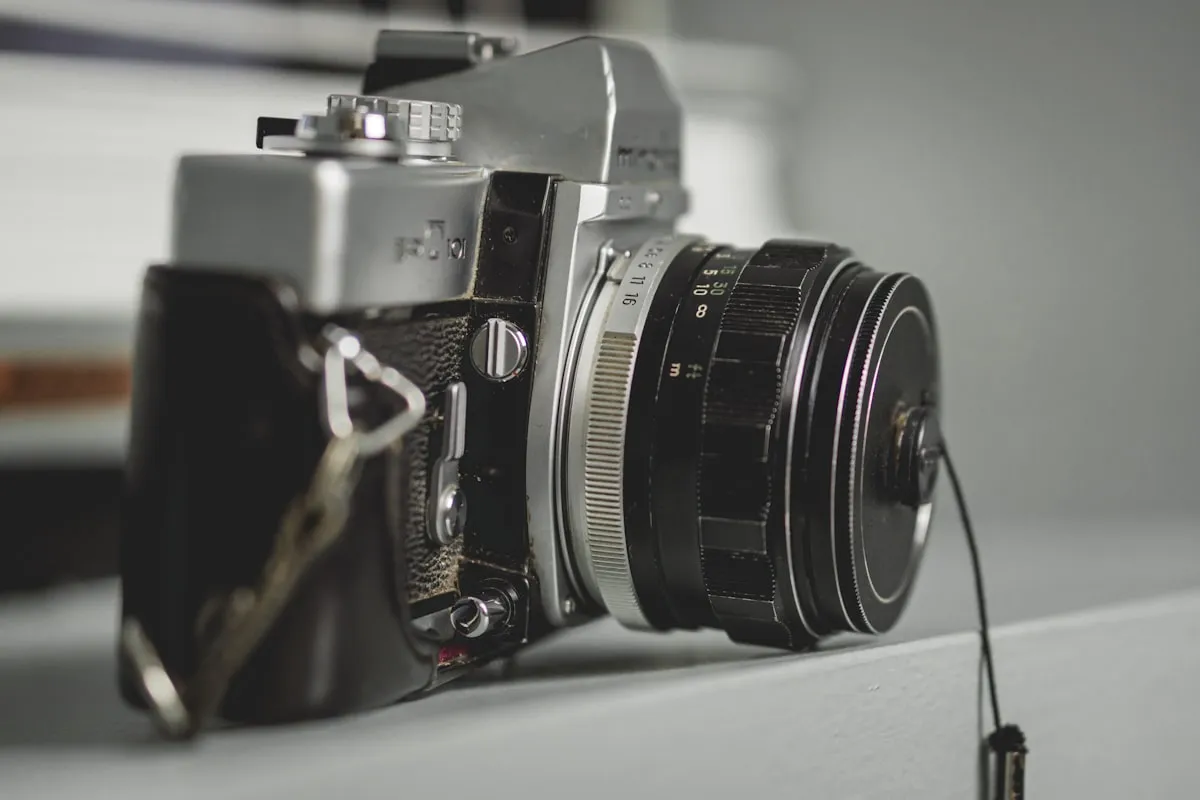
Film photography has a steep learning curve because the feedback loop is slow. You shoot, you wait, you get your scans back, and only then do you discover that half the roll is underexposed or that you left the lens cap on for three frames. Digital shooters see their mistakes instantly and correct on the spot. Film shooters carry theirs around for days or weeks before the evidence arrives.
The good news is that most film photography mistakes are predictable. The same errors come up over and over, and once you know about them, they're easy to avoid. Here are ten of the most common — and how to fix each one.
1. Not Metering Properly
Your camera's built-in meter is a useful tool, but it's not infallible. Most meters use center-weighted or evaluative metering, which works well in even light but struggles with high-contrast scenes. Backlit subjects, bright skies behind dark foregrounds, snow, and stage lighting all fool built-in meters into under- or overexposing.
The fix: Learn to recognize tricky lighting before you shoot. When the scene has strong contrast, meter for the shadows if you're shooting negative film (it handles overexposure well) or meter for the highlights if you're shooting slide film (which clips highlights harshly). A handheld or phone-based light meter gives you incident readings that aren't fooled by reflective surfaces, which is a significant advantage in difficult light.
2. Forgetting to Set the ISO Dial
You finish a roll of Portra 400, unload it, and load a roll of Ektar 100. You start shooting — and twenty frames later realize the camera's ISO dial is still set to 400. Every frame on that roll of Ektar is now two stops underexposed, because the meter was recommending exposures for a film twice as fast as what's actually loaded.
The fix: Make setting the ISO dial part of your loading ritual. Every time you load a roll: open the back, load the film, advance to frame 1, set the ISO dial. In that order, every time. Some cameras with DX coding read the ISO from the canister automatically — but not all cameras have DX coding, and not all films have accurate DX codes. Check the dial regardless.
Most film photography mistakes are predictable. The same errors come up over and over, and once you know about them, they're easy to avoid.
3. Opening the Camera Back Mid-Roll
This one hurts. You forget there's film loaded, flip the back open to check, and light floods across the emulsion. Depending on how far you opened it and how bright the ambient light was, you've ruined anywhere from a few frames to the entire roll. The frames nearest the exposed section get the worst of it — washed out with orange or white light leaks that obliterate the image.
The fix: Before opening the back, always check the frame counter and the rewind knob. If the counter shows anything other than “S” or “0,” there's film in there. If the rewind knob has tension when you turn it gently, film is loaded. When in doubt, don't open it. Rewind the roll first — you lose nothing if the camera was empty, and you save everything if it wasn't.
4. Underexposing Color Negative Film
This is the single most common exposure error among film beginners, and it comes from digital habits. On a digital sensor, overexposure clips highlights irreversibly — so digital shooters learn to “expose to the right” carefully. Color negative film works the opposite way. Highlights have enormous latitude (Portra 400 looks fantastic three stops overexposed), but shadows fall apart quickly — underexposed shadows lose color, gain grain, and turn muddy.
The fix: When shooting color negative, err on the side of overexposure. A common technique is to rate your film one stop slower than box speed — shoot Portra 400 at ISO 200, or Gold 200 at ISO 100. This gives the shadows extra density on the negative, resulting in richer colors and smoother tones. The latitude is asymmetric: overexposure forgives, underexposure punishes.
5. Shooting Expired Film Without Compensating
Expired film can produce beautiful results — color shifts, increased grain, unexpected tones. But the emulsion degrades over time, and if you shoot expired film at box speed without compensating, you'll likely get thin, underexposed negatives with muted colors and heavy grain. The older the film and the worse its storage conditions, the more speed it's lost.
The fix: The general rule of thumb is to add one stop of exposure for every decade past the expiration date. A roll of ISO 400 film that expired in 2016 should be shot at roughly ISO 200. Film that expired in 2006 would be shot at ISO 100. Cold-stored film degrades much slower than film kept in a hot attic, so adjust accordingly if you know the storage history. And track your expired film results in a film roll tracker so you can calibrate your compensation for future rolls from the same batch.
6. Not Tracking Your Exposures
You get your scans back. Frame 14 is stunning — perfect exposure, beautiful light. Frame 22 is two stops under and the colors are flat. The problem is that you have no idea what settings produced either result. Without exposure data, you can't replicate your successes or diagnose your failures. Every roll becomes an isolated event instead of a data point in your growth as a photographer.
The fix: Track every frame. At minimum, note the aperture, shutter speed, and any relevant conditions (backlit, shade, metered for highlights, etc.). A notebook works if you're disciplined. A purpose-built app like Pellica is faster and captures GPS, weather, and timestamps automatically. The key is having data to compare against your results when the scans arrive. Without that comparison, you're just guessing at why things worked or didn't.
7. Choosing the Cheapest Lab
Lab quality varies enormously, and the cheapest option is rarely the best value. A bargain lab might use exhausted chemicals, scan at low resolution, apply heavy-handed automatic color correction, or handle your negatives carelessly (scratches, dust, fingerprints). You've already invested in film and camera time — the processing and scanning step determines whether that investment produces good results or mediocre ones.
The fix: Research your lab options. Read reviews, look at sample scans, ask in local photography groups. A good lab charges a few dollars more per roll but delivers clean, well-exposed scans with accurate color, and they handle your negatives with care. Use Pellica's lab finder to discover well-reviewed labs near you and compare what they offer. Many labs have tiered pricing — basic scans for casual rolls, premium scans for work you care about.
8. Shooting Too Cautiously
The cost of film makes beginners ration their frames. They wait for the “perfect” moment, deliberate over every composition, and finish a 36-exposure roll over three weeks. The result is often stiff, overthought images — and slow improvement, because you're not shooting enough to build instincts.
The fix: Reframe the math. A roll of Kodak Gold costs about $10 including processing. That's roughly 28 cents per frame. Twenty-eight cents for a photograph — less than a gumball. Shoot the scene from two angles. Try one exposure normal and one overexposed. Take the candid shot even if you're not sure it'll work. Thirty-six frames goes faster than you think, and the frames you almost didn't take are often the ones you end up loving.
9. Ignoring the Light
Digital cameras compensate for bad light with high ISO, aggressive noise reduction, and auto white balance. Film doesn't have those safety nets. A scene shot in flat midday sun will look flat on film. Harsh overhead light creates deep shadows under eyes and noses that negative film won't recover gracefully. Fluorescent office lighting gives color negative film a sickly green cast that no amount of scanning correction fully fixes.
The fix: Pay attention to light quality, not just quantity. The golden hours (shortly after sunrise, shortly before sunset) produce warm, directional light that film absolutely loves. Open shade gives soft, even illumination that's flattering for portraits. Overcast skies act as a giant diffuser. Film rewards you for chasing good light more generously than digital does — the tonal transitions and color rendering on a well-lit film frame have a quality that's hard to replicate digitally.
10. Not Finishing Rolls
Half-shot rolls sitting in cameras for months is a quiet epidemic among film photographers. You load a roll, shoot 15 frames over a weekend, and then the camera sits on a shelf. Weeks pass. The exposed frames degrade as the latent image fades — colors shift, contrast drops, grain increases. Meanwhile, you're not shooting because your camera already has film in it and you don't want to “waste” the remaining frames.
The fix: Commit to finishing rolls within a reasonable timeframe — ideally within a week or two of starting. If you're struggling to fill 36 frames, switch to 24-exposure rolls. Or shoot a half-frame camera that gives you 72 exposures per roll. If a roll has been sitting for more than a month, just finish it off with casual shots around your neighborhood and send it to the lab. The remaining frames cost you nothing (you already bought the film), and getting the developed images back beats leaving latent images to fade.
The Common Thread: Awareness and Tracking
Most of these mistakes share a root cause: not paying enough attention to what you're doing, or not having the data to learn from what you did. Film photography demands more intentionality than digital. You can't review frames on the back of the camera. You can't reshoot for free. Every decision — film choice, ISO setting, metering, lab selection — has consequences that you won't see until later.
That delayed feedback is exactly why tracking matters. When you log your exposure settings with Pellica's film roll tracker and then match those settings against your scans, every mistake becomes a lesson. You see that frame 8 was underexposed because you metered for the sky instead of the subject. You see that frames 20-24 are soft because you were shooting at 1/30s handheld. You see which lab gave you better scans and which expired film needed more compensation than you gave it.
Use the built-in light meter to nail exposure before you press the shutter. Use the lab finder to choose a processor that does justice to your negatives. And track everything in between. The mistakes on this list are all fixable — but only if you can see them clearly enough to correct course.