Kodak just made a quiet change to its Vision3 cinema film line that could reshape the still photography market. The company is replacing the remjet backing on all Vision3 stocks — 500T 5219, 200T 5213, 250D 5207, and 50D 5203 — with a new Anti-Halation Undercoat called AHU. The shift applies across every format from Super 8 to 65mm. It sounds like a minor technical update. It is not. Because remjet removal is the entire reason CineStill exists, and Kodak just made it optional.
What Remjet Is and Why It Matters
Remjet is a black carbon layer coated on the back of motion picture film. It serves two purposes: it absorbs light that passes through the emulsion and base, preventing halation (internal reflections that create halos around bright light sources), and it dissipates static electricity generated by high-speed transport through cinema cameras and projectors. Without the anti-static function, sparks could fog the film mid-roll. Without the anti-halation function, every practical light on a film set would bloom into an unusable mess.
The problem with remjet is that it is not compatible with standard C-41 processing. C-41 is the universal colour negative process used by every photo lab on Earth. ECN-2 is the cinema process, and its first bath is specifically designed to soften and remove the remjet layer before development begins. If you drop Vision3 film with remjet into a C-41 tank, the carbon particles contaminate the chemistry, coat the rollers, and potentially ruin every roll processed after it. Labs will not touch it. Some will refuse to even open the canister.
CineStill's Business Model
CineStill was founded on a single, elegant insight: if you remove the remjet layer from Kodak Vision3 cinema film before spooling it into 35mm still photography cartridges, the underlying emulsion can be processed in standard C-41 chemistry. No ECN-2 required. Any lab can develop it. That is the product.
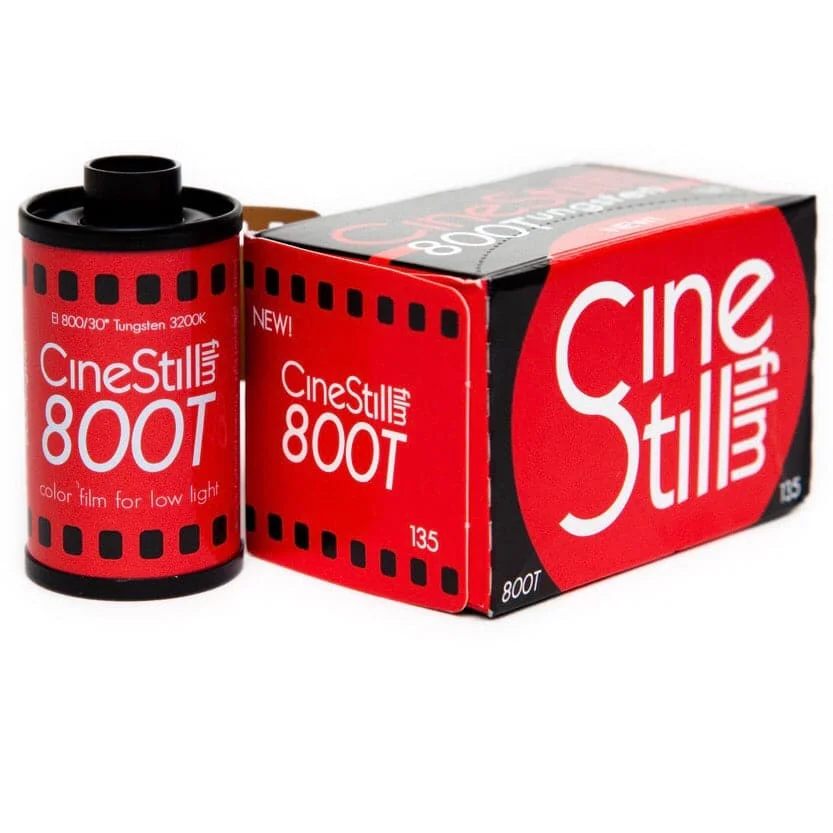
CineStill 800T is Kodak Vision3 500T (5219) with the remjet pre-removed, respooled into 135 cartridges, and marketed at a higher box speed. CineStill 400D is Vision3 250D (5207), same treatment. The company buys bulk cinema stock from Kodak, strips the backing in a controlled environment, repackages it for still cameras, and sells it at a premium. The value proposition is access: you get cinema-grade emulsion without needing a specialised lab.
There is a side effect. Removing the remjet also removes the anti-halation protection. When you shoot CineStill 800T under neon signs or sodium street lamps, the light passes through the emulsion, bounces off the film base, and re-exposes the emulsion from behind — creating the distinctive red-orange halation glow that has become CineStill's signature aesthetic. That glow is not a feature of the emulsion. It is an artefact of the missing layer. People love it.
The red halation glow that defines CineStill's look is not a feature of the emulsion. It is an artefact of a missing layer — and Kodak's new AHU coating may eliminate it entirely.
What the AHU Replacement Means
Kodak's new Anti-Halation Undercoat (AHU) replaces remjet with a layer that dissolves in standard photographic processing chemistry. It still blocks halation — that is its primary function — but it does not require the ECN-2 pre-bath to remove. In theory, a C-41 lab could process AHU-coated Vision3 film without any special handling. The anti-static properties are handled by the new formulation as well, though Kodak has not published detailed technical specifications yet.
The implications are significant. For decades, the remjet layer was the barrier that kept cinema film out of still photography labs. With AHU, that barrier dissolves — literally. A photographer could buy Vision3 stock in bulk, spool it into reusable cartridges, shoot it in a 35mm still camera, and drop it at any C-41 lab for processing. No remjet contamination, no special requests, no refusals at the counter.
The transition is gradual. Kodak has not announced a hard cutoff date for remjet-backed stock. Existing inventory will continue to circulate for months or longer, and the changeover timeline varies by format and market. But the direction is clear: remjet is being phased out.
Will CineStill 800T Still Exist?
This is the question every CineStill shooter is asking. There are several scenarios worth considering.
- Scenario 1: CineStill pivots to the aesthetic. If the new AHU layer effectively blocks halation, then Vision3 processed in C-41 will look different from current CineStill — cleaner highlights, no red glow. CineStill could continue to offer a product with the anti-halation layer intentionally removed, preserving the halation aesthetic that built their brand. The value proposition shifts from “we make cinema film processable in C-41” to “we deliver the halation look that the stock film no longer provides.”
- Scenario 2: CineStill becomes redundant. If photographers can buy Vision3 directly, spool it themselves, and process it at any C-41 lab, the core reason to pay the CineStill premium disappears. The halation glow was a happy accident, not the original selling point. Many shooters chose CineStill for the emulsion, not the artefact.
- Scenario 3: CineStill diversifies. The company has already expanded beyond respooled Vision3. CineStill offers chemistry kits, development tanks, and other darkroom products. A future where the film line shrinks but the brand survives on adjacent products is plausible.
None of these scenarios are certain. The AHU layer's exact behaviour in C-41 chemistry, the timeline for full adoption, and CineStill's strategic response are all unknowns. What is certain is that the relationship between Kodak's cinema division and the still photography market just changed fundamentally.
What This Means for Photographers
The most immediate practical impact: more lab access for cinema stocks. If you have avoided Vision3 because your local lab refuses ECN-2 film, the AHU transition removes that obstacle. Once AHU-coated stock reaches retail, any lab running C-41 lines can process it. That opens Kodak's cinema emulsions — widely regarded as some of the finest colour negative films ever manufactured — to a much broader audience.
For CineStill devotees who shoot specifically for the halation glow, the picture is less clear. If AHU blocks halation as effectively as remjet did, the glow goes away when you shoot AHU-coated stock. You would need to source old remjet-backed Vision3, remove the remjet yourself, or wait for CineStill to offer a halation-specific product. The aesthetic that defined a generation of night photography may become harder to achieve, not easier.
Either way, 2026 is a pivotal year for cinema film in still cameras. Experiment now while both versions of Vision3 are available. Shoot a roll of CineStill 800T under neon. Shoot a roll of AHU-coated Vision3 500T under the same conditions. Compare. That side-by-side is going to be one of the most talked-about comparisons in the film community this year.
Track Your Cinema Film Experiments
When you are testing two versions of the same emulsion under identical conditions, notes are not optional — they are the experiment. Which roll was the remjet version? Which was AHU? What ISO did you rate each at? Which frames had the strongest point light sources? Without a log, your side-by-side is just two unmarked rolls and a guess.
Pellica's film roll tracker lets you tag each roll with its exact stock — Vision3 500T, CineStill 800T, or whatever you load — and log per-frame notes on lighting, metering, and intent. The built-in light meter helps you meter consistently across comparison rolls, and the lab finder locates C-41 services near you when your test rolls are ready for processing.
The film market is shifting. The photographers who document their experiments are the ones who will understand what the shift actually means for their work.