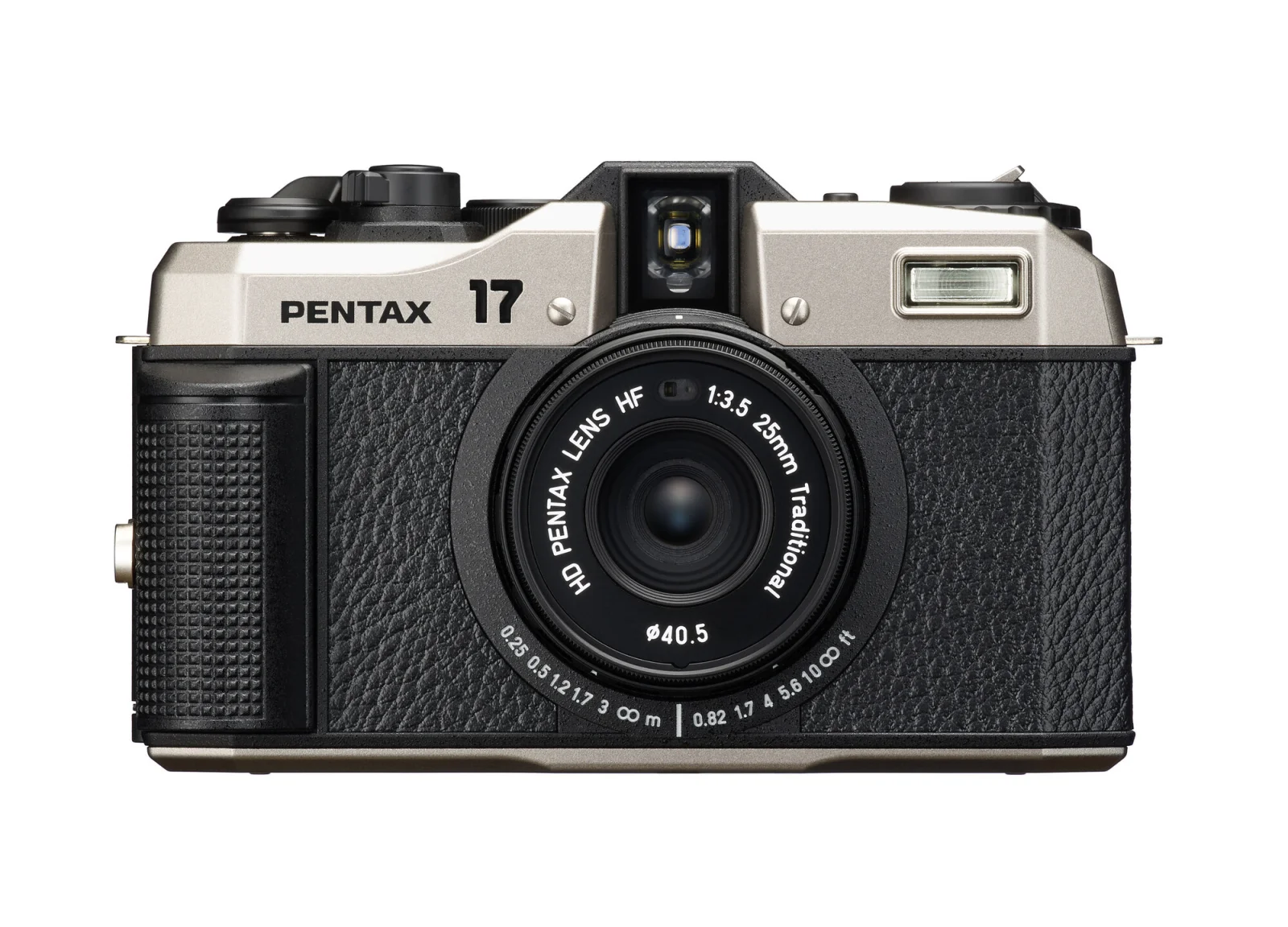
In the summer of 2024, Pentax did something no major camera manufacturer had done in decades: it released a brand-new film camera. The Pentax 17, a compact half-frame 35mm body, was met with immediate demand that outstripped supply for months. It proved that there was a genuine, commercially viable market for new film hardware — not just from boutique startups, but from a legacy brand with real engineering resources.
That success raised an obvious question: what comes next? Rumors pointed to an affordable compact, two SLR models, and a broader roadmap under Ricoh's Pentax Film Project initiative. Eighteen months later, none of those have materialized. The lead designer has retired, the project page has disappeared from Ricoh's website, and CP+ 2026 came and went without a single film camera announcement. The Pentax Film Project is not dead — but it is clearly not moving forward on the timeline anyone expected.
The Pentax 17 sold out for months and proved new film cameras can find an audience. Eighteen months later, the follow-up is nowhere in sight.
TKO's Retirement and What It Means
Takeo Suzuki, known within the photography community as “TKO,” was the heart of the Pentax Film Project. A veteran Pentax engineer with decades of experience, TKO led the design of the Pentax 17 from concept through production. He was also the public face of the project — appearing at trade shows, engaging with the community on social media, and articulating the vision for why Pentax should invest in new film bodies when the rest of the industry had moved on.
TKO retired in March 2025. His departure was announced quietly, with minimal fanfare. Ricoh issued a statement saying that his retirement “does not affect the possibility of future film camera models” — the kind of carefully worded corporate language that confirms nothing and reassures no one. Losing a project champion at any company is significant. Losing the person who conceived, designed, and evangelized the only new film camera from a major manufacturer is a different category of loss entirely.
The film photography community has been watching closely for signs of who, if anyone, has taken over TKO's role. So far, no one has stepped into the spotlight. That silence is itself a signal.
The Disappearing Webpage
Sometimes the most telling signs are the quietest. At some point in late 2025, the dedicated Pentax Film Project page was removed from Ricoh's official website. There was no announcement, no explanation. The page that once laid out the company's vision for new film cameras — complete with concept images and a stated commitment to the analog format — simply vanished.
Companies remove pages for different reasons. It could be a routine website reorganization. It could be that the project has been absorbed into a broader product strategy that does not need its own landing page. Or it could be that the initiative has been deprioritized to the point where maintaining a public-facing page felt like making a promise Ricoh was no longer confident it could keep.
None of these explanations are confirmed. But the optics are not encouraging. A company actively developing new film cameras has every reason to keep that page live and updated. A company that has quietly shelved the project has every reason to remove it.
What Was Rumored
Before TKO's retirement and the webpage removal, the rumor mill around the Pentax Film Project was active and optimistic. Multiple sources pointed to at least three planned models:
- An affordable compact camera — smaller and cheaper than the Pentax 17, aimed at first-time film shooters. This was reportedly the most advanced in development, with some sources suggesting a sub-$300 price point.
- A manual-focus SLR — a fully mechanical or semi-mechanical body in the tradition of the Pentax K1000, one of the best-selling film cameras ever made. This would target enthusiasts and students.
- An advanced SLR — with autofocus and more sophisticated metering, positioned as a professional-grade film body for serious analog photographers.
All three models are now understood to be on indefinite hold. No prototypes have been shown publicly since the Pentax 17's launch. No release dates have been hinted at. The rumor pipeline has gone quiet in a way that suggests the sources themselves have lost visibility into the project's status.
CP+ 2026: Present but Silent
Ricoh had a booth at CP+ 2026 in Yokohama, as expected. They showed the Pentax 17, their existing digital lineup, and various accessories. What they did not show was any new film hardware, any updated roadmap for the Film Project, or any indication that additional analog cameras were in development.
For context, CP+ is the largest camera trade show in Asia and one of the most important globally. If Ricoh had something to announce regarding film cameras, this would have been the venue. Canon used CP+ 2026 to debut its analog concept camera. Pentax used it to display what it already had. The contrast was not lost on the community.
Representatives at the booth reportedly deflected questions about future film models with variations of “we have nothing to announce at this time.” Corporate non-answers are standard at trade shows, but combined with the other signals, they paint a consistent picture of a project that has stalled.
Why It Matters
Pentax was the only major camera manufacturer actively investing in new film camera production. Nikon, Canon, and Sony exited the film market years ago. Leica still sells the MP and M-A but has not released a new film model in over a decade. Fujifilm discontinued its last film camera in 2017. The entire weight of “a major brand believes in film cameras” rested on Pentax — specifically, on the Pentax Film Project.
If the project is entering a prolonged pause, the implications ripple beyond one company. New film cameras from established brands validate the format. They attract new shooters who might not trust a $400 Kickstarter camera but will trust a Pentax. They create retail presence — a new film camera on a store shelf tells every passerby that analog photography is alive. Lose that, and the new film camera market reverts to small-batch startups and vintage bodies on the used market.
That is not a catastrophe. The film community thrived for years before the Pentax 17 existed. Used cameras remain abundant, and startups like PONF and Analogue are filling niches. But the symbolic weight of a Pentax or Ricoh commitment to new film hardware is hard to replace.
Track Every Roll, Whatever Camera You Shoot
Whether the next Pentax film camera arrives in 2027 or never, the cameras that exist today are more than enough to make extraordinary photographs. A Pentax 17, a thrift-store K1000, a borrowed Olympus OM-1 — the camera matters less than what you do with it and how you learn from each roll.
Pellica's film roll tracker lets you log every frame with your camera, lens, film stock, and exposure settings. Over time, that record becomes a personal reference — patterns in what works, what doesn't, and how your eye evolves. The built-in light meter helps nail exposure on any body, and the lab finder connects you with development services near you.
New cameras come and go. Your process is what compounds.