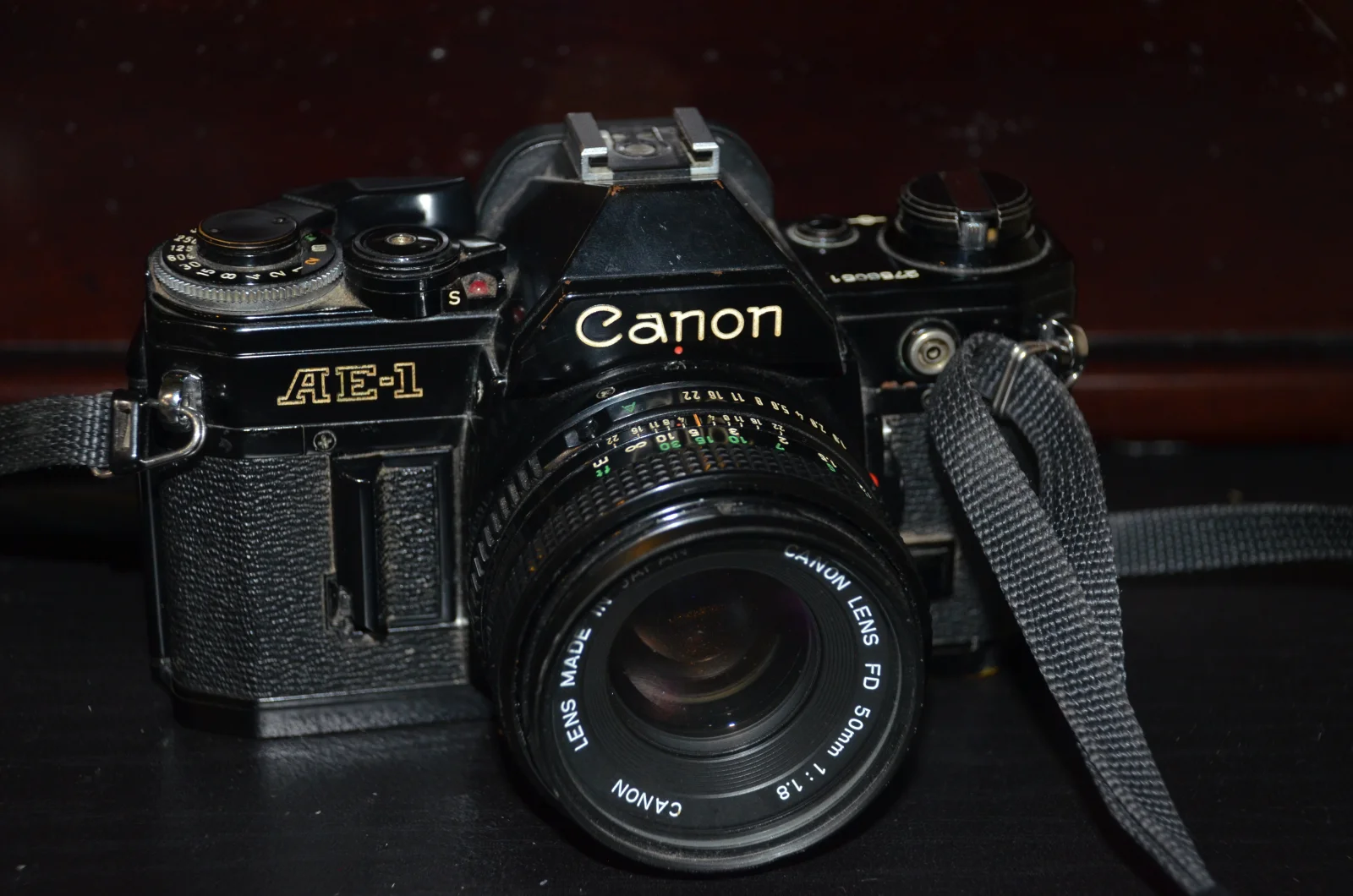
The Canon AE-1 turns 50 this month. Launched in April 1976, it was the camera that made SLR photography accessible to people who had never considered owning one. Half a century later, it remains one of the most recognizable film cameras ever made — and one of the most frequently recommended to beginners entering analog photography. Canon, however, says it has no plans to celebrate the anniversary. The internet disagrees.
The Canon AE-1 democratized the SLR fifty years ago. Canon says it has no anniversary plans. Leaked prototypes and persistent rumors suggest otherwise.
The Camera That Made SLRs Mainstream
Before the AE-1, single-lens reflex cameras were professional tools. They were heavy, expensive, and required manual control of every exposure variable. The AE-1 changed that equation by embedding an electronic microprocessor into the camera body — the first SLR to do so at a consumer price point. Shutter-priority automatic exposure meant the camera could set the aperture for you. You picked the shutter speed, pressed the button, and got a properly exposed frame most of the time.
Canon also broke convention with marketing. The AE-1 was advertised not to professionals but to families, hobbyists, and casual shooters — the tennis player, the soccer parent, the weekend traveler. The messaging was aspirational without being intimidating. Photography, Canon argued, was for everyone. The price was under $300 with a 50mm f/1.8, which put a real SLR within reach of the middle class for the first time.
The strategy worked. Canon sold over five million AE-1 units, making it one of the best-selling cameras in history. More importantly, it created the template that every consumer camera since has followed: automation to lower the barrier, marketing to broaden the audience, and a price that makes the purchase feel reasonable rather than extravagant.
CP+ 2026: What Canon Showed
At CP+ 2026 in Yokohama this February, Canon displayed a retro concept camera that drew significant attention. It featured a waist-level viewfinder, a deliberately modest 6-megapixel sensor, and no rear LCD. Canon presented it as a “slow photography” device — a digital camera designed to feel analog. The design language was unmistakable: rounded edges, chrome accents, a form factor that referenced mid-century cameras without directly copying any one model.
Canon did not call it the RE-1. Canon did not link it to the AE-1 anniversary. Canon did not announce production plans. What Canon did was place a retro-styled camera in front of the largest photography trade show audience in Asia and let the internet draw its own conclusions. The conclusions were immediate and loud.
The RE-1 Rumors
Within days of the CP+ showing, rumor sites began publishing leaked specifications for a camera they called the Canon RE-1 — a retro-styled digital mirrorless positioned as the spiritual successor to the AE-1. The reported specs include a 32.5-megapixel full-frame sensor (the same unit found in the Canon R6 Mark III), a photo-focused feature set with minimal video capabilities, and a projected price around $1,999.
The positioning would fill an obvious gap in Canon's lineup. Nikon has the Zf, a retro-bodied full-frame mirrorless that has sold exceptionally well since its 2023 launch. Fujifilm has the X100VI, a compact rangefinder-style camera with a months-long waitlist that still has not fully cleared. Canon is the last major camera manufacturer without a retro-styled mirrorless offering, and the market has made it clear that the demand exists.
A photo-focused approach would differentiate the RE-1 from both competitors. The Nikon Zf is a capable hybrid camera. The X100VI shoots excellent video. If Canon deliberately limits video features to prioritize the stills experience — faster mechanical shutter, better AF for single shots, a simpler menu system — it would appeal to photographers who feel that modern cameras try to do too much.
Canon's Official Denial
In a February 2026 interview with Phototrend, Canon's Manabu Kato, head of imaging products, directly addressed the anniversary question. Canon has no plans to celebrate the AE-1's 50th birthday with a product launch, he stated. The concept camera at CP+ was exactly that — a concept. Not a preproduction prototype, not a teaser for an upcoming product, just an exploration of what a different kind of digital camera might look like.
The Phoblographer ran the story under the headline “Canon Just Said No to the One Camera Everyone Actually Wants.” Photography forums treated the denial with the skepticism that camera company denials typically receive. The reasoning is simple: manufacturers routinely deny products right up until the announcement date. Nikon denied the Zf. Fujifilm denied the X100VI timeline. Canon itself denied several R-series bodies before revealing them. An official “no” in February does not preclude an announcement later in the year.
The leaks have not stopped since the denial. Rumor sites with established track records continue to report that an announcement is expected in the second half of 2026. Whether Canon releases it as the RE-1, under a different name, or as something altogether different from what the rumors describe, the sustained leak activity suggests that some retro-oriented product is in development.
What Film Shooters Actually Want
There is an irony in the RE-1 conversation that rarely gets acknowledged. The people most excited about a retro digital camera are often the same people who already shoot film. They own AE-1s, Nikon FMs, Olympus OM-1s. They know what the analog experience feels like, and they appreciate that a digital manufacturer is trying to recreate it. But many of them do not actually want a digital retro camera — they want a new film camera.
The film community has been vocal about this for years. Producing a new mechanical SLR or rangefinder with modern manufacturing quality — better light seals, tighter tolerances, fresh foam and lubricants — would address the real pain point of the film revival: the aging supply of secondhand bodies. An AE-1 from 1976 is 50 years old. Its electronics are fragile. Its light seals are degraded. Repair parts are increasingly scarce. A new production film camera from Canon, even a limited run, would be a more fitting tribute to the AE-1's legacy than any digital homage.
That said, the economics likely do not support it. Tooling for mechanical camera production was dismantled decades ago. The demand for new film cameras, while real, is small compared to the digital market. Canon is a public company answering to shareholders who expect growth in the mirrorless segment. A retro digital camera is the commercially viable way to honor the analog aesthetic. Whether that satisfies the film community is another question.
The AE-1 Is Still Here
Regardless of what Canon announces this year, the AE-1 itself is not going anywhere. It remains one of the most popular film cameras on the secondhand market, consistently available on eBay, at camera shops, and in thrift stores around the world. The FD lens mount gives access to an enormous range of affordable glass. The shutter-priority automation still works exactly as intended, making it a genuinely useful camera for anyone learning exposure.
At 50, the AE-1 has outlived the era it was designed for and found a second life in an era nobody predicted. It is not a collector's item gathering dust on a shelf. It is a working tool, loaded with Portra or HP5 or Superia, producing images in 2026 the same way it did in 1976. That continuity is the real anniversary. No product launch required.
Track Every Roll Through Your AE-1
The AE-1's shutter-priority mode means you set the speed and the camera handles the rest. But knowing what the camera chose — what aperture it selected, under what light conditions, on which film stock — is how you learn to see light the way the meter does. Logging those details frame by frame turns a roll of film into a notebook of decisions you can review once the scans come back.
Pellica's film roll tracker lets you record exposure data, film stock, and notes for every frame as you shoot. The built-in light meter gives you a second reading to compare against the AE-1's internal meter, and the lab finder connects you with development services near you when the roll is finished.
Fifty years after its launch, the AE-1 is still teaching people how to photograph. The best way to honor that is to keep shooting it — and to remember what you shot.