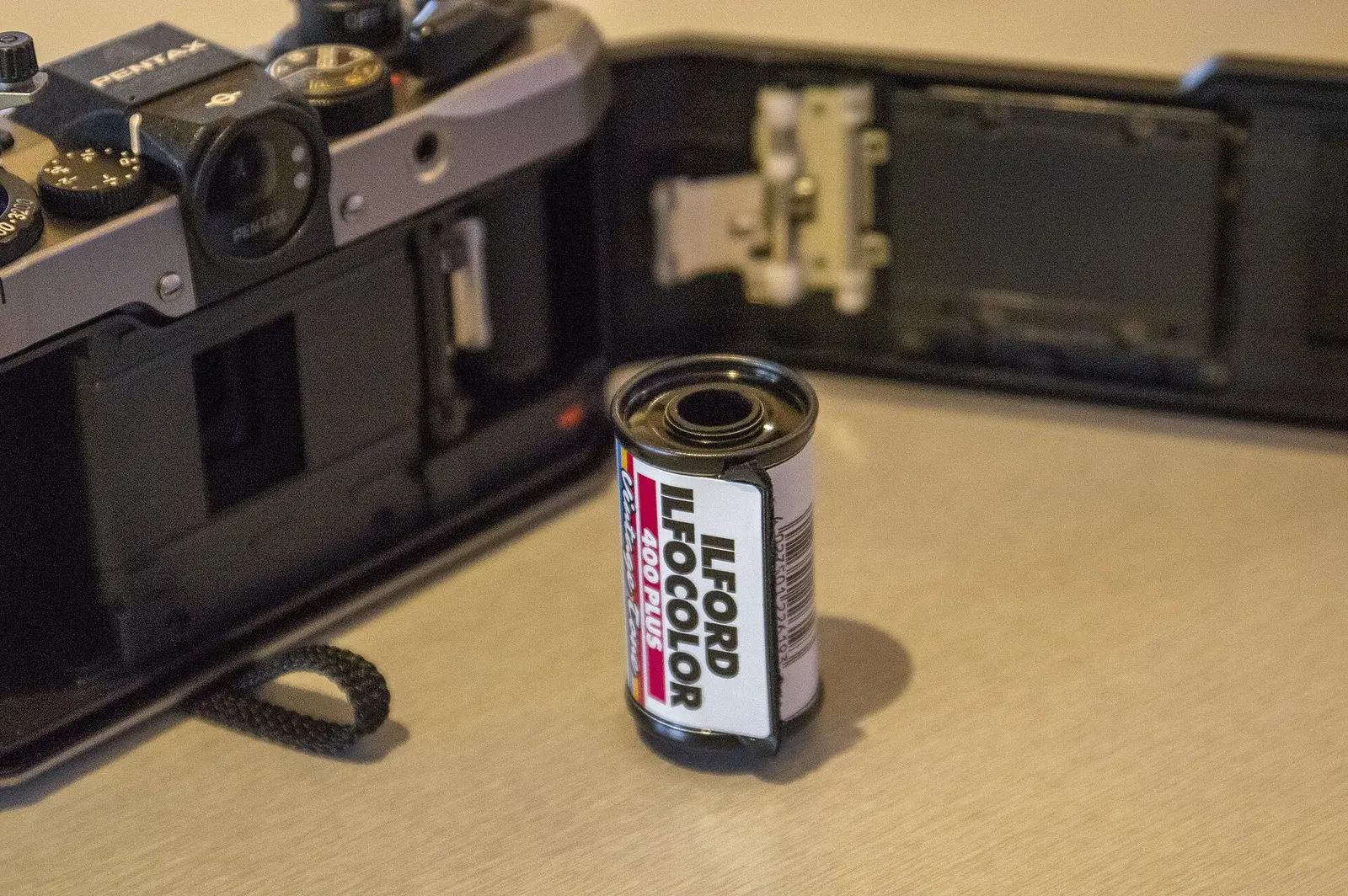
As of October 2026, the new film cameras you can actually buy are the Pentax 17 ($499.95), the Kodak EC35 ($34.99), the Polaroid Mod ($169.99), Lomography's half-frame Simple Use, Fujifilm's first black-and-white QuickSnap, and MiNT's Rollei 35AF and InstantKon RF70. The one everyone is waiting for, the Analogue aF-1, is still pre-order only: Analogue plans mass production for the fourth quarter of 2026 and has stopped giving delivery dates.
Every price below was read on the shop's own page on 10 October 2026 unless a source is named. Several of 2026's "new cameras" are digital cameras dressed as film cameras; they have their own section at the end, so you know what you are buying.
| Camera | Film | Price (10 Oct 2026) | Status | Best for |
|---|---|---|---|---|
| Pentax 17 | 35mm, half-frame | $499.95 (Ricoh US), £500 (Analogue Wonderland), €549.99 (Nation Photo) | In stock | A serious new camera, 72 frames a roll |
| Kodak EC35 | 35mm, reloadable | $34.99 (Reto), £34.99 (Analogue Wonderland) | In stock, seven colours | The cheapest reloadable with a known price |
| Lomography Simple Use half-frame | 35mm, half-frame, reloadable | €24.90 B&W, €29.90 colour (Phototrend, July) | Sold by Lomography | 40 frames preloaded, then 72 per roll |
| Fujifilm QuickSnap Black and White | 35mm B&W, ISO 400, single-use | £20.99 pre-order at Amazon UK (Digital Camera World, 28 Sept) | From September 2026, per Fujifilm | Black and white any lab can develop |
| Polaroid Mod | Instant, i-Type and 600 | $169.99, £149.99, €169.99 (Polaroid) | Sold on Polaroid's store in the US, UK, France and Spain | In-camera effects without a phone |
| Rollei 35AF | 35mm, autofocus | HK$6,240, about $800 (MiNT) | In stock | A new autofocus compact you can buy today |
| MiNT InstantKon RF70 | Instax Wide | From HK$6,900, about $885 (MiNT) | In stock | Manual-control instant photography |
| Analogue aF-1 | 35mm, autofocus | €449.99 pre-order | Not shipped; mass production planned Q4 2026 | Waiting, with a deposit down |
The aF-1 is still a queue with no published end. The Rollei 35AF is the autofocus compact you can actually buy new in 2026.
Which New Film Camera Should You Buy?
- Under $40: the Kodak EC35 if you want full frames and a price you can check, the half-frame Simple Use if you want twice the pictures from each roll.
- One roll of black and white with no fuss: the QuickSnap Black and White. It develops in ordinary colour chemistry, so any lab takes it.
- A camera to keep for years: the Pentax 17. It is the only new camera here with a choice of exposure modes, exposure compensation and zone focus.
- Autofocus, today: the Rollei 35AF. The aF-1 may be cheaper, but it does not exist in shops yet.
- Instant: the Polaroid Mod for effects on a dial, the RF70 for manual control on Instax Wide.
Pentax 17: Still the Serious Choice
Ricoh launched the Pentax 17 in 2024, and it is still sold new. On 10 October, Ricoh's US store listed it at $499.95 with $50 of film and processing included, Analogue Wonderland had it in stock at £500, and Nation Photo in France at €549.99, marked "last items in stock".
It is a half-frame camera: each picture uses half a standard 35mm frame, so a 36-exposure roll gives you 72 vertical pictures. The lens is a 25mm f/3.5, "equivalent to 37mm in 35mm format" according to Ricoh, focused by hand across six zones. There is no manual exposure mode: Ricoh lists program modes, a maximum-aperture priority, a slow-shutter mode and bulb, with ±2 EV of compensation. Half-frame halves your cost per picture and the size of each negative: plenty for screens and small prints, grainier if you print large.
A correction to earlier versions of this guide: the Pentax 17's lead designer, Takeo "TKO" Suzuki, left Ricoh Imaging in March 2025, not in 2026. Ricoh Imaging Japan said then that the film project was "not paused but seeking further feedback before committing to more models", according to Kosmo Foto. No second model has been announced since, and we found no announcement that the Pentax 17 is discontinued. Our Pentax film project report follows what comes next.
Kodak EC35: $34.99, and the Film Is the Exposure Control
The EC35 launched on 17 July 2026 as a reloadable 35mm point-and-shoot. On 10 October, Reto's own store listed all seven colours at $34.99, in stock, and Analogue Wonderland sold it at £34.99. It is made by Reto under a Kodak brand licence, not by Eastman Kodak.
It has one aperture and one shutter speed, so the film you load decides whether your pictures come out. Our EC35 article works out which film speed suits which light.
Lomography Simple Use, Now in Half-Frame
Lomography's reloadable Simple Use came out in a half-frame version on 15 July 2026. According to Phototrend, the colour edition comes loaded with LomoChrome Classicolor ISO 200 and the black-and-white one with Lady Grey ISO 400, each good for 40 pictures, and a 36-exposure roll gives up to 72 after that. It has a 21mm f/9 lens, a single 1/120 s shutter and a flash on an AAA battery. Phototrend gives €24.90 for black and white and €29.90 for colour; analog.cafe gives $29 and $35. Lomography's own shop refused our requests on 10 October, so we could not read today's price there.
The arithmetic is what makes it interesting. With a roll of Kodak Ultramax 400 at £11.95 (36 exposures, Analogue Wonderland, 10 October), each picture costs about £0.17 in a half-frame camera against about £0.33 in the full-frame EC35, before development. The negatives are half the size.
Track this in the app: Film Roll Tracker
Fujifilm QuickSnap Black and White: The First B&W QuickSnap
Fujifilm announced it on 1 July 2026 for the QuickSnap's 40th year and said it would be available "from September 2026 onward". Its specifications: black-and-white negative film at ISO 400, 27 exposures, a 32mm f/10 lens, 1/140 s and a flash that reaches 1 to 3 metres. The useful detail is in Fujifilm's announcement: it develops in the same chemistry as colour negative, "CN-16 and C-41", so you can hand it to any lab that develops colour film, at colour prices.
Fujifilm's release gives no price. Digital Camera World reported a pre-order at £20.99 on Amazon UK on 28 September. At that price each picture costs about £0.78 before development, more than twice what a roll in a reloadable costs per frame. Fujifilm has not said whose black-and-white film is inside.
Polaroid Mod: Effects on a Dial
Polaroid launched the Mod on 29 September 2026: a Polaroid Now with four creative modes on a ring around the lens. On 10 October, Polaroid's own store listed it at $169.99 in the US, £149.99 in the UK and €169.99 in France and Spain; the French, Spanish and British pages marked it in stock. It takes i-Type and 600 film. Our Mod vs Now Gen 3 comparison explains what the extra $40 over a Now Gen 3 buys.
Rollei 35AF and MiNT InstantKon RF70
Both come from MiNT in Hong Kong, and both were in stock on its own store on 10 October, priced in Hong Kong dollars. The Rollei 35AF, a compact 35mm camera with autofocus, cost HK$6,240 in chrome and HK$6,480 in black, about $800 and $830. It is the only new autofocus film compact you can buy in a shop today; our one-year retrospective gathers what owners report.
The InstantKon RF70 shoots Instax Wide with a glass lens, a coupled rangefinder and manual exposure. It cost HK$6,900 for the camera alone and HK$7,400 with the starter package, about $885 and $950.
Lomography's Other New Cameras
The Fisheye No. 2 is a refreshed version of Lomography's circular-image camera: a 10mm f/8 lens with a 170° view on ordinary 35mm film, at £59 according to Kosmo Foto. In September, Lomography added two Sprocket Rocket panoramic editions at £45 and a Ladybug Lomomatic 110, per Kosmo Foto: new colours of existing cameras. For 110 film itself, see our 110 revival report.
Upcoming Film Cameras: The aF-1
The Analogue aF-1 is a new 35mm autofocus compact, priced at €449.99 to pre-order on Analogue's site. It has not shipped. In February 2026 Analogue said its shutter "didn't yet meet our long-term durability standards", and in August it said it would not "share a delivery date" until it was confident, per Kosmo Foto. On 10 October its roadmap still read "Q4 2026: Mass production" and "Expected delivery 2026". We found no update since August. Our aF-1 status report keeps the full timeline.
Digital Cameras That Look Like Film
These are sold next to film cameras, often with film words, but none of them takes film.
- Canon's waist-level concept (CP+, February 2026): "the technology used is 100% digital", according to Phototrend, and Canon has announced no production, price or date. Earlier versions of this guide called it a film design; it is not. More in our Canon concept article.
- Kodak Charmera Millennium Edition: a 1.6-megapixel keychain camera at $34.99 a blind box, per Hi Consumption. Our Charmera guide.
- Yashica FX-D: a digital camera with a "film" advance lever and six film simulations. Our FX-D explainer.
- Yashica Crew: a 13-megapixel digital compact with a 6x zoom, per Digital Camera World; PetaPixel's headline puts it at $170.
- Escura SnapRoll: a 2-megapixel camera shaped like a 35mm film cartridge, €34 in France, per Phototrend. Its own box says it is a digital camera, not a film.
Frequently asked questions
What new film cameras came out in 2026?
The Kodak EC35 (July, $34.99), Lomography's half-frame Simple Use (July), Fujifilm's QuickSnap Black and White (from September), the Polaroid Mod (29 September, $169.99) and the Lomography Fisheye No. 2. The Pentax 17, Rollei 35AF and MiNT InstantKon RF70 are still sold new. The Analogue aF-1 has not shipped as of October 2026.
What is the best new film camera in 2026?
For most people who want one camera to keep, the Pentax 17: $499.95 at Ricoh US on 10 October 2026, half-frame, with several automatic exposure modes and exposure compensation. For autofocus you can buy today, the Rollei 35AF. For under $40, the Kodak EC35.
When will the Analogue aF-1 ship?
Analogue has not given a date. Its roadmap on 10 October 2026 placed mass production in the fourth quarter of 2026 and said delivery was expected in 2026; in August the company said it would announce a delivery timeline only once it was confident.
What is the cheapest new film camera in 2026?
Among reloadable cameras, the Lomography Simple Use half-frame (€24.90 in black and white, per Phototrend) and the Kodak EC35 ($34.99). Fujifilm's QuickSnap Black and White single-use camera was on pre-order at £20.99 on Amazon UK in September, but it cannot be reloaded.
Is the Canon waist-level concept a film camera?
No. The prototype Canon showed at CP+ 2026 is digital, and Canon has announced no production, price or release date.
Track Every Camera, Every Roll
Whichever camera you choose, new or used, half-frame or full-frame, what you learn comes from comparing your results with the settings that produced them. Pellica makes that easy: add your cameras, create a roll when you load film, and log each frame with a quick tap. The built-in light meter helps with fixed-exposure cameras like the EC35, and the lab map finds who develops your rolls, including the QuickSnap's black and white in C-41.
Correction, 10 October 2026: earlier versions said the Pentax 17's designer left Ricoh in early 2026 (it was March 2025, and his name is Takeo Suzuki), gave the Fisheye No. 2 as "around $69" per Kosmo Foto (Kosmo Foto gives £59), described Canon's CP+ concept as a film camera design (it is digital), and gave the Pentax 17's lens as 50mm-equivalent (Ricoh says 37mm).