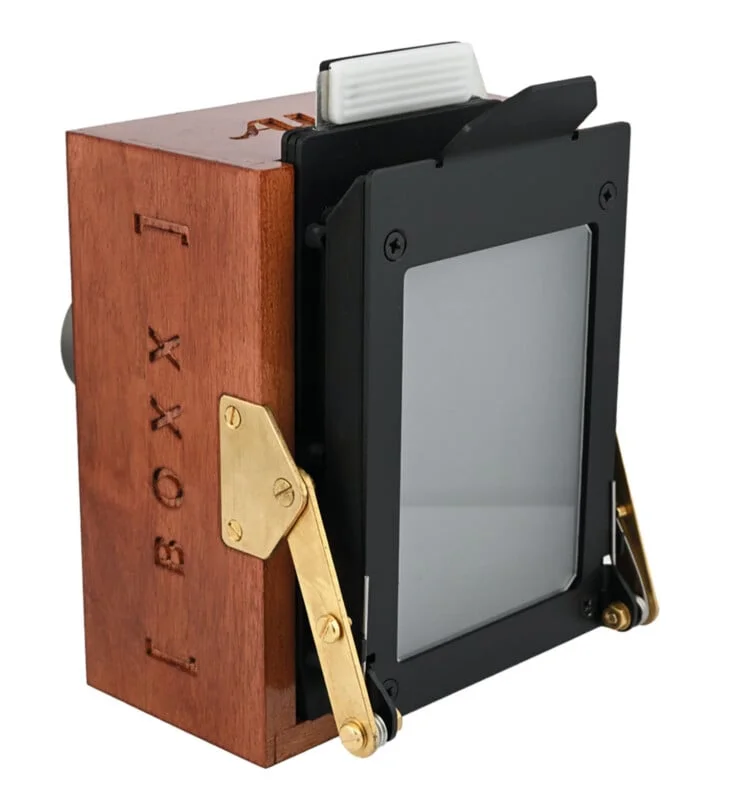
What if you could watch a photograph develop in your hands, sixty seconds after pressing the shutter? Not a Polaroid. Not a phone screen. A 6x9cm black-and-white reversal print, materializing inside the camera body itself. That's the promise of the Alfie Boxx — a modular medium format camera announced on March 19, 2026, by UK-based Alfie Cameras. You expose a frame, inject processing chemistry through a syringe port, and the image appears before your eyes. No darkroom. No lab. No waiting. It's heading to Kickstarter in spring 2026, and nothing else on the market comes close.
A camera that develops its own photographs. Not as a gimmick — as a new way of thinking about what film can do.
Syringe, Chemistry, and Sixty Seconds of Magic
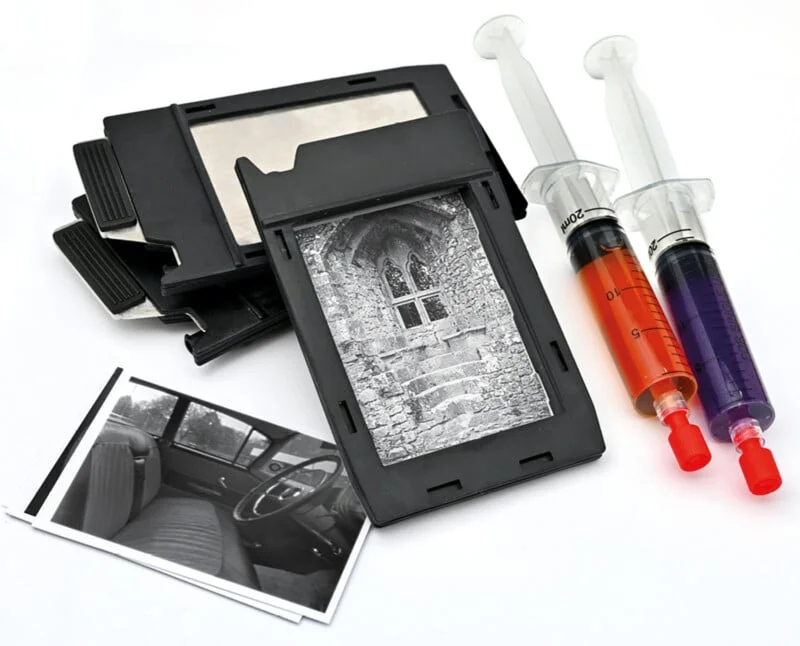
The Boxx shoots B&W reversal film in 6x9cm format — a generous medium format frame with far more detail and tonal range than 35mm or even 6x6. But here's where it diverges from every other camera: after exposing a frame, you don't advance the film. You pick up a syringe, insert it into a built-in port on the camera body, and inject processing chemicals directly into a sealed chamber around the exposed film.
The chemistry flows across the emulsion. The image develops in real time. You watch it appear.
What you get is a positive print — a reversal, not a negative. That distinction matters. There's no inversion step, no darkroom enlarger, no scanning. You hold the final image in your hands minutes after the shutter fires. Think Polaroid — but on proper medium format film with the resolution and tonal depth that implies.
Alfie Cameras hasn't disclosed every detail of the chemical process, but the principle of in-camera reversal processing isn't new. The breakthrough is the engineering: making it reliable and repeatable inside a portable body. Temperature control, even chemical distribution, light sealing during development — each of these is a serious technical challenge. The Boxx claims to have solved all of them.
Three Lenses, Three Ways to See
The Boxx ships with (or offers as options) three interchangeable lenses, each built for a different kind of photograph:
- 100mm f/8 portrait lens — A moderate telephoto for 6x9, equivalent to about 45mm on 35mm film. The f/8 maximum aperture keeps the lens compact and sharp across the frame, though you'll want decent light or a tripod.
- 55mm f/11 landscape lens — A wide-angle option with massive depth of field. On 6x9, 55mm gives you a perspective close to 24mm on 35mm — wide enough for sweeping scenes without extreme distortion.
- 65mm f/190 pinhole — Yes, f/190. No glass, just a precision aperture. Exposures run long, results come out dreamy and soft, and that's the entire point. Pinhole photography on medium format reversal film, developed in-camera — has anyone written that sentence before?
The interchangeable mount means the system can grow. Additional focal lengths, specialty lenses, even third-party optics could follow. For a camera this unconventional, modularity keeps the platform alive long after the initial novelty fades.
Who Would Shoot With This?
The Boxx doesn't compete with a Mamiya RB67 or a Fuji GW690. It occupies a category that barely exists: experiential analog photography, where making and developing the image matters as much as the image itself. This is a camera for people who want to slow down beyond what even traditional film demands.
Workshop instructors get a portable, self-contained tool to teach photographic chemistry. Fine art photographers can fold development artifacts — uneven chemistry, edge effects, the slight imperfections of in-camera processing — into process-driven projects. Street photographers who want to hand a stranger a finished print on the spot have a way to do it.
And the 6x9 format gives the output real presence. You're not squinting at a tiny rectangle. A 6x9cm reversal print is large enough to pin on a wall, slip into a journal, or hand to someone who'll remember it. The size turns each frame into a finished object — not a curiosity.
The Crowdfunding Gamble
Alfie Cameras plans to launch the Boxx on Kickstarter in spring 2026, pricing still to be announced. The timeline hits the crowdfunding sweet spot — early enough to build buzz, late enough (hopefully) for production-ready prototypes. But the usual hardware Kickstarter caveats apply: delays happen, first-run quality varies, and the gap between prototype and mass production is where most projects stumble.
Then there's the chemical supply chain. The Boxx needs specific B&W reversal chemistry, and long-term availability of those chemicals will determine whether the camera stays usable or becomes a beautiful shelf ornament. Alfie Cameras must either manufacture their own chemistry kits or lock in partnerships with existing suppliers. That's the kind of detail that separates a lasting product from a Kickstarter that ships once and fades away.
Still — in a market flooded with reissued point-and-shoots and retro-styled digital cameras pretending to be analog, the Boxx is doing something nobody else is attempting. It's not nostalgia. It's invention. And that alone makes it worth watching.
When Every Frame Is a Chemistry Experiment
Here's the thing about a camera that develops its own film: every variable you control — or fail to control — shows up in the print. Chemistry temperature, development time, ambient conditions, the angle at which you inject the syringe. Guessing doesn't work. You need a record of what you did so you can repeat what worked and fix what didn't.
Pellica's film roll tracker lets you log every detail per frame as you shoot — camera, lens, film stock, exposure settings, and development notes. The built-in light meter helps you nail exposure on cameras with no metering of their own — which is exactly what the Boxx is. And when you want to compare your in-camera results with traditional lab processing, the lab finder connects you with services near you.
The Boxx invites you to be deliberate about every frame. Tracking what you do — and learning from it — is how you turn a fascinating experiment into a reliable creative practice.