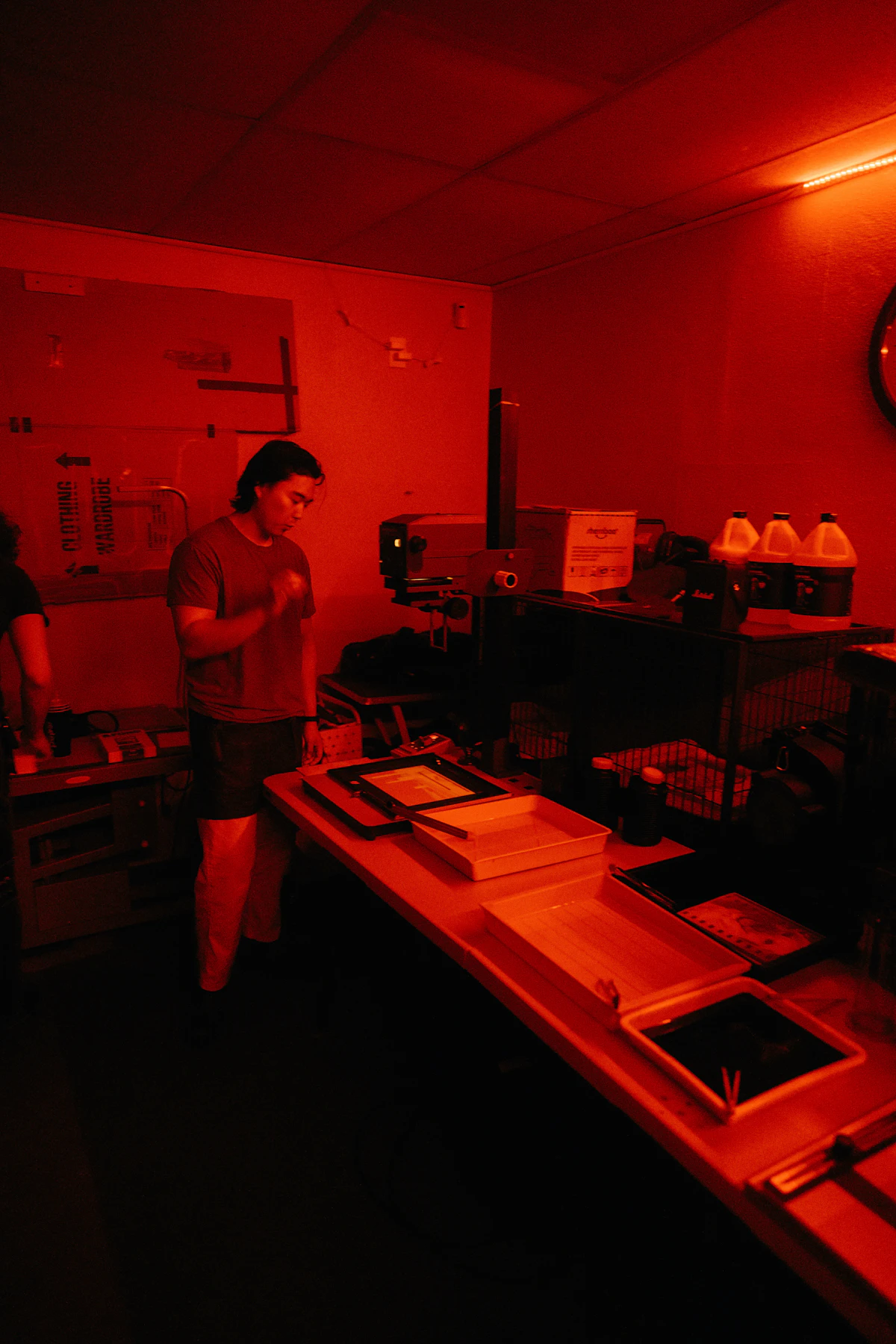
Ilford just made the strongest case yet that home developing isn't just for people with dedicated darkrooms in their basements. The company has released a Pop-Up Darkroom — an external metal frame structure with light-tight fabric panels that sets up anywhere you have a flat surface and about two square meters of space. No permanent room conversion needed. No bathroom takeover. No duct-taping towels under doors. Just unfold the frame, zip the panels, and you're working in complete darkness.
Ilford built a portable darkroom you can set up in your backyard. Home developing just lost its biggest barrier to entry.
The Pop-Up Darkroom: What It Actually Is
The structure stands roughly 2.2 meters tall with a 1.3 × 1.3 meter workspace inside. The frame is metal — sturdy enough to hang a safelight from and attach a small shelf, but light enough for one person to move around. The walls are multi-layer light-tight fabric panels with overlapping zipped entries that maintain darkness even when you're stepping in and out.
Ilford designed this for loading film onto reels and doing contact prints or small enlargements. The footprint is compact enough for a garage corner, a spare room, a garden shed, or even an outdoor patio on a calm evening. When you're done, the whole thing collapses and stores flat. Think of it as a photography-specific pop-up tent — purpose-built for the one task where you genuinely need total darkness.
This solves the single biggest practical barrier to home developing: most people don't have a light-tight room. Changing bags work for loading film onto reels, but they're cramped and frustrating. Converting a bathroom costs time and money, and nobody wants to explain to their housemates why the shower is full of chemical trays at 11 PM. The Pop-Up Darkroom sits between a changing bag and a permanent darkroom — enough space to work comfortably, total darkness when sealed, and zero permanent modification to your living space.
The Darkroom Starter Kit
Alongside the Pop-Up Darkroom, Ilford has partnered with Paterson to release a Darkroom Starter Kit containing everything a beginner needs to develop film at home. Paterson has been making developing tanks and reels for decades — their equipment is the standard recommendation in every home developing guide, and for good reason. The tanks are indestructible and the reels, once you learn the loading technique, work reliably every time.
The kit includes a Paterson developing tank with reels (handling both 35mm and 120 film), measuring graduates, a thermometer, film clips, and Ilford's own chemistry set for black & white processing. The chemistry covers Ilfosol 3 developer, Ilfostop stop bath, and Rapid Fixer — a standard combination that handles the vast majority of B&W stocks. Ilford hasn't announced the exact retail price yet, but bundling these components typically saves 20–30% over buying each item individually.
The strategic thinking here is obvious: if Ilford provides the darkroom space (Pop-Up) and the developing equipment (Starter Kit), the only remaining purchase is film — which Ilford also makes. They're building a complete on-ramp for new home developers, and every person who starts developing at home is a customer who buys more film.
The 35mm Gift Calendar
Ilford also announced a 35mm Gift Calendar with 12 doors, each containing a different roll of film from the Ilford and Kentmere ranges. It's an advent calendar for film photographers — open a door, get a roll you might not have tried before. The lineup reportedly includes HP5+, FP4+, Delta 400, Delta 3200, Kentmere 400, and several others.
This is a smart move for building brand loyalty among newer shooters. Someone who has only ever shot HP5+ might discover they love the finer grain of FP4+ or the push-ability of Delta 3200. Each roll becomes an experiment, and experiments drive engagement. If you're tracking your rolls — noting which stock was in the camera, what settings you used, how the results looked — a sampler calendar like this becomes a structured learning exercise rather than random shooting.
The Price Reality Check
Before we get too excited, let's talk about what film actually costs right now. Ilford HP5+ and FP4+ in 120 format currently run about $11 per roll. A 25-sheet box of 4x5 HP5+ sits at $95. These prices reflect the combined pressure of raw material costs, manufacturing capacity, and tariff-driven price adjustments that have hit the entire photographic supply chain over the past year.
For 35mm shooters, HP5+ and FP4+ are still around $8–9 per roll, which is reasonable by 2026 standards. Kentmere 400, Ilford's budget-friendly option, comes in slightly cheaper. Color film from Kodak and Fujifilm runs higher — Portra 400 is pushing $14–16 per roll depending on your retailer.
This is exactly why home developing makes financial sense. At lab prices of $10–15 per roll for develop-and-scan, a regular shooter spends $40–60 per month on processing alone. Home developing drops that to $1–2 per roll once you have the equipment. The Ilford Starter Kit pays for itself within a month or two of regular shooting.
Realistic Cost Breakdown: Getting Started in 2026
Here's what a complete home developing setup looks like financially, including the new Ilford products:
The Darkroom Space: Ilford Pop-Up Darkroom (estimated $150–200), or a changing bag ($25–40) if you only need darkness for film loading. The Pop-Up gives you room for contact prints and enlargements. A changing bag limits you to tank loading only.
Developing Equipment: Ilford x Paterson Starter Kit (estimated $60–80), or individual pieces — Paterson tank ($30–35), reels ($10–15), thermometer ($10), graduates ($8–12), film clips ($5).
Chemistry: Ilford B&W chemistry set included in the Starter Kit handles approximately 15–20 rolls. Replacement chemistry runs about $25–30 for developer, stop, and fixer — enough for another 15–20 rolls. That works out to roughly $1.50 per roll for chemicals.
Scanning: A dedicated film scanner like the Plustek 8200i runs $300–350. Budget option: a smartphone scanning setup with a light table ($30–50) and a scanning app. Not as sharp as a dedicated scanner, but perfectly usable for web and social media.
Total entry cost: $250–350 for a basic setup (changing bag, Starter Kit, smartphone scanning), or $500–700 for the full experience (Pop-Up Darkroom, Starter Kit, dedicated scanner). Either way, the ongoing cost per roll drops to $1–2 for B&W developing, which means the setup pays for itself within 25–50 rolls compared to lab processing.
Home Developing Is Having a Renaissance
Ilford releasing these products isn't a gamble — it's a response to demand they're already seeing. YouTube tutorials on film developing consistently pull millions of views. Reddit's darkroom communities are more active than they've been in years. Film photography workshops that include a developing component sell out fast.
The pattern makes sense. As film prices rise, the cost of lab processing becomes harder to justify for regular shooters. Home developing offers a way to keep shooting film affordably. It also deepens the connection to the craft — there's a qualitative difference between dropping off a roll and getting scans back, versus pulling your own negatives out of the fixer and seeing frames you created from exposure through development. The process becomes the point, not just the result.
Ilford's products lower the practical barriers. The Pop-Up Darkroom eliminates the need for a dedicated room. The Starter Kit removes the guesswork of assembling equipment. The Gift Calendar encourages experimentation with different stocks. Together, they form a complete ecosystem designed to turn curious photographers into committed home developers.
There's a qualitative difference between getting scans back from a lab and pulling your own negatives out of the fixer. The process becomes the point, not just the result.
Track Every Roll, From Loading to Development
Home developing creates a tighter feedback loop than lab processing, but only if you're tracking what you do. Which developer did you use? What dilution? What temperature and agitation schedule? How did that compare to the last time you developed the same stock? Without notes, you're guessing. With notes, you're building a system.
Pellica's film roll tracker captures your shooting data frame by frame — stock, ISO, exposure settings, location, and notes — so when you develop at home, you can match every negative to the conditions that created it. The lab finder is still there for rolls you want professionally processed, and the built-in exposure tools help you nail your metering before the film ever hits the tank.
Whether you're setting up Ilford's Pop-Up Darkroom for the first time or developing your hundredth roll, the principle is the same: the more you know about what you did, the better your next roll will be.