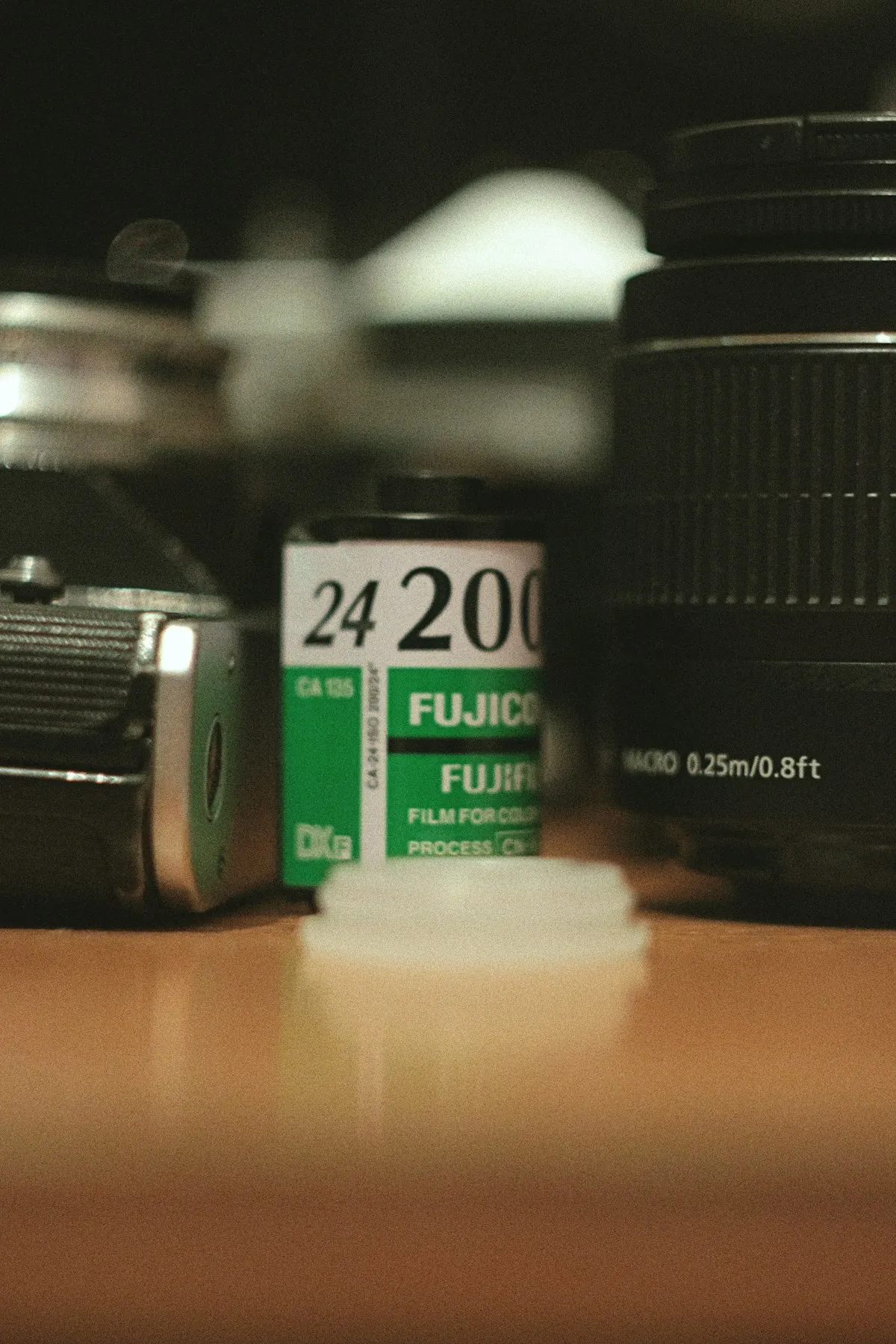
ISO is the single most important number on a box of film. It tells you how sensitive the emulsion is to light, and that sensitivity determines where and when the film performs best. Pick the wrong ISO for your situation and you'll fight your camera all day — too slow a film indoors means blurry handheld shots, too fast a film on a bright beach means you can't open up your aperture without overexposing.
Unlike digital cameras where you change ISO between frames, film locks you in for the entire roll. That constraint forces you to think about light before you load the camera, and choosing well makes everything else easier.
What ISO Actually Means
ISO stands for the International Organization for Standardization, which defined the scale we use today. Before ISO, the same concept went by ASA (American Standards Association) and DIN (the German system). You'll still see ASA on older cameras and light meters — the numbers are identical to ISO.
The scale is linear: ISO 400 film is twice as sensitive to light as ISO 200, which is twice as sensitive as ISO 100. Each doubling represents one stop of exposure. Higher ISO means larger silver halide crystals in the emulsion, which is why faster films show more visible grain — you're literally seeing bigger crystals in the final image.
Unlike digital, you can't change ISO between frames. That constraint forces you to think about light before you load the camera — and choosing well makes everything else easier.
ISO 50-100: Maximum Detail, Maximum Light Required
Slow films in the ISO 50-100 range produce the finest grain and highest resolving power. The tradeoff is obvious: these films need plenty of light. Bright sun, a tripod, or wide apertures — often all three.
Kodak Ektar 100 is the finest-grained color negative film in current production. Colors are vivid and saturated with a slight cool bias and punchy contrast. Landscapes, architecture, and bold color scenes benefit most. Skin tones can lean ruddy, so it's not the first choice for portraits.
Fuji Velvia 50 is a slide film (E-6 process) with razor-thin exposure latitude. Half a stop off and you'll see it. But when you nail the exposure — emerald greens, deep saturated skies, grain so fine it's nearly invisible. A reliable light meter is non-negotiable with Velvia.
Best for: Landscapes, studio, product photography. Bright conditions only.
ISO 200: The Daylight Sweet Spot
ISO 200 films offer a nice balance: grain is still very fine, but you get one extra stop of flexibility compared to ISO 100. On a sunny day you can comfortably shoot at f/8 and 1/250s. On an overcast day, you're still workable at wider apertures.
Kodak Gold 200 defined casual photography for decades. Warm, slightly saturated tones with amber-golden highlights that make everything look like a memory. At roughly half the price of Portra, Gold is the stock to load when you want to shoot freely.
Kodak ColorPlus 200 is the budget sibling — similar colors but slightly less saturated with a more neutral rendering. An excellent learning film at a price that encourages experimentation.
Best for: Sunny outings, vacations, casual portraits, any situation where warmth and nostalgia serve the image.
ISO 400: The Versatile Standard
If you could only shoot one film speed for the rest of your life, ISO 400 would be the rational choice. It handles bright daylight, overcast conditions, indoor window light, and even dim interiors with a steady hand or wide aperture. The grain is present but controlled on modern 400-speed emulsions, and the latitude on color negatives is generous.
Kodak Portra 400 is the benchmark. Fine grain, beautiful natural skin tones, and exposure latitude that borders on absurd — three stops overexposed and the results still look gorgeous, just creamier and more pastel. Many photographers deliberately rate it at ISO 200 for that overexposed aesthetic.
Ilford HP5 Plus 400 is the B&W equivalent of Portra in versatility. Smooth tonal range, classic grain, wide latitude. Pushes cleanly to 800 and respectably to 1600.
Kodak Tri-X 400 delivers punchier contrast and slightly more pronounced grain than HP5. Deeper shadows, brighter highlights, a gritty character that defined an era of photojournalism. The choice between HP5 and Tri-X is a matter of taste.
Fuji Superia 400 sits in the middle ground of color rendition — cooler than Kodak stocks with vivid greens and blues. A reliable, affordable all-rounder.
Best for: Everything. Portraits, street, travel, events, everyday shooting.
ISO 800: When the Light Gets Low
ISO 800 films let you shoot handheld in conditions that would leave slower films struggling. Indoor events, overcast evenings, dimly lit cafes, golden hour in the shade — 800-speed stocks keep your shutter speeds fast enough to avoid camera shake.
Kodak Portra 800 inherits the natural color rendering of its slower sibling with a noticeable step up in grain. The extra speed makes it practical for indoor events and late afternoon light where Portra 400 would need you to shoot wide open.
CineStill 800T is motion picture stock adapted for C-41 processing. The “T” means tungsten-balanced — designed for warm artificial light, giving daylight shots a cool blue cast. Under streetlights and neon, it produces a cinematic look with characteristic halation around bright point light sources. A specialty stock, not an everyday film, but for nighttime urban photography there's nothing else quite like it.
Best for: Indoor events, low light handheld, night photography (800T specifically).
ISO 1600-3200: Extreme Low Light
Films at this speed exist for situations where slower stocks simply can't cope. Concert halls, nightclubs, dimly lit interiors without flash. The grain is heavy and unmistakable.
Ilford Delta 3200 is the go-to here. Its true sensitivity is closer to ISO 1000-1200 (the 3200 rating accounts for favorable development characteristics), but rated and processed at 3200, it delivers usable images in near-darkness. The grain is prominent, organic, and atmospheric — for documentary and concert photography, it becomes part of the visual language.
Best for: Concerts, indoor documentary, any scene where flash is prohibited or undesirable.
The Exposure Triangle on Film
On a digital camera, you adjust ISO freely alongside aperture and shutter speed. On film, ISO is fixed the moment you load the roll. Your aperture and shutter speed carry the full burden of adapting to changing light. Load ISO 100 and walk into a dim restaurant, and you're stuck shooting wide open at slow shutter speeds — or accepting underexposed frames.
This is why choosing the right ISO before you load matters. Think about where you'll be shooting for the next 24-36 frames. Outdoors all day? ISO 200. Evening event? ISO 800. Mixed situations? ISO 400 is the safest compromise.
Pushing and Pulling: The Workaround
Pushing means rating your film at a higher ISO than box speed and extending development time to compensate. Pulling is the reverse. Both techniques alter contrast and grain, and neither is a free lunch, but they expand what's possible when you're locked into a roll that doesn't match your light. Tri-X and HP5 are famously forgiving when pushed one or two stops. Track your push/pull experiments with a film roll tracker to learn which combinations work for your taste.
How to Choose: A Simple Framework
- Bright sun, outdoors all day: ISO 100-200.
- Mixed light, indoors and outdoors: ISO 400.
- Indoor events, overcast, evening: ISO 800.
- Very low light, no flash: ISO 1600-3200.
When in doubt, go one step faster than you think you need. A slightly overexposed negative is easier to work with than a badly underexposed one, especially on color film where shadow recovery is limited.
Track Your ISO Preferences with Pellica
After a few months of shooting different film speeds, patterns emerge. Maybe you gravitate toward ISO 400 for most of your work. Maybe you realize you rarely shoot below ISO 200 because you prefer the flexibility. Pellica logs the film stock and ISO for every roll, so you can look back and see which speeds actually produce your favorite images — not just which ones you thought you'd like in theory.
Combine that with per-frame exposure data from the built-in light meter, and you'll know exactly how each ISO performs in your hands, with your cameras, in the conditions you actually shoot in. That personalized knowledge is worth more than any general guide — including this one.