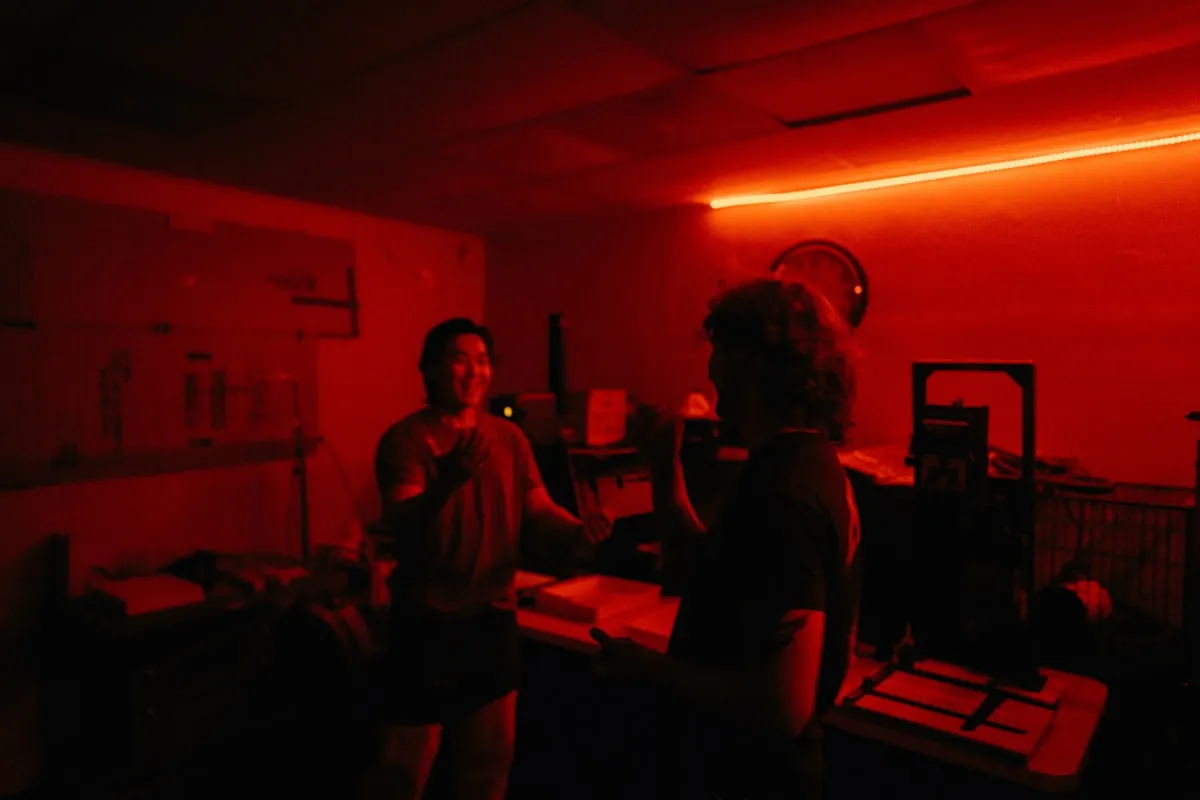
In 2025, 312 new film development labs opened worldwide. That is roughly one new lab every 28 hours, somewhere on the planet. After two decades of closures that gutted the analog infrastructure and left photographers shipping rolls across state lines, the trend has reversed. The labs are coming back — and they look different from what came before.
This is not a handful of boutique operations in Brooklyn and Shoreditch. The new wave spans community darkrooms, cooperative models, mobile processing vans, and full-service labs in cities that lost their last film processor years ago. The infrastructure is growing as fast as the demand that created it.
312 new film labs opened in 2025 — one every 28 hours. After decades of closures, the analog infrastructure is rebuilding faster than anyone predicted.
Who Is Driving This Boom
The numbers point to one demographic above all others. Gen Z photographers under 25 now represent 41% of new film photography customers — the single largest segment entering the market. Among Gen Z photography hobbyists, 68% report active use of film cameras. These are not people revisiting a childhood medium. They grew up digital and chose analog deliberately.
The demand shows up in specific stock performance. Kodak Portra 400 has seen 156% demand growth since 2020, driven by portrait and wedding photographers who want the look without the post-processing. Kodak Gold 200 grew 118% over the same period, reflecting the expansion of the entry-level market — first-time shooters grabbing the most accessible stock on the shelf.
The film photography market hit $613 million in 2026, with wholesale orders up 127% since 2020. When demand grows at that pace, infrastructure follows. Labs open because there are rolls to process. It is that straightforward.
New Lab Models: Beyond the Traditional Wet Lab
The 312 new openings are not all traditional storefronts with a Noritsu in the back. The lab landscape is diversifying in ways that reflect how people actually engage with film photography today.
- Community darkrooms offer shared access to enlargers, developing tanks, and scanning equipment for a monthly membership fee. They function like co-working spaces for analog photographers — lower cost than building your own setup, with the added benefit of being around other shooters.
- Co-op lab models pool resources among a group of photographers who share equipment, chemistry, and space. Several have launched in mid-size cities where demand exists but no commercial lab has opened yet.
- Mobile processing vans bring developing services directly to communities, events, and workshops. They eliminate the need for a fixed location entirely, serving neighborhoods that would never support a full-time lab on their own.
These models lower the barrier to lab ownership and expand access to communities that traditional commercial labs never reached. When a mobile van pulls up to a neighborhood block party or a community center, it introduces film processing to people who never would have sought it out.
The Darkroom Chicago: A Community-First Lab
One of the most significant new lab projects comes out of Chicago. The Darkroom Chicago is set to launch in 2026 as the city's first Black-owned film lab. It is not just a processing service — it is a cultural project with roots in the community it serves.
The lab honors the legacy of Photocell, a pioneering Black-owned film lab that operated in Chicago from 1979 to 1981. Photocell was ahead of its time, providing processing services and creative space to a community that mainstream photo labs often underserved. The Darkroom Chicago picks up where Photocell left off, four decades later, in a market where the demand is exponentially larger.
Central to the project is the Mobile Darkroom Initiative, which will bring film processing, photography workshops, and community archiving to South and West Side neighborhoods. This goes beyond developing rolls. It is about putting cameras and darkroom skills into the hands of people who might never walk into a traditional photo lab, and preserving community histories through the medium of film.
Projects like The Darkroom Chicago matter because they expand who participates in film photography. The analog revival is often framed as a young, affluent, aesthetically-driven movement. Community labs rewrite that narrative by making the medium accessible to people for whom it serves a different purpose entirely — documentation, education, self-expression, and collective memory.
Why Lab Access Matters for the Analog Ecosystem
Film photography has a dependency chain that digital does not. You need film stock, a camera, a lab (or home developing equipment), and often a scanner. Remove any link and the entire chain breaks. For most of the 2010s, the weakest link was lab access. Closures meant longer turnaround times, higher prices, and in many cities, no local option at all.
The 312 new labs in 2025 are rebuilding that link. More labs mean shorter shipping distances, faster turnaround, and competitive pricing. They also mean that someone who buys their first film camera on a whim has a realistic path to getting their images back — not a two-week mail order to a lab three states away.
Lab density also creates a feedback loop. When processing is easy and affordable, people shoot more film. When people shoot more film, manufacturers invest in production capacity. When production capacity grows, prices stabilize. When prices stabilize, even more people try film. Every new lab that opens accelerates this cycle.
The geographic spread matters too. New labs are opening not just in film photography's traditional strongholds — Tokyo, Berlin, New York — but in cities across Southeast Asia, Latin America, and sub-Saharan Africa. Film photography is becoming genuinely global again, and the infrastructure is following.
Find Your Nearest Lab
With 312 new labs opening in a single year, keeping track of what's available near you is a moving target. Pellica's lab finder maps over 500 film labs worldwide, so you can find processing services wherever you are — whether that is a new community darkroom in your neighborhood or a mail-order lab with next-day turnaround.
The film roll tracker lets you log every detail per frame as you shoot — stock, ISO, aperture, shutter speed, and notes — so when your rolls come back from the lab, you can match every scan to the conditions that created it. The built-in light meter helps nail exposure before the shutter fires.
The analog ecosystem is rebuilding. More film, more cameras, more labs. The infrastructure that makes film photography practical is stronger in 2026 than it has been in over a decade. The best time to shoot a roll is now.