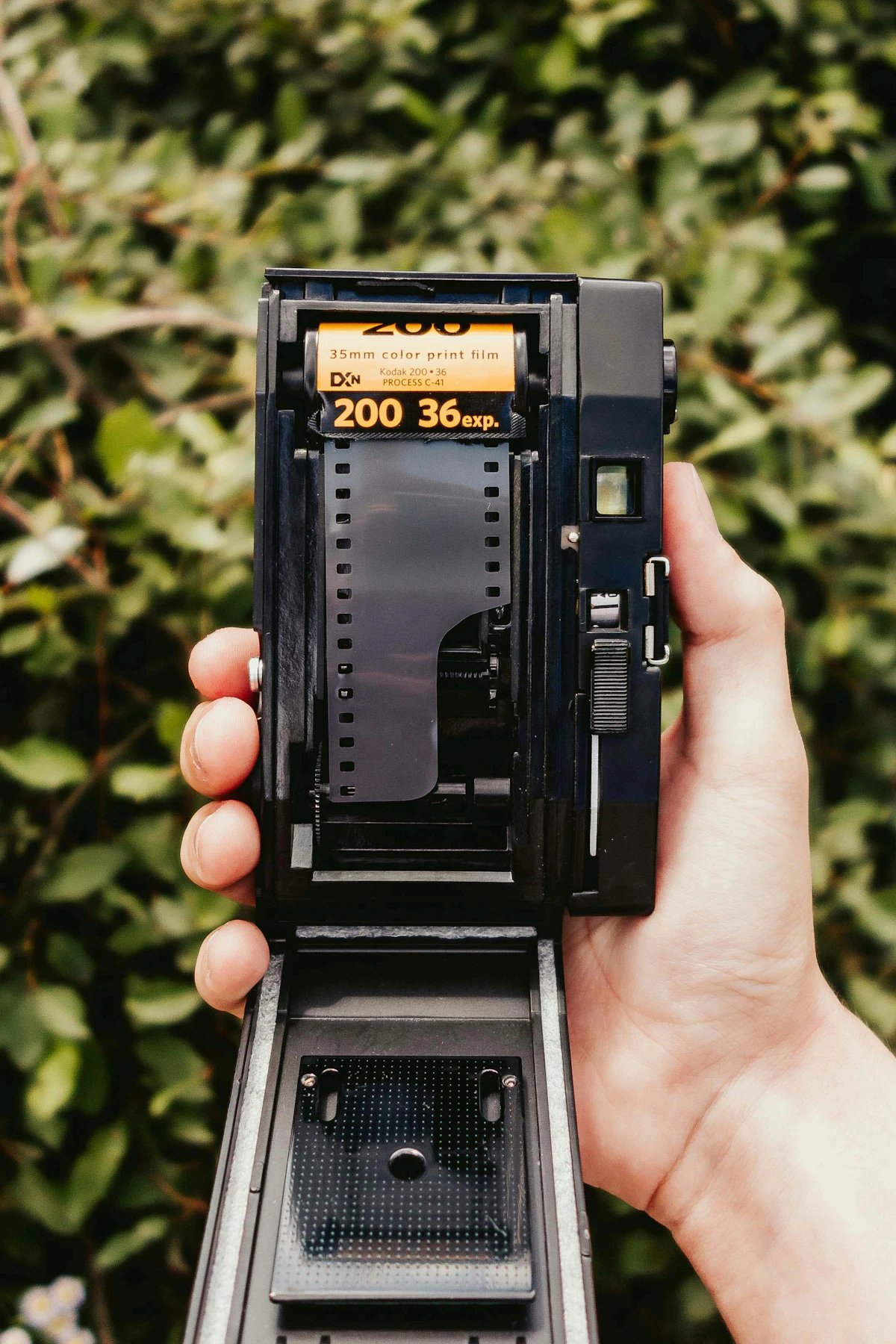
On March 12, 2026, a small Italian company called I'm Back announced something that sounds like it shouldn't be possible: a self-contained APS-C digital sensor module, shaped like a 35mm film cartridge, that drops into any standard 35mm camera body. No modifications required. Just open the back, slot it in like you'd load a roll of Portra, close the door, and your vintage SLR becomes a 26-megapixel digital camera. If this actually works as described, it's one of the most interesting pieces of photographic hardware to appear in years.
A digital sensor module shaped like a 35mm film roll that fits inside ANY 35mm camera. If it works as described, it could change everything for vintage camera owners.
What It Actually Is
The I'm Back APS-C module uses a Sony IMX571 sensor — the same 26-megapixel chip found in cameras like the Fujifilm X-T5 and Nikon Z50 II. It's a proven, well-regarded sensor with excellent dynamic range and low-light performance. The module captures RAW and JPEG stills at full 26MP resolution and records 4K video. Connectivity includes both Wi-Fi and Bluetooth, so you can transfer images to your phone without cables.
The physical design is the clever part. The sensor assembly, processor, battery, and wireless radios are all packed into a housing shaped like a standard 35mm film cartridge with an extended plate that sits where the film plane normally would. The idea is that the sensor plate positions itself exactly where film sits in the camera — behind the lens, at the focal plane — so any lens mounted on the body projects its image directly onto the digital sensor.
There's no screen on the module itself. You compose and focus through the camera's native viewfinder, exactly as you would when shooting film. Image review happens on your phone via the wireless connection, or later on a computer. I'm Back is positioning this as a feature, not a limitation: the shooting experience stays analog. Only the capture medium changes.
The 1.5x Crop Factor Question
Here's where we need to be realistic. The IMX571 is an APS-C sensor, which means it's smaller than a full 35mm film frame. The result is a 1.5x crop factor. Your 50mm lens behaves like a 75mm. Your 35mm wide-angle becomes a 52mm normal lens. Your 28mm becomes a 42mm.
For portrait shooters and telephoto work, this isn't a big deal — it might even be welcome. But for anyone who chose their lenses based on the 35mm field of view, the crop fundamentally changes the character of the setup. A Nikon FM2 with a 50mm f/1.4 is one of the most iconic combinations in photography. With the I'm Back module, that becomes a 75mm f/1.4 equivalent — still beautiful, but a different photograph entirely.
I'm Back hasn't addressed whether a full-frame version is on the roadmap. The engineering challenge of fitting a 36x24mm sensor into a film-cartridge form factor is significantly harder than APS-C, so don't hold your breath. For now, the crop is something you either accept or work around by choosing wider lenses.
Which Cameras Will It Work With?
I'm Back claims compatibility with “any 35mm camera body,” which is an ambitious statement. The film chamber dimensions and film plane positioning are standardized across 35mm cameras, so in theory, if your camera opens normally and loads standard 135 cartridges, the module should fit.
That said, real-world compatibility will vary. Cameras with tight-fitting backs, unusual pressure plate designs, or non-standard film paths might have issues. Some older cameras have DX-code readers or film-speed detection mechanisms that could interfere. Canon AE-1s, Nikon FMs, Pentax K1000s, Minolta X-700s — the common workhorses of the film era should be fine. Obscure models or cameras with motorized film transports might be another story.
One thing that's genuinely exciting: this could resurrect cameras with exceptional optics that are essentially worthless as film bodies because of mechanical issues. A Nikon F3 with a broken shutter timing circuit is a paperweight for film — but if the I'm Back module handles the shutter electronically, that camera might shoot again. We'll need to see the final product to know exactly how the electronic shutter interacts with different mechanical shutter systems.
Screen-Free Operation — Feature or Compromise?
I'm Back is marketing the lack of a screen as an intentional design choice: shoot analog, capture digital. And there's genuinely something appealing about that. The whole reason film photography feels different is the delayed feedback loop — you don't chimp, you don't delete, you commit to the frame and move on. The I'm Back module preserves that experience while eliminating the cost and wait of development.
But let's be honest about what you're giving up. Without a screen, you can't confirm focus accuracy, check exposure, review composition, or adjust white balance in real time. For a camera that relies on 40-year-old manual focus screens, that's a genuine concern. The Wi-Fi phone connection provides a workaround, but pulling out your phone to review every few shots defeats the purpose of the streamlined analog experience.
The photographers who will love this are the ones who already trust their exposure and focus skills — people who shoot film confidently without bracketing every frame. If you're already tracking your shots and dialing in your settings from experience, losing the screen won't bother you. If you're still learning, the lack of immediate feedback could be frustrating.
The Battery Life Unknown
I'm Back hasn't released battery specifications yet, and this is one of the biggest unknowns. A digital sensor, image processor, storage controller, and Wi-Fi/Bluetooth radios all drawing from a battery small enough to fit inside a film cartridge housing — that's a significant engineering constraint. For context, the Fujifilm X-T5 using the same IMX571 sensor gets around 580 shots per charge from a battery many times the size of what can fit in a 135 cartridge.
If the I'm Back module manages 200–300 shots per charge, that would be roughly equivalent to shooting 6–8 rolls of film in a session — plenty for most outings. Under 100 shots would be a problem. And if the Wi-Fi connection drains the battery significantly faster, the practical shot count could be even lower. This is one area where the crowdfunding pitch needs hard numbers before anyone commits money.
The Bigger Picture — Film and Digital, Together
The most interesting thing about the I'm Back module isn't the sensor or the specs — it's the philosophy. For years, the film versus digital debate has been framed as a choice. You shoot one or the other. You buy into one system or the other. The I'm Back module says: why not both? Same camera, same lenses, same viewfinder, same workflow. Film when you want film. Digital when you want digital.
That's a genuinely compelling proposition for anyone who owns vintage glass. Nikon F-mount lenses from the 1970s, Canon FD lenses, Pentax K-mount primes — these are some of the finest optics ever produced, and many of them can be found for $50–200. If the I'm Back module works reliably, it gives those lenses a second life without requiring adapters, mirrorless bodies, or any compromise on the shooting experience.
The I'm Back module says: why not both? Same camera, same lenses, same viewfinder. Film when you want film. Digital when you want digital.
Should You Back the Crowdfunding Campaign?
The honest answer is: wait and see. The concept is brilliant, but I'm Back is a small company, crowdfunding hardware is notoriously risky, and there are real technical questions that haven't been answered yet. How does the sensor align precisely enough for sharp images across different camera bodies? What's the actual battery life? How does the electronic shutter interact with mechanical focal plane shutters? What about flange distance variations between manufacturers?
I'm Back has delivered products before — they've shipped digital backs and inserts for medium-format cameras — so this isn't vaporware from a company with no track record. But a universal 35mm insert is a significantly more complex engineering problem than a dedicated back for a specific camera model.
If you're the early-adopter type who backs interesting hardware with eyes open, this is one of the more exciting projects to watch. If you prefer to wait for reviews and real-world testing, keep an eye on the campaign and plan to buy the retail version once independent photographers have put it through its paces.
Track Everything, However You Capture It
Whether you're loading a roll of Kodak Gold into your Pentax K1000 or slotting in an I'm Back digital module, the shooting experience is the same: manual focus, manual exposure, no instant review. That deliberate process is what makes these cameras special — and it's exactly why tracking your settings matters.
Pellica's film roll tracker was built for this workflow. Log your aperture, shutter speed, and ISO for each frame. Tag locations, note the lighting conditions, write down what you were thinking when you pressed the shutter. When your film comes back from the lab — or when you transfer those digital files to your computer — every image has the context you need to learn from it.
The I'm Back module might bridge the gap between film and digital capture, but it doesn't change the fundamentals. Intentional photography starts with paying attention. Tracking is how you make that attention count.