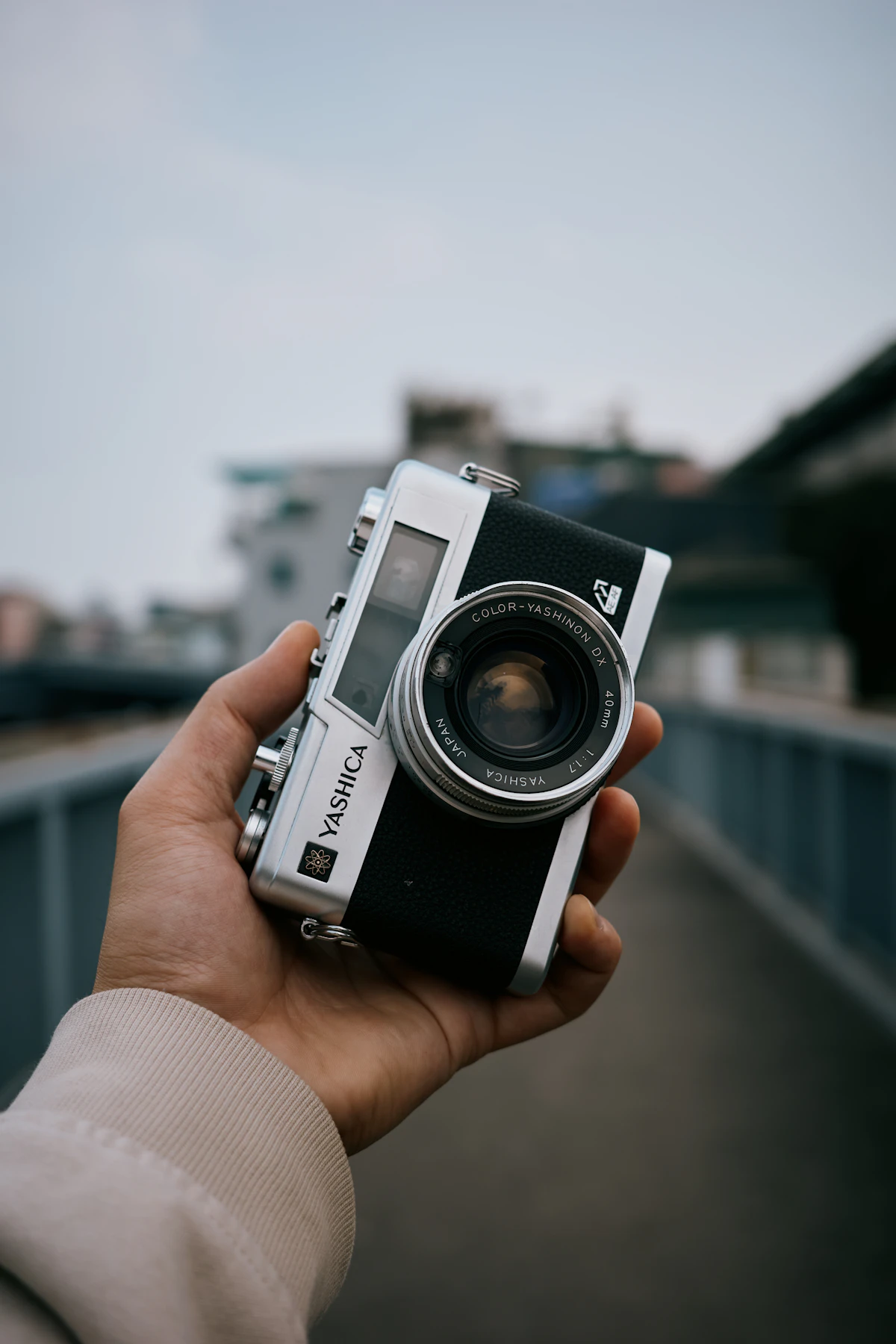
The point-and-shoot film camera has been dead for years. Not dead as in “less popular” — dead as in no manufacturer on Earth was producing one. If you wanted a compact 35mm autofocus camera, your options were limited to hunting the used market, where a Contax T2 will set you back $1,000–1,500 and even a Yashica T4 commands $500 or more. A Nikon L35AF — a $100 camera in 2015 — now sells for $300. The used market has been broken by hype, scarcity, and influencer culture for the better part of a decade.
That changes now. Amsterdam-based Analogue is shipping the aF-1, the first brand-new production point-and-shoot film camera with modern autofocus technology. It features a 35mm f/2.8 fixed lens and — here's the part that matters — LiDAR autofocus. Not the infrared systems that old point-and-shoots used. Actual LiDAR, the same depth-sensing technology in your iPhone. Pre-orders have been open since late 2025, and shipping began in Q1 2026 at a price of approximately €450.
The first brand-new point-and-shoot with LiDAR autofocus. After years of broken used-market prices, a new option finally exists.
Why LiDAR Changes the Game
The autofocus systems in vintage point-and-shoot cameras were, to put it generously, inconsistent. Most used infrared rangefinding — a beam bounced off the subject to estimate distance. It worked fine in good conditions with cooperating subjects standing at medium distances. It struggled with glass, reflective surfaces, backlit scenes, very close subjects, and anything off-center. Anyone who's shot a roll through a Yashica T4 knows the feeling: 30 sharp frames and 6 mysteries where the camera decided the background was more interesting than your subject.
LiDAR is a fundamentally different technology. It maps the scene in three dimensions using thousands of data points, measuring actual distance with millimeter precision rather than estimating it from a single reflected beam. It works in complete darkness. It's not fooled by glass or reflective surfaces. It handles close-focus situations that would confuse any infrared system. In short, it's the autofocus technology that 1990s engineers wished they had.
For a point-and-shoot camera, where the entire premise is “frame it and press the button,” reliable autofocus isn't a nice-to-have. It's the whole product. If the LiDAR system delivers on its promise, the aF-1 eliminates the single biggest frustration of shooting compact film cameras.
The Lens: 35mm f/2.8
Analogue went with a 35mm focal length and an f/2.8 maximum aperture. This is a conservative but smart choice. 35mm is the classic point-and-shoot focal length — wide enough for groups and street scenes, tight enough for environmental portraits. The Contax T2 shot at 38mm. The Olympus Stylus Epic at 35mm. The Nikon L35AF at 35mm. There's a reason this focal length keeps showing up: it's the most versatile option for a fixed-lens camera you carry everywhere.
f/2.8 is one stop slower than the f/2 lenses found on premium compacts like the Contax T2 or Ricoh GR1. In practical terms, that means slightly less background blur and slightly less low-light capability. But f/2.8 also allows for a smaller, lighter lens element with potentially sharper corner-to-corner performance. The Olympus Stylus Epic — arguably the most beloved point-and-shoot ever made — was also f/2.8, and nobody complained about its optical quality.
The real question is how the lens renders. Numbers are one thing; character is another. Does it produce pleasing bokeh at close range? How does it handle flare? What's the contrast like? These are things we'll only know once photographers start putting rolls through it and sharing results. Analogue hasn't published MTF charts or detailed optical specifications, so the lens remains the aF-1's biggest unknown.
The Price Conversation
Let's address the elephant: €450 is a lot of money for a point-and-shoot camera. Historically, these cameras were the budget option — cheap, cheerful, and disposable enough that you didn't worry about dropping one. A new point-and-shoot at €450 sits in premium SLR territory.
But context matters. A used Contax T2 — a 30-year-old camera with a 30-year-old autofocus system, no warranty, and unknown shutter count — costs $1,000–1,500. A clean Yashica T4 is $500 and climbing. Even the once-affordable Olympus Stylus Epic has crossed $300. You're paying €450 for a brand-new camera with modern technology, a warranty, and presumably available replacement parts. Compared to the used market, that's arguably the better deal.
The more relevant comparison might be the Pentax 17, which launched at around $500. That camera proved there's a substantial market of people willing to pay a premium for a new film camera that just works. The aF-1 is positioned in the same space: not cheap, but offering something you genuinely cannot get anywhere else.
If you're looking for a budget entry into film photography, this isn't it. Check out our guide to cameras under $100 instead. But if you want a new, reliable point-and-shoot with modern autofocus and you're tired of gambling on overpriced used cameras with uncertain reliability, the aF-1 is the first real option in a generation.
What It Means for the Film Camera Market
The aF-1 isn't just a camera — it's a signal. A new company investing in the tooling, engineering, and manufacturing required to produce a brand-new film camera from scratch means someone with money believes the film market is worth entering. That's not nostalgia. That's a business calculation.
Between the Pentax 17, Lomography's expanding lineup, the MiNT InstantKon cameras, and now Analogue's aF-1, we're seeing something that would have been unthinkable five years ago: a growing market for new film cameras. Not reissues of old designs, not toy cameras, but genuinely engineered products that incorporate modern technology where it matters while preserving the analog shooting experience.
If the aF-1 sells well — and early pre-order demand suggests it will — expect competitors. Where there's one successful new point-and-shoot, others will follow. That's good for everyone who shoots film, because competition drives prices down, quality up, and keeps the ecosystem alive.
A new company investing in brand-new film camera engineering isn't nostalgia. It's a business calculation — and a signal that the film market is worth entering.
The Point-and-Shoot Workflow
The beauty of a point-and-shoot is that it removes friction. No metering decisions, no focusing ritual, no aperture priority debates. You see a moment, you press the button, and the camera handles the rest. That simplicity is why these cameras produce some of the most honest photographs — you're reacting to life, not managing a machine.
But “simple to shoot” doesn't mean “nothing to track.” With a point-and-shoot, you're still choosing your film stock, still making decisions about when and where you shoot, and still managing the reality that every frame costs money. At $15–20 per roll plus development, a 36-exposure roll through the aF-1 represents real investment. Knowing what worked and what didn't matters.
Pair It With the Right Tools
Even with a camera that handles exposure and focus automatically, the analog workflow benefits from intentional tracking. Pellica's light meter helps you understand the conditions you're shooting in — useful for choosing the right film speed before you load a roll, even if the camera handles metering once the film is in. And the film roll tracking features let you log which stock you loaded, when you started and finished the roll, and what conditions you shot in.
When your scans come back, that context transforms a folder of images into a learning opportunity. You'll know which film stocks sing in which light, which situations pushed the aF-1's autofocus, and where the 35mm f/2.8 lens shines brightest. That's how you go from taking photos to making them — even with a camera designed to do most of the thinking for you.