
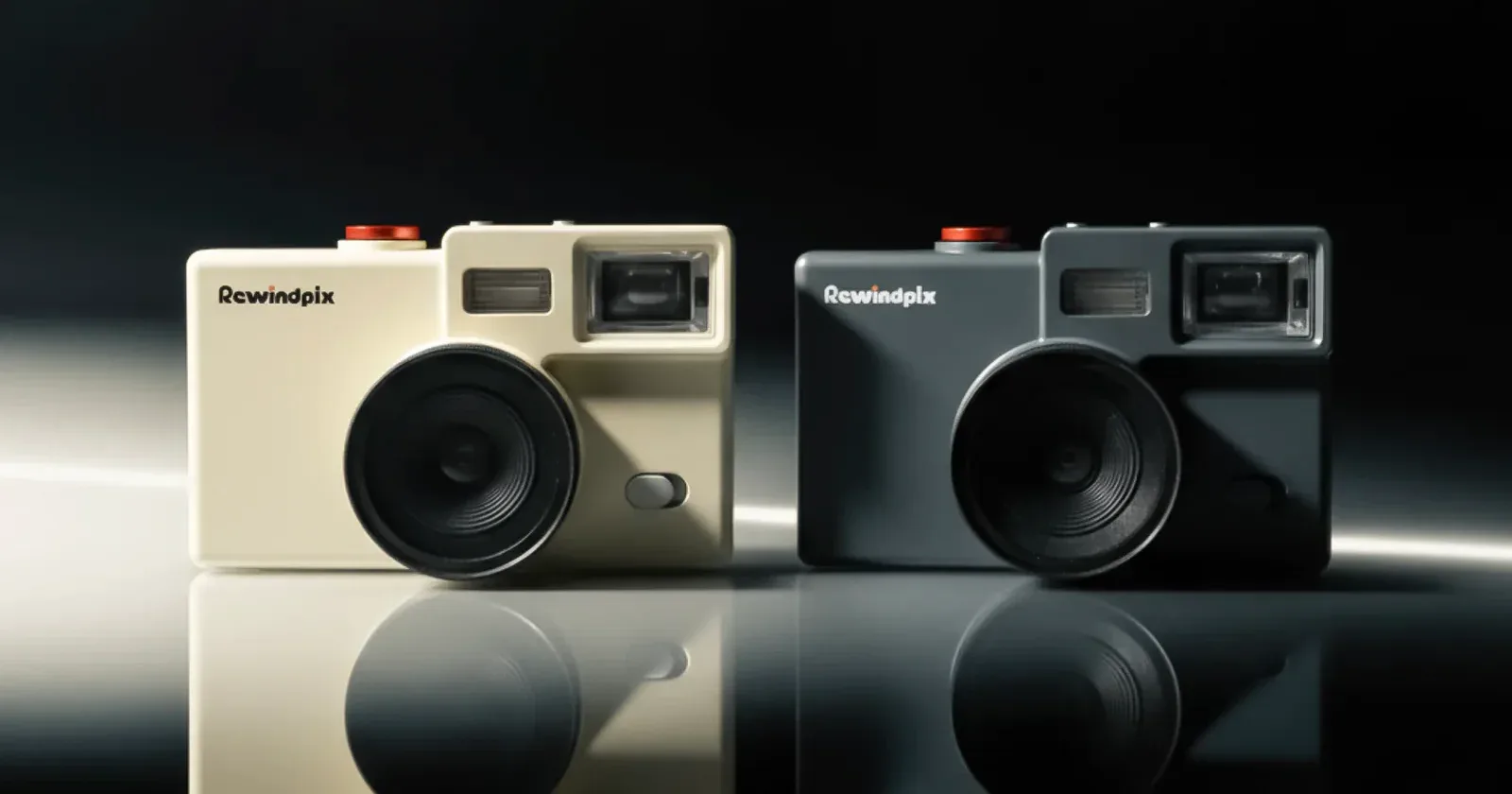
On March 3, 2026, a screen-free pocket camera with no real film inside it opened on Kickstarter with a modest $15,000 goal. By the time it closed around May 11, RewindPix had pulled in $1,143,077 from roughly 7,589 backers — more than 7,600% of the target, or about 76 times what its creator asked for. For a camera that records plain digital files, that is a startling number, and the reason it works says something uncomfortable about why anyone shoots film.
RewindPix is not a film camera. It is a 13-megapixel digital compact built, deliberately, to feel like one. There is no big LCD to chimp on, a mechanical winder you crank between frames, a 36-shot limit per “roll,” and named “film stocks” you pick before you press the shutter. It sells the ritual of film without any film — and thousands of people just paid more than a million dollars to get it.
RewindPix doesn't sell a sensor. It sells the winder, the 36-frame limit, and the discipline of not looking — the exact ritual film already gives you for real.
What the Numbers Actually Say
The headline figure invites exaggeration, so here is the precise version. RewindPix raised $1,143,077 against a $15,000 goal. That is roughly 7,600% funded — not 7,600 times the goal, but about 76 times it. The campaign teased in December 2025, launched on March 3, 2026, and closed in the second week of May, with worldwide shipping to backers targeted for June 2026.
Pricing settled over the run. Earlier in the campaign the camera was promoted at higher tiers, in the neighborhood of $119 to $199. Backers landed on $99 as an early-bird price, against a planned retail price of $169. Whether that MSRP holds when the camera ships is the usual crowdfunding question — hardware campaigns have a long history of optimistic timelines and prices that drift. Treat June 2026 and $169 as intentions, not guarantees.
Who Built It, and Why
RewindPix comes from photographer and designer Xiao Liu, and the origin story lands with anyone who has owned a camera they loved. Liu lost his Ricoh GR IIIx in water — a small, sharp, pocketable camera with a devoted following — and went looking for a replacement. By his account, the existing screen-free options let him down: Camp Snap, FlashBack One, and Paper Shoot all aim at roughly the same idea of a simple, distraction-free digital camera, and none of them scratched the itch.
So he built his own and leaned into the part those cameras underplay: the feeling of shooting film. Not the chemistry, not the grain you get from actual silver halide, but the choreography. The winding. The waiting. The committing to a frame because you only have thirty-six of them.
Track this in the app: Film Roll Tracker
The Hardware, Without the Hype
Under the retro shell, the specs are modest and honest about what they are. This is a small-sensor compact, not a mirrorless body in disguise.
- Sensor. A 13MP 1/3.06-inch Sony CMOS — a phone-class sensor, small by camera standards, which sets realistic expectations for low light and dynamic range.
- Lens. A fixed 35mm-equivalent f/2.2 lens, the classic do-everything focal length for street and everyday shooting.
- Body. 185 g, measuring 110 x 65 x 35 mm — genuinely pocketable, in the spirit of the point-and-shoots it's imitating.
- Controls. A 0.78x optical viewfinder, a mechanical film-advance winder, a Xenon flash, and only a tiny data-only LCD — no image preview on the camera itself.
That last point is the design philosophy in one line. RewindPix is deliberately screen-free. You don't review your photos on the camera; you review them later in a companion mobile app. The aim is to kill chimping — the reflex of checking the back of the camera after every shot — and force you to trust the frame and move on.
‘Rolls’ and ‘Film Stocks’ on a Digital Camera
This is where RewindPix borrows film's vocabulary wholesale. Shots group into 36-exposure “rolls.” For each roll you load up to three swappable on-camera “film” looks, and — crucially — you choose them before you press the shutter, not after. There are 36 built-in presets, plus a custom film-stock builder that dials in grain, light leaks, and color tone or warmth. The images come out ready to share, with no editing step.
Read that again as a film shooter and the mimicry is almost on the nose. A roll is thirty-six frames. The look is decided up front, the way loading Portra or HP5 commits you for the next two days. You can't change your mind mid-roll without consequence. That is the actual constraint of film, recreated in software — and the constraint, not the grain, is what RewindPix is really selling.
How It Differs From the I'm Back Roll
Two film-adjacent crowdfunding projects ran at the same time, and they are easy to confuse. RewindPix is a standalone compact — a complete camera you buy and shoot on its own. It is a different animal from the I'm Back digital film roll, a digital sensor module shaped like a 35mm cartridge that loads inside an existing film body so your old SLR captures digital files through its own lens.
The two answer different questions. I'm Back is for people who want to keep using a camera and lenses they already own. RewindPix is for people who want the ritual itself, in a new pocketable package, without owning a film camera at all. Both are bets that the analog experience — not the medium — is what people are actually paying for.
A Threat and a Compliment at Once
RewindPix is both a threat to film and a loud validation of it. The threat is obvious: $99 buys the winding, the frame limit, the named stocks, and the no-chimping discipline with zero development cost, no scanning, and instant shareable files. For a lot of casual shooters drawn to film for the vibe rather than the chemistry, that is a tempting off-ramp.
But look at what RewindPix had to build to earn that million dollars. It didn't copy a sensor or a megapixel count. It copied film's constraints — the thirty-six frames, the commitment up front, the refusal to let you peek. Those constraints are the product. That is exactly the argument film shooters have made for years in the film versus digital conversation: the discipline is the point.
The difference is that RewindPix simulates the look, and you can still toggle your way to a different one. Real film commits you to a physical emulsion with a grain structure and a color response that nobody fully reverse-engineers in firmware. If you want the actual grain and the actual ritual — not a preset called “grain” — you load a roll, you shoot it, and you log it. The simulation borrows the language of rolls and stocks. A film log captures that same language for the real thing.
Log Every Roll, Whatever You Shoot
RewindPix proves that the data points film shooters already track — the roll, the stock, the frame count — are exactly what make the experience feel like film. If you shoot the real thing, capture them properly. Pellica's film roll tracker lets you log every roll and frame with full exposure data, film stock, camera body, and personal notes. The built-in light meter helps you nail exposure, and the lab finder connects you with development services wherever you shoot.
If you're weighing a simulated roll against a real one, our film roll tracking apps roundup is a good place to start — because the moment you commit to thirty-six real frames, you'll want a record of every one.
A million dollars says the ritual is worth paying for. The grain, the chemistry, and the record of how you made the shot are still yours to keep — for real.