
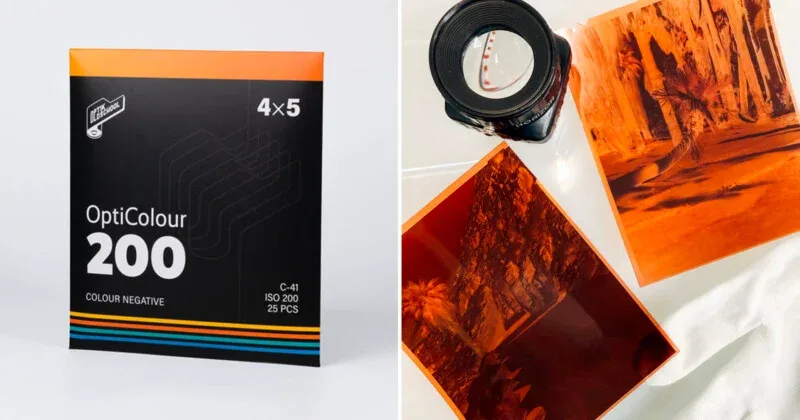
Around May 5, 2026, the German brand Optik Oldschool announced something large-format shooters almost never get to hear: a color-negative film cut into sheets. OptiColour 200 now comes in 4x5, 5x7 and 8x10 — a standard ISO 200 C-41 stock priced at EUR 79.90 direct for a 25-sheet box of 4x5, or roughly $96 per 25 sheets through US distributors. PetaPixel covered the launch, then ran a follow-up on June 5 to clarify what this film actually is.
Here is the part that matters before you reach for your wallet. Optik Oldschool calls OptiColour 200 the first completely new large-format color-negative product since 2010, and by most accounts it is among the cheapest color sheet film you can buy. Both of those claims are about the format and the price, not the emulsion. The film inside the box is the Wolfen NC200 emulsion, coated by InovisCoat in Monheim am Rhein, Germany, and it already circulates under several other names. The new thing is the cut, not the chemistry.
A genuinely new color sheet film is one of the rarest events in analog — but OptiColour 200 is a new cut of an emulsion you may already own under a different name.
Why a New Color Sheet Film Is Rare
New color-negative film barely happens at all. Coating a fresh color emulsion demands chemistry, multi-layer coating precision, and quality control that only a handful of facilities on earth can deliver. Now narrow that to large format, where the market is tiny, the sheets are cut individually, and most shooters have spent the last fifteen years rationing fridge stock or moving to black and white. Color sheet film is rarer than rare.
That is the context for Optik Oldschool's framing. When the maker says first completely new large-format color-negative product since 2010, it is pointing at a real gap. Kodak Portra and Ektar exist in sheets, but those are long-running stocks, not new arrivals. A box of color 4x5 that did not exist a year ago is a genuine event, even when the emulsion it carries is not new. Treat the since-2010 and cheapest claims as the maker's and retailers' positioning rather than independently established fact — the price especially shifts depending on where you buy.
One Emulsion, Many Names
This is the detail that separates an informed purchase from an accidental double buy. OptiColour 200 is the Wolfen NC200 emulsion, manufactured by InovisCoat GmbH in Monheim am Rhein, near Düsseldorf. The “Wolfen” in the name is ORWO heritage, not the coating site — the historic Wolfen plant belongs to FilmoTec, a separate company. The same emulsion reaches the market under other labels, including ORWO Wolfen NC200 and KONO Color 200. PetaPixel's June 5 follow-up summed it up cleanly: this is a new color film that goes by many names.
For most formats that is trivia. For large format at roughly $4 per sheet, it is money. If you have already shot NC200 in 35mm or 120 under one of its other names and learned how it behaves, you do not need to treat OptiColour 200 as an unknown quantity — it is the same emulsion on the same 175-micron PET base. And if you are price-shopping color sheet film, two boxes with different brand names on the label may contain the identical film, so you can compare on price and format instead of imagining you are choosing between two distinct stocks.
- OptiColour 200. Optik Oldschool's branding, and the one now offered in 4x5, 5x7 and 8x10 sheets.
- ORWO Wolfen NC200. A long-standing name for the same NC200 emulsion in 35mm and 120.
- KONO Color 200. Another label under which the same film circulates.
Track this in the app: Film Roll Tracker
The Specs, Plainly
OptiColour 200 is a conventional color-negative film with no exotic requirements. Here is what Optik Oldschool lists:
- ISO 200 (200/24deg). Daylight-balanced, a versatile general-purpose speed for outdoor and bright work.
- Standard C-41 process. No special chemistry. Any lab that runs color negative can develop it, and so can you at home with a normal C-41 kit.
- 175-micron PET base. A clear polyester base, relevant for how the sheets sit in holders and on the scanner bed.
- Available in 4x5, 5x7 and 8x10. All three sheet sizes large-format shooters actually use.
The C-41 point is the practical headline. With no remjet layer and no custom process, OptiColour 200 drops straight into existing workflows. If you already develop C-41 at home, the only adjustment is handling sheets instead of a roll — tank, chemistry and temperatures stay the same.
What 35mm and 120 Shooters Should Know
OptiColour 200 is not arriving from nowhere. The NC200 emulsion has existed in 35mm and 120 for a while — the 120 version was announced in June 2025 — and large format is simply the 2026 expansion of an existing lineup. That history is genuinely useful, because anything you have already learned about how this emulsion renders color, handles overexposure, or scans carries over to the sheets.
It also means the honest caveats carry over. The recut-of-NC200 framing is the maker's and PetaPixel's reading of the situation, and it is the most credible one, but some shooters describe NC200 as still maturing — batch-to-batch consistency and color rendering have drawn mixed reports. Treat your first box as something to test methodically rather than a known reference stock. As for the rumored connection to LomoChrome Classicolor 200, keep that firmly in the speculation column: it is unconfirmed and worth mentioning only as a rumor, not a fact to plan around.
Where to Buy and What It Costs
Pricing and availability are spread across a few retailers, and this is where the one-emulsion-many-names reality meets the per-sheet math. The figures Optik Oldschool and US distributors quote:
- Optik Oldschool (direct). EUR 79.90 for a 25-sheet box of 4x5.
- US distributors. About $96 per 25 sheets of 4x5, which works out to roughly $4 a sheet.
- Stockists. Fotoimpex in Germany, Freestyle Photo in the US, and Downtown Camera in Canada, alongside Optik Oldschool direct.
At around $4 per sheet, every exposure carries real cost and small decisions compound. A blown sheet is not a frame you shrug off — it is a measurable fraction of the box. That is exactly the regime where keeping notes pays for itself. For the wider picture on how analog pricing has moved, our guide to what film costs in 2026 puts these numbers in context, and the case for shooting larger sheets at all is the same case for bigger negatives: more resolution, more tonal information, more reason to get the exposure right the first time.
Why This Is a Logging Problem, Not Just a Buying One
The many-names situation creates a quiet trap. You can buy the same emulsion twice — once as OptiColour 200, once as ORWO Wolfen NC200 or KONO Color 200 — without realizing you are testing identical film and drawing conclusions as if you compared two stocks. The only defense is a record of which alias and which format you actually shot.
Personal exposure index matters here too. Shooters are still figuring NC200 out, so the EI that gives you clean shadows in 4x5 is worth pinning down and reusing rather than rediscovering every box. And because the same film behaves slightly differently across 4x5, 120 and 35mm — different scanners, holders, and development tanks — per-format notes are what turn $4-a-sheet experiments into a repeatable process.
Log Every Roll, Whatever You Shoot
A new color sheet film is rare enough to document carefully, and the one-emulsion-many-names reality makes a record essential: write down which alias and format you loaded, the EI you settled on for NC200, and your C-41 notes so 4x5 results stay comparable with 35mm and 120. Pellica's film roll tracker lets you log every roll and frame with full exposure data, film stock, camera body, and personal notes. The built-in light meter helps you nail exposure, and the lab finder connects you with development services wherever you shoot.
Buy the film once, learn it properly, and never wonder again whether you already shot it under another name.